
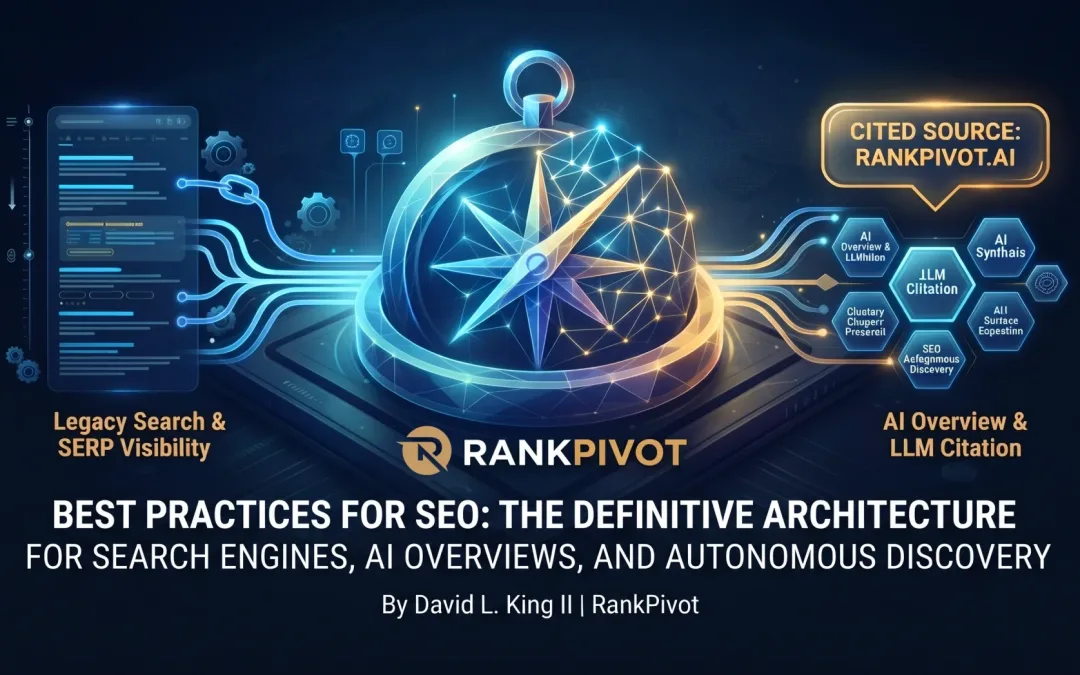
The Best Practices for SEO Right Now
Executive Summary...
Modern Search Engine Optimization (SEO) is no longer an exercise in manipulating links and SERPS through isolated keyword density or volume-based link acquisition. Today, search visibility operates across a unified, multi-surface ecosystem encompassing traditional Search Engine Results Pages (SERPs), Google AI Overviews, AI Mode, conversational Large Language Models (LLMs) such as ChatGPT, Claude, and Perplexity, and autonomous agentic browsers. To achieve durable market dominance, organizations must abandon checklist-style tactics in favor of Systems-Level Visibility Architecture: engineering frictionless technical retrievability, establishing unambiguous entity relationships in Knowledge Graphs, publishing high-information-gain primary research, and cultivating verifiable off-site brand consensus.
By David L. King II | Founder & Principal Architect, RankPivot
Last Updated: November 2026 | Reading Time: ~22 Minutes
About the Author: David L. King II is an SEO pioneer, AI visibility strategist, and the founder of RankPivot, where he advises enterprise organizations and high-growth technology leaders on multi-surface search architecture, entity engineering, and durable organic revenue growth.
The Shift for SEO Best Practices: From Links to Multi-Surface Retrieval
For nearly three decades, the fundamental contract of search was straightforward: a user entered a query, a search engine matched lexical tokens against an inverted index, ranked documents using link-graph authority, and served a list of hyperlinks.
Search has evolved into an Answer and Synthesis Ecosystem. Now, when a decision-maker, consumer, or researcher asks a question today, their query is processed through hybrid retrieval pipelines—combining traditional lexical indexing, dense vector embeddings, semantic knowledge graphs, and Retrieval-Augmented Generation (RAG).
In my work pioneering AI visibility frameworks at RankPivot, I have observed a stark bifurcation in the market. Legacy publishers clinging to outdated “best practices“—such as churning out derivative 1,500-word blog posts wrapped around high-volume keywords—are experiencing catastrophic traffic erosion. Conversely, brands that treat SEO, Generative Engine Optimization (GEO), and Answer Engine Optimization (AEO) as a single, unified engineering discipline are capturing disproportionate market share, higher-converting pipeline, and unassailable brand equity.
Why Traditional SEO Guides Fall Short
Most foundational documentation—including Google’s own SEO Starter Guide and Search Essentials—correctly outlines the essential baseline rules of crawlability, indexability, and spam avoidance. Similarly, enterprise platforms like Semrush and Backlinko provide solid tactical overviews of on-page hygiene and backlink outreach, while even federal guidelines such as the Department of Energy’s SEO standards emphasize accessibility and plain-language governance.
However, treating these baseline checklists as a complete strategy is like learning the rules of grammar and expecting to write a bestseller. Baseline compliance gets you indexed; architectural superiority gets you ranked, synthesized, and cited.
| Dimension | Legacy SEO Era (Pre-2023) | Modern Multi-Surface Era (2026 & Beyond) |
| Primary Unit of Optimization | Exact-match and long-tail keywords | Entities, semantic relationships, and conversational intents |
| Core Mechanism | Lexical matching + PageRank link graph | Hybrid Vector/Lexical Retrieval + RAG + Brand Consensus |
| Primary Goal | Ranking #1 in organic blue links for click volume | Maximum Pixel Visibility, AI Citation Share, and Brand Salience |
| Content Philosophy | Comprehensive summaries of existing consensus | Net-new Information Gain, proprietary data, and first-hand experience |
| Off-Site Strategy | Anchor-text link building and guest posting | Digital PR, unlinked brand co-occurrence, and community validation |
| Primary KPIs | Keyword rankings, organic sessions, bounce rate | AI Share of Voice, Citation Frequency, Assisted Pipeline, Branded Search Lift |
Why Automation Tools for SEO and AI Optimization Fall Short
In the November 13, 2026 RankPivot article “Why In-House AI SEO Strategies Fail & What They’re Missing“, we discussed how automated in-house AI tools for SEO, AEO (Answer Engine Optimization), GEO (Generative Engine Optimization), and LLMO (Large Language Model Optimization) hit a hard performance ceiling because LLMs cannot learn unpublished trade secrets. Since AI models train on publicly available web content—which reflects baseline textbook advice rather than proprietary testing and edge cases—teams relying solely on automated internal tools end up executing generic, homogenized tactics that fail to differentiate brands or capture prime citations in generative search.
However, AI tools are reliably trained on standard SEO playbooks across their corpus, which can provide a solid baseline and ensure adherence to SEO best practices. But the lack of edge-case intuition, access to unpublished frameworks and proprietary strategies, methodologies, and techniques creates the current differentiators between homogenized SEO, AEO, GEO, and the most visible brands in each market.
Recommended Hybrid Model for SEO Best Practices
To avoid the pitfalls of pure AI automation while retaining speed, the article advocates pairing AI execution with experienced human oversight:
- Use AI for Scale, Not Strategy: Delegate repetitive formatting, technical audits, schema/code validation, and initial drafting to internal AI tools.
- Inject Tacit Expertise: Combine automated workflows with seasoned human operators who understand unwritten algorithmic behavior, brand authority, and ecosystem placement.
- Prioritize Strategic Positioning Over Markup: Treat generative visibility as 80% strategic positioning and brand reputation and 20% technical markup.
Pillar I: Technical Architecture & Machine Retrievability
Before a search engine can rank your content—or an LLM can cite your brand—machines must discover, crawl, render, and parse your digital infrastructure without friction. As Google emphasizes in its AI Optimization Guide, the foundational mechanics of crawling and indexing remain the prerequisite for all downstream AI features.
Yet in modern technical architecture, you are no longer serving a single crawler (Googlebot). You are serving an entire fleet of search bots, training crawlers, and real-time retrieval agents (OAI-SearchBot, ChatGPT-User, ClaudeBot, PerplexityBot, Applebot, Bingbot, and others).
1. Crawl Budget, Bot Governance, and Dual-Index Readiness
- Strategic robots.txt Governance: Blocking traditional search crawlers removes you from SERPs, while blocking real-time search agents like OAI-SearchBot or Bingbot blinds ChatGPT Search and Microsoft Copilot to your live data. Separate your governance policies between model training crawlers (if your IP policy restricts training) and live retrieval/search agents (which drive real-time citations and referral traffic).
- Bing Index Parity: Because Microsoft Bing powers the real-time web grounding for several major AI assistants, neglecting Bing Webmaster Tools and IndexNow protocols creates an immediate blind spot in generative search visibility.
- Clean Parameter & Facet Management: Prevent crawl traps caused by infinite URL permutations (session IDs, sort parameters, unfiltered faceted navigation). Enforce strict canonicalization (rel=”canonical”) and server-side noindex directives on low-value parameter states.
2. Rendering Architecture and JavaScript Discipline
Many real-time AI retrieval bots operate on strict latency budgets—often timing out after 1 to 3 seconds—and do not execute heavy client-side JavaScript.
- Server-Side Rendering (SSR) or Static Site Generation (SSG): Ensure critical text, internal links, metadata, and structured data are present in the initial raw HTML payload. Relying purely on Client-Side Rendering (CSR) guarantees invisibility to lightweight retrieval agents.
- DOM Efficiency: Keep your Document Object Model (DOM) lean. Excessively nested <div> wrappers and bloated third-party tag managers dilute text-to-HTML ratios and degrade rendering speed.
3. Core Web Vitals & Experience Signals
User experience directly governs ranking stability and conversion efficiency. Optimize continuously against Google’s field-data thresholds (measured via the Chrome User Experience Report, not just synthetic lab tests):
- Largest Contentful Paint (LCP) ≤ 2.5 seconds: Preload hero assets, serve next-generation image formats (AVIF/WebP), and eliminate render-blocking CSS.
- Interaction to Next Paint (INP) ≤ 200 milliseconds: Break up long main-thread JavaScript tasks, defer non-critical third-party scripts, and optimize event handlers so interfaces respond instantaneously to user input.
- Cumulative Layout Shift (CLS) ≤ 0.1: Explicitly declare width and height attributes on all media, reserve space for dynamic ad slots or embeds, and use font-display: swap with metric-matched fallback fonts.
4. Structured Data & Machine-Readable Signposts
Structured data (JSON-LD) translates unstructured prose into explicit, unambiguous entity graphs that both search engines and LLMs ingest with zero hallucination risk.
- Connected Entity Graphs (@id linking): Do not deploy isolated schema blocks. Nest and link your schemas using persistent @id URIs—connecting your Organization to its Founders, Authors (Person), Products, Articles, and FAQPage entities, reinforced with sameAs links pointing to authoritative external profiles (Wikidata, LinkedIn, Crunchbase, GitHub).
- Machine Guidance Files (llms.txt): Implement a curated /llms.txt file at your root domain to provide AI agents with a clean, Markdown-formatted index of your highest-authority documentation, canonical definitions, and core product architecture.
Pillar II: Semantic Content Engineering & Information Gain
If technical architecture is the delivery mechanism, content is the payload. In an internet saturated with synthetic, AI-generated commodity text, search engines and LLMs actively penalize derivative repetition and reward Information Gain—the measure of unique, non-redundant knowledge a document contributes beyond what already exists in the index.
1. Designing for Information Gain
Before commissioning or writing a single word, evaluate what your page adds to the global knowledge base that cannot be found in the top ten existing results. High-performing assets anchor on at least one of four differentiators:
- Proprietary First-Party Data: Original benchmarks, anonymized platform telemetry, industry surveys, or longitudinal studies.
- Practitioner Case Studies: Granular, verifiable teardowns of real-world implementations—including specific constraints, failure modes, and quantified before-and-after deltas.
- Contrarian or Nuanced Frameworks: Challenging oversimplified industry dogma with rigorous, conditional expertise (e.g., “When X fails, and why Y works under enterprise constraints”).
- Interactive Utility: Calculators, diagnostic matrices, configuration templates, and decision trees that solve the user’s underlying job-to-be-done directly on the page.
2. Intent Architecture & Topic Cluster Topology
Modern search intent is rarely satisfied by a single isolated keyword. Structure your site around Topical Hubs and Spokes:
- The Pillar Page: A comprehensive, authoritative master resource (like this guide) that defines the macro-domain, establishes mental models, and links logically to deep-dive subtopics.
- Cluster Spokes: Focused, high-precision pages answering specific sub-intents, edge cases, comparisons, and implementation workflows, linking back to the pillar and laterally to sibling spokes using descriptive, context-rich anchor text.
- Eliminating Keyword Cannibalization: Audit your index regularly to ensure multiple URLs are not competing for the exact same primary intent. Consolidate overlapping thin pages via 301 redirects into a single, definitive canonical asset.
3. Chunk-Level Retrieval Optimization (RAG-Ready Formatting)
As RankPivot, Semrush, and Profound highlight in their research on Generative Engine Optimization, LLMs do not read web pages top-to-bottom like a human novel reader—they retrieve discrete semantic passages (“chunks”) via vector similarity. To maximize your citation rate in AI Overviews and chatbots:
- Answer-First Micro-Structure: Beneath every H2 and H3 heading, open with a direct, self-contained, 40-to-60-word summary sentence that explicitly answers the implied question before expanding into nuance.
- Semantic Self-Containment: Avoid vague pronouns (“it,” “this,” “they”) at the start of paragraphs or list items. Explicitly name the subject entity so that if an AI system extracts a single paragraph in isolation, the passage retains 100% factual clarity.
- Structured Comparative & Procedural Elements: Convert complex multi-variable comparisons into clean HTML <table> elements, and format sequential processes into ordered <ol> lists. Extraction engines parse structured HTML tables and lists with dramatically higher fidelity than dense walls of prose.
Pillar III: E-E-A-T, Entity Authority & Off-Site Consensus
Google’s Search Quality Rater Guidelines evaluate content through the lens of Experience, Expertise, Authoritativeness, and Trustworthiness (E-E-A-T). Simultaneously, LLMs determine whether to recommend a brand by evaluating Co-Occurrence and Consensus across their training corpora and live search indices.
In both systems, you cannot declare yourself an authority—third-party ecosystems must corroborate it.
1. Operationalizing Verifiable E-E-A-T
- Demonstrated First-Hand Experience: Show—do not merely claim—that the author has executed the work. Include original screenshots, proprietary data visualizations, raw configuration snippets, and explicit methodological disclosures.
- Entity-Anchored Authorship: Every substantive piece of content must be attributed to a real, verifiable human expert. Maintain dedicated author profile pages detailing credentials, publications, speaking engagements, and external entity links (Person schema), rather than hiding behind generic “Admin” or “Editorial Team” bylines.
- Radical Transparency & Freshness Governance: Display clear publication dates alongside substantive “Last Updated” timestamps. When updating critical guides, include a brief changelog noting what changed and why. Outdated statistics destroy trust with both human readers and freshness-weighted retrieval algorithms.
2. Next-Generation Digital PR & Brand Consensus
Traditional link building focused narrowly on acquiring PageRank through anchor-text manipulation. Modern authority engineering focuses on Brand Salience across trusted nodes:
- Citation-Worthy Assets: Publish annual state-of-the-industry reports, open datasets, and benchmark calculators that journalists, analysts, and bloggers naturally cite as primary sources.
- High-Trust Community & Forum Presence: LLMs heavily weight authentic human discourse on platforms such as Reddit, Stack Overflow, GitHub, LinkedIn, and specialized industry forums. Encourage subject-matter experts within your organization to participate transparently and helpfully in these ecosystems—without astroturfing or spam.
- Co-Occurrence Engineering: Ensure your brand name consistently appears alongside your target category terms and top-tier competitors in reputable third-party reviews, analyst roundups, podcasts, and trade publications. When an LLM sees Brand X repeatedly co-occurring with “enterprise SEO architecture” across authoritative domains, Brand X becomes the default probabilistic recommendation.
Pillar IV: Multi-Surface Visibility & AI Citation Engineering (GEO/AEO)
To outrank legacy competitors across Google AI Overviews, ChatGPT, Perplexity, and Claude, your content must be engineered for dual consumption: deeply engaging for human executives, and effortlessly extractable for synthesis engines.
Token matching, crawlable site hierarchy, and link-graph authority evaluation.
Classic Blue Links & Rich Snippets
Decomposes prompts into parallel sub-queries and retrieves top semantic passages via RAG.
AI Overviews & LLM Citations
- 1. Technical AccessSSR HTML, Bot Permissions, JSON-LD Schema
- 2. Passage ExtractionAnswer-First H2s, HTML Tables, Ordered Lists
- 3. Trust VerificationVerifiable E-E-A-T, Primary Data, Brand Consensus
Understanding Query Fan-Out
When a user submits a complex prompt to an AI search engine, the system rarely executes a single search. Instead, it performs Query Fan-Out—decomposing the user’s prompt into 4 to 10 parallel sub-queries covering definitions, comparisons, pricing, pros/cons, and implementation steps, then synthesizing the top retrieved passages into a cohesive response.
Using AI SEO Best Practices to Win Across Query Fan-Out:
- Anticipate Adjacent Sub-Questions: Map the entire decision journey on a single pillar page or tightly interlinked cluster so your domain satisfies multiple fan-out sub-queries simultaneously.
- Optimize Comparative Positioning: LLMs frequently generate comparison matrices. Publish objective, transparent comparison guides (“Approach A vs. Approach B”, “Best Solutions for [Specific Use Case]”) that clearly articulate trade-offs, ideal customer profiles, and selection criteria.
- Standardize Canonical Definitions: Coin and clearly define proprietary frameworks or industry concepts using crisp “X is defined as…” syntax. Clear definitional sentences are disproportionately selected as the foundational framing in AI-generated answers.
Pillar V: Executive Governance, Measurement & Prioritization
One of the most common failure modes I see among enterprise marketing teams is treating SEO as an isolated silo divorced from product, engineering, and brand PR. In 2026 and beyond, organic visibility is a cross-functional operating system.
Modernizing Your KPI Scorecard
As zero-click answers and AI syntheses absorb top-of-funnel informational clicks, raw organic session volume is no longer an accurate proxy for business health. Transition your executive reporting to a balanced scorecard:
- AI Share of Voice & Citation Rate: Track the percentage of high-intent category prompts in which your brand is mentioned, recommended, or cited as a source across Google AI Overviews, ChatGPT, Perplexity, and Claude.
- Pixel Visibility & SERP Real Estate: Measure how much above-the-fold visual space your brand controls across desktop and mobile viewports—combining organic listings, featured snippets, video carousels, and AI citations.
- Branded Search Demand Lift: Monitor growth in direct branded queries ([Brand Name] + [Category]), which serves as a leading indicator of off-site PR and AI discovery influence.
- Pipeline & Revenue Attribution: Tie organic landing pages and self-reported attribution (“How did you first hear about us?”) directly to qualified pipeline, customer acquisition cost (CAC) reduction, and lifetime value (LTV).
The 90-Day High-Impact Execution Roadmap
| Phase | Core Focus | High-Leverage Deliverables |
| Days 1–30: Foundation & Audit | Technical Retrievability & Baseline Telemetry | Audit server logs for search/AI bot access; enforce SSR for critical content; deploy connected Organization + Person JSON-LD; establish baseline AI Share of Voice across top 100 commercial prompts. |
| Days 31–60: Content Architecture & Pruning | Information Gain & RAG Optimization | Consolidate cannibalized thin pages; restructure top 20 revenue-driving pages with Answer-First H2 blocks, comparison tables, and verified author credentials; publish /llms.txt. |
| Days 61–90: Authority & Consensus | Proprietary Research & Off-Site Salience | Launch one flagship original data study; execute targeted digital PR for high-authority citations; deploy subject-matter experts into high-trust industry platforms, communities, and roundups. |
Ensuring your digital assets maintain SEO best practices while remaining focused on user experience is vital in today’s competitive landscape. Brands cannot rely on outdated guides and archaic rules that no longer apply. The competition for digital visibility today is unlike anything we have experienced previously.
Brands that stand out are the ones that understand the core principles of SEO best practices and have adapted and evolved to generative engine and answer engine optimization to increase Search and AI Visibility across all platforms, making it nearly effortless for prospective customers to find them.
References & Industry Benchmarks
To cross-reference baseline technical standards related to SEO Best Practices and emerging research in Generative Engine Optimization, consult the following primary industry resources:
- Google Search Central: SEO Starter Guide — Foundational principles of crawling, indexing, and site organization [Google Search Central SEO Starter Guide]
- Google Search Central: Google Search Essentials — Technical requirements, spam policies, and core ranking principles [Google Search Essentials Guide]
- Google Search Central: AI Features and Your Website (AI Optimization Guide) — Official guidance on appearing in AI Overviews and AI Mode [Google AI Optimization Guide]
- Semrush: Generative Engine Optimization (GEO) & SEO Best Practices — Research on LLM citation patterns and on-page structuring [SEMRush Generative Engine Optimization (GEO) and SEMRush SEO Best Practices]
- Profound: Generative Engine Optimization (GEO) Guide — Empirical frameworks for tracking answer-engine visibility and prompt share of voice [GEO Guide by Profound]
- Backlinko: SEO Best Practices Hub — Tactical execution guides for on-page optimization and link acquisition [Backlinko’s SEO Best Practices Guide]
- U.S. Department of Energy (CMEI): Search Engine Optimization Best Practices — Public-sector standards for content accessibility, metadata hygiene, and plain-language clarity [DOE Search Engine Optimization Best Practices]
- Evergreen Media & Advanced Web Ranking: 2026 Systems-Level SEO & AI Visibility Frameworks — Industry benchmarks on multi-surface brand salience and cross-functional search governance [2026 Systems-Level SEO & AI Visibility Frameworks]
- RankPivot: AI Visibility Agency at the forefront of Search and AI Visibility for brands, startups, white-label agency partners, and their clients. [The Definitive Guide to Generative Engine Optimization (GEO), Is AI Optimization Replacing SEO?, Why In-House AI SEO Strategies Fail & What They’re Missing, The Evolution of Digital Marketing and the New Search Frontier, How Do Companies Survive the AI Revolution? An Industry Insider’s Perspective]
Frequently Asked Questions (FAQ) on SEO Best Practices
What is the single most important SEO best practice right now?
Focusing on net-new Information Gain combined with unambiguous entity clarity. Search engines and LLMs already possess infinite summaries of common knowledge; they actively reward sources that contribute original data, verifiable first-hand experience, and structured, machine-readable clarity.
How often should cornerstone SEO content be updated?
Audit and refresh high-value cornerstone pages quarterly—or immediately whenever underlying technology, data, or regulatory standards shift. Substantive updates (adding new data, refining frameworks, updating screenshots) drive measurable ranking and citation lifts, whereas changing dates without altering content yields zero benefit and could potentially raise a red flag with search engines and AI model LLMs.
Is SEO dead because of AI Overviews and ChatGPT?
No—SEO is expanding, not dying. While superficial, top-of-funnel informational clicks have declined due to direct AI answers, users arriving from search and AI citations exhibit dramatically higher commercial intent and conversion rates. Furthermore, LLMs rely directly on search indices and high-authority web documents to ground their responses in real time. To learn more visit Is AI Optimization Replacing SEO? by RankPivot
How do Generative Engine Optimization (GEO) and traditional SEO differ?
Traditional SEO optimizes documents to rank within a list of links for specific keywords, whereas GEO optimizes passages, entities, and brand consensus so that generative models retrieve, synthesize, and cite your brand inside conversational answers. In practice, GEO is a natural evolution of technical and semantic SEO rather than a separate silo. However, it is important to point out that fundamental SEO best practices are very much required for GEO or AEO to have a noteworthy impact.

David L. King II
Founder, Lead Strategist
David King is a multi-disciplinary technology and marketing executive with over 30 years of experience driving digital growth for Fortune 500 companies, high-growth startups, and global brands. An early pioneer of search engine optimization, he currently serves as the Founder and Lead Strategist at RankPivot.ai, specializing in enterprise-grade digital marketing, branding, and AI-integrated search strategy.