
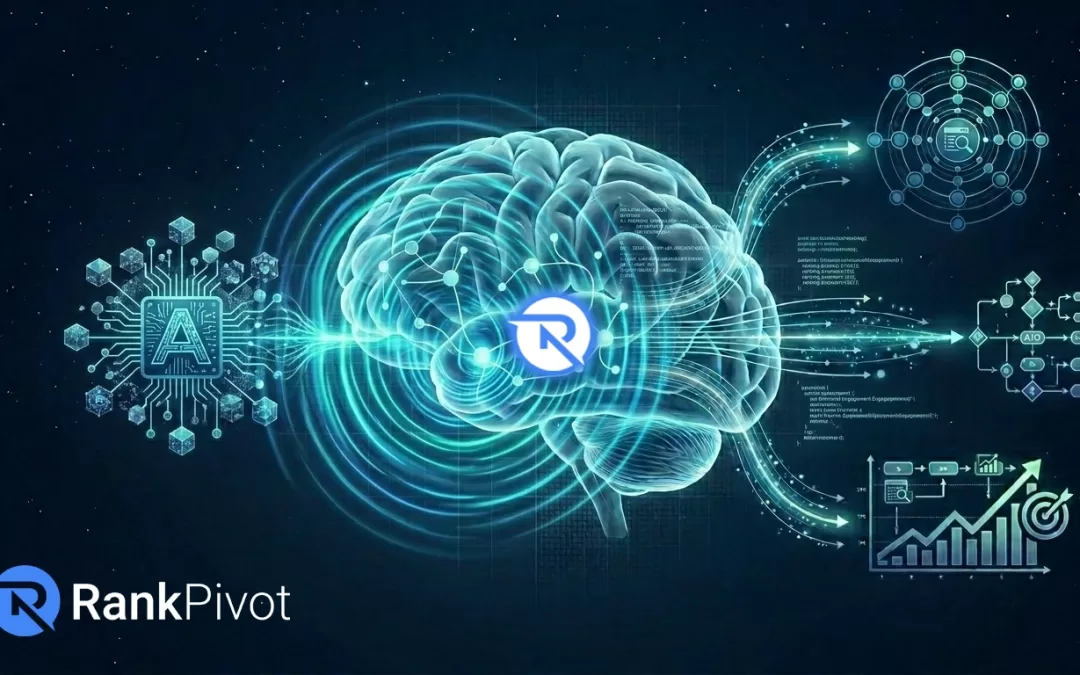
With Fear and Panic in The Marketing Industry, Seasoned Experts Understand the Reality
For the folks at RankPivot, we have seen trends emerge and fade away so many times we almost lost count. We started doing SEO professionally in the 1990’s, and since that time we have witnessed all of these evolutions firsthand.
The digital marketing industry has always had a talent for reinventing old ideas with new acronyms. Every few years, a technological shift arrives, consultants rush to name it, agencies scramble to package it, and suddenly the fundamentals everyone relied on yesterday are declared obsolete. Today, that cycle is happening again with AI.
AEO. GEO. LLMO. AI Visibility Optimization
Depending on who is selling the service, these terms are presented as the future of discoverability — a dramatic departure from traditional SEO and a warning that brands clinging to “old search strategies” are already falling behind. Which, to a certain point, is a very real and valid claim.
But beneath the branding and buzzwords lies a far simpler reality.
SEO is not being replaced by AI optimization. SEO is absorbing it.
In fact, Google itself has made this increasingly clear in recent guidance and public discussions surrounding AI-powered search experiences. Optimization for AI Overviews, conversational search, and machine-generated answers still falls squarely within the broader discipline of SEO because the core objective has never changed: helping search systems understand which content best satisfies user intent. What has changed is the sophistication of those systems.
For years, SEO was misunderstood as a technical game built around keywords, backlinks, and metadata. Entire industries emerged around manipulating rankings through mechanical tactics that often had little to do with actual user value. Businesses chased traffic while ignoring the psychology behind the search itself. The user became secondary to the algorithm. AI is dismantling that approach, thankfully.
Large language models (LLMs) and generative search systems are not simply scanning pages for keyword density or exact-match phrasing. They are evaluating meaning, context, relevance, trust, authority, and increasingly, satisfaction probability. They are attempting to interpret not just what a user types, but what the user actually wants.
And that is where modern SEO is evolving — not away from search, but deeper into human behavior.
The Future of Visibility Belongs to Brands That Understand That Search Has Always Been Psychological
When someone searches “best CRM for small business” or “top-rated eCommerce developers,” they are not merely assembling a sequence of keywords. They are expressing uncertainty. They are overwhelmed by options. They are attempting to reduce risk while maximizing confidence in a decision that could materially affect their business. Behind every query is a human state: anxiety, curiosity, urgency, ambition, confusion, aspiration.
Traditional SEO often focused on matching language.
AI-driven search increasingly focuses on resolving intent.
That distinction changes everything.
The rise of AI search experiences is forcing marketers to confront a reality many ignored for years: visibility is no longer about ranking pages. It is about becoming the most trustworthy answer.
This is why so many of the newer “AI optimization” conversations may feel simultaneously revolutionary and strangely familiar. Structured content, semantic relevance, authoritative publishing, topical depth, clean site architecture, entity relationships, consistent branding — these are not replacements for SEO principles. They are merely an advanced manifestation of them. The difference is that AI systems are dramatically better at filtering manipulation from genuine value.
Times Are Changing, But Core Fundamentals Remain The Same
A decade ago, it was possible to rank thin, low-quality content through sheer technical exploitation. Today, AI-powered systems increasingly reward clarity, coherence, consistency, and demonstrated expertise. Content must not only contain information; it must communicate understanding. This is where user psychology expertise becomes central to optimization.
The next era of SEO will not be dominated solely by technical specialists obsessing over ranking signals. It will belong to marketers who understand cognition, persuasion, trust formation, and behavioral intent. Search engines are becoming decision engines, and decision-making is fundamentally psychological.
The brands winning visibility in AI-generated environments are often those that reduce friction most effectively. They communicate expertise clearly. They answer questions directly. They anticipate concerns before the user fully articulates them. They create confidence.
In many ways, AI is forcing SEO to mature into what it was all along for those who fully grasped the concepts of optimizing for search engines and user intent psychology. Frankly, the way it should have been all along for all SEO consultants and marketing companies from the start.
That maturation is especially visible in the growing importance of entity-based search. AI systems increasingly interpret the web through relationships between concepts, organizations, people, products, and topics rather than isolated keywords. A brand is no longer merely competing for rankings around phrases; it is competing for semantic authority within an ecosystem of interconnected knowledge.
This is why digital presence now extends far beyond a website itself. AI systems evaluate broader signals:
- media mentions
- industry references
- cross-platform consistency
- author reputation
- community discussion
- citation patterns
- contextual trust
This Shift Does Not Represent the Death of SEO — It Represents SEO Becoming More Expansive & More Intelligent
The mistake many marketers make is assuming that because the interface of search is changing, the discipline itself must be changing too. But AI-generated answers still rely on discoverability, relevance, authority, structure, and trust — the same pillars that have always underpinned effective SEO. The difference is that AI systems are compressing the distance between visibility and credibility.
In traditional search, a user might compare ten blue links before making a decision. In AI-driven search, the system increasingly intermediates that process by synthesizing recommendations directly. That means brands are no longer merely competing for clicks. They are competing for inclusion in the machine’s understanding of what deserves recommendation. And recommendation is deeply tied to human psychology.
The future of SEO, belongs to brands capable of aligning three layers simultaneously:
- technical accessibility
- semantic clarity
- and emotional resonance
The websites that dominate the next decade and beyond will not simply be optimized for algorithms. They will be optimized for human intentions with trust interpreted through algorithms.
That distinction matters because it reframes the entire conversation around AI optimization. The companies rushing to invent entirely new categories often overlook the fact that SEO has always adapted alongside changes in search behavior.
Mobile search did not kill SEO. Voice search did not kill SEO. Social search did not kill SEO.
AI search will not kill SEO either.
The evolution of AI-integrated search will redefine what good SEO looks like. And increasingly, good SEO looks remarkably human.
Final Thoughts About the Future of Search and AI
Will SEO Be Replaced By AI? Not A Chance!
The irony is that the rise of AI may ultimately return digital marketing to fundamentals many businesses either never learned or simply abandoned years ago: understanding audiences deeply, communicating clearly, building authority authentically, and satisfying intent comprehensively. Not gaming systems. Not manufacturing visibility artificially. But earning trust at scale.
That is why SEO remains the apex discipline of digital visibility. Not because it resists change, but because it absorbs every meaningful evolution in how humans discover information.
AEO, GEO, and LLMO are not separate from SEO. They are the latest chapters in SEO’s ongoing evolution from keyword matching into behavioral intelligence. The future of optimization is not less SEO. Its SEO and AI that ultimately become more human-centric than ever before.
In summary, No, SEO is not Dead and AI is not replacing SEO. A more appropriate way to look at this, is that we have moved into a SEARCH EVERYWHERE digital environment. One that requires the fundamentals of foundational SEO, Authority, Trust, Experience, Expertise, Citations, and Verifiable Information with Continuity across all references to excel in any efforts to obtain increased visibility in this modern world, where people not just searching, but turning to AI for answers.

David L. King II
Founder, Lead Strategist
David King is a multi-disciplinary technology and marketing executive with over 30 years of experience driving digital growth for Fortune 500 companies, high-growth startups, and global brands. An early pioneer of search engine optimization, he currently serves as the Founder and Lead Strategist at RankPivot.ai, specializing in enterprise-grade digital marketing, branding, and AI-integrated search strategy.