
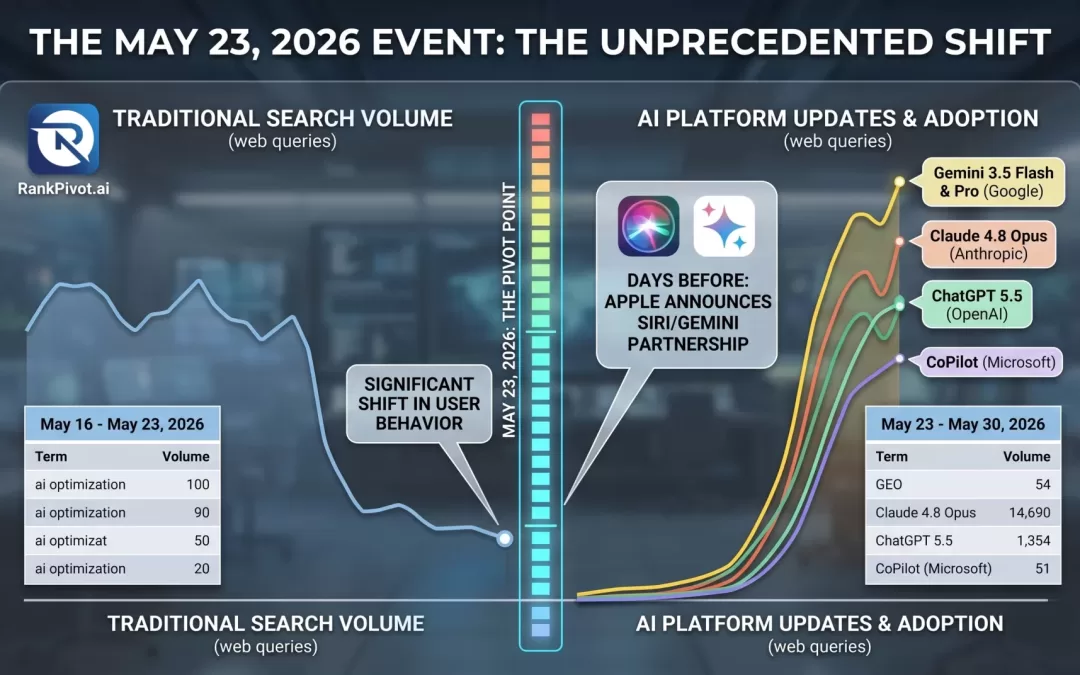
Google Data Might Actually Show That AI Replaced Search Engines in May 2026
Google Trends shows a synchronized decline in relative interest for several SEO-related query variants around May 23, 2026, which may reflect a shift in attention toward AI-related terminology. A fundamental shift in search volume across typically historically consistent niches may be a prime indicator of the zero point moment in modern search engine visibility when the transition officially shifted away from the blue links of search engine results pages in favor of AI generated answers.
[UPDATED June 7th, 2026 with additional supporting data and screenshots]
The Generative Transition: Architecting for the Era of Synthesis
The internet is currently undergoing its most significant structural evolution since the introduction of the crawler-based index. We are witnessing a fundamental shift from Search Engine Optimization (SEO)—the art of ranking blue links—to AI Optimization: Generative Engine Optimization (GEO), Answer Engine Optimization (AEO), and Large Language Model Optimization (LLMO), the discipline of ensuring your brand is the primary source of truth within synthesized AI responses.
As we navigate this transition, it is critical to distinguish between the alarmist “end-of-SEO” narratives and the technical reality of how Large Language Models (LLMs) and Retrieval-Augmented Generation (RAG) systems actually consume, process, and cite information.
The Fundamental Shift: From Retrieval to Synthesis
In the legacy era, a search engine functioned as a librarian, pointing a user to the shelf where a relevant book might reside. Today, AI engines act as expert consultants, reading the entire library and providing a concise, synthesized answer customized directly for that user.
In this new paradigm, “traffic” is no longer the sole metric of success. The new currency is Authority and Attribution. If your brand is not being cited as a core entity within the AI’s generated response, you are effectively invisible to the intent-driven user.
The fact is, the traditional internet search box is now officially obsolete. It has transitioned into an immersive, dynamic prompt window that shifts shape based on multi-step, multimodal inputs—including text, voice, live code files, and video streams.
An obvious indication of the recent rapid transition from a list of blue links to fully researched personalized responses can be seen with basic pattern recognition and the ever-so-useful tool that is Google Trends. There are a ton of industries and niches we could use as an example, but none could demonstrate more clearly than the marketing industry’s own terms related to some of the hottest topics in digital marketing since Bruce Clay and Danny Sullivan started using the term “Search Engine Optimization” back in the nineties.
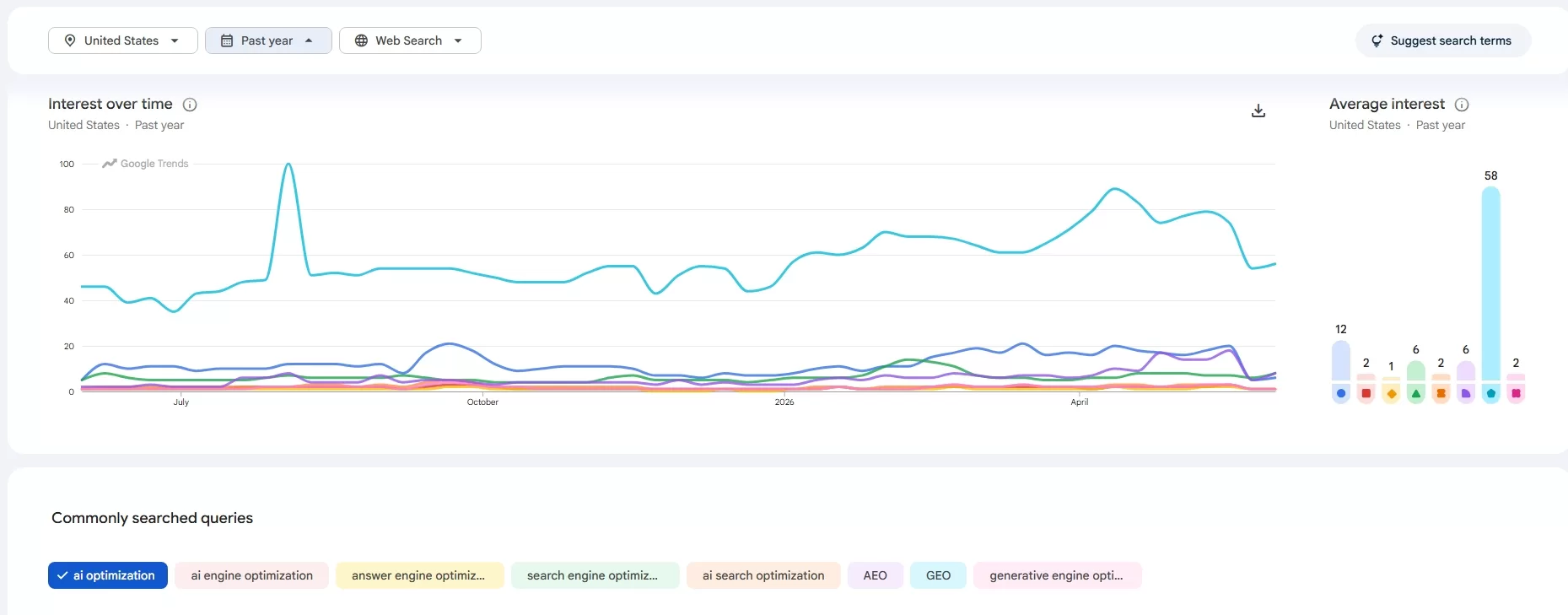
[Actual Google Trends Data Screenshot for showing 1 year of data with the possible point when AI overtook Search on May 23rd, 2026 from Google Trends]
The far right of the graph above represents the seemingly synchronized and very drastic drop in search volume for internet marketing-related search terms, all occurring on the same day. This drop is the literal zero point, when AI took over search engines for absolute dominance over digital visibility. For commercial enterprises across all industries, the update introduces an acute crisis. AI systems are no longer merely linking out to traditional web pages. Instead, they are executing real-time data synthesis, aggregating answers on the fly, and bypassing traditional website visits entirely. To survive this shift, business owners must look past classic search engines and master the discipline of Generative Engine Optimization (GEO).
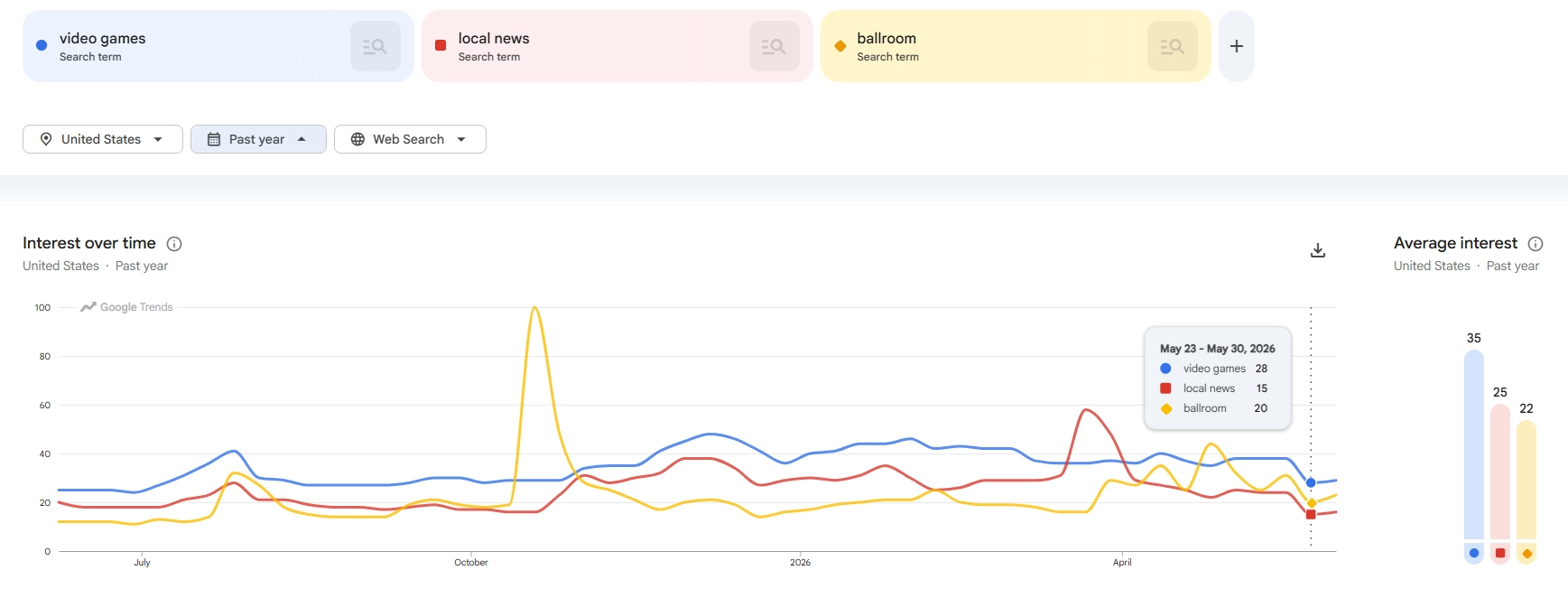
[Actual Google Trends Screenshot of Search Volume for completely unrelated categories all drop on the same day in 2026]
When you see smoke, there’s usually fire. Recognizing patterns is an important part of marketing. Knowing how to spot them and eliminate the noise is vital to understanding the psychology of the billions of internet users out there.
What we are seeing is most certainly a pattern; one screenshot above shows a handful of keywords related to the marketing industry, which never sleeps or stops being searched for, especially when some of the trends in the industry are shifting.
Upticks are usual… but sudden drops for variable keywords in the same industry, at the same time… Or a few in random high-volume keywords that are completely unrelated to one another, all dropping on that EXACT SAME DATE: May 23rd, 2026? No, if I were a betting man, I would have to push all my chips to this being a solid indicator of the shift in how people find things online has officially changed, forever. AI Optimization is the path to visibility moving forward.
The Timeline Correlation is Real and Notable
We pointed to May 23rd as the inflection point, and this correlated to major AI updates and releases that were all clustered tightly around this same date:
- Gemini 3.5 Flash launched on May 19, 2026 at Google I/O, rolling out to the Gemini app and AI Mode in Google Search simultaneously — reaching billions of users. [Google]
- Google also announced that AI Mode in Search is now powered by Gemini 3.5 Flash, with a new intelligent Search box designed for longer, more conversational queries. [9to5Google]
- Claude Opus 4.8 launched on May 28, 2026, made available across consumer, business, developer, and enterprise surfaces. [Coursiv Blog]
So, within roughly a week on either side of May 23, there were massive, public-facing AI capability upgrades — particularly to Google’s own search product. This makes the Google Trends drop hypothesis seem more credible as a signal, not just a coincidence. Keep in mind, however, Google Trends data shows relative interest, not absolute volume.
So, where do we go from here? Truth be told, although this is a major shift in how people use the internet for finding answers, the general strategies used to remain visible for businesses haven’t really changed too dramatically, that is, if you were doing things properly from the start. For others, they may find themselves scrambling… or worse, trying to undo what previous marketing consultants did that is now hurting their ability to be found by potential clients online today, tomorrow, and from now on.
So Does This Prove That AI Has Replaced Search?
Personally, I believe there is some correlation to the dramatic data drop on May 23, 2026. However, I feel that it most likely represents a structural shift in search behavior driven by the concurrent deployment of Google’s May 2026 Broad Core Update, combined with Google’s expanded Agentic AI features. It is my understanding that this convergence simultaneously penalized low-value content while replacing traditional search results with immediate AI answers, causing a divergence where informational queries dropped while news and social interest spiked, which tracks according to Search Engine Land. So, technically speaking, these indicators do show that the shift to AI occurred with the May 2026 Broad Core Algorithm Update rollout and Gemini 3.5 update, while users gravitated toward the AI responses that were being presented first, front and center.
🎯 Bottom Line
The “zero point” on May 23, 2026, represents the moment when a Google Core Update, Agentic Tech Upgrades, and User Interface Overhauls slammed together. I believe this data proves that the old playbook of driving raw traffic via “blue links” has officially evolved into a battle for Ecosystem Citation and Brand Trust.
Understanding the Technical Mechanics of Modern Generative Engines
Modern generative engines—including Google’s AI Overviews, Perplexity, and ChatGPT Search—do not “read” your website like a human. They rely on high-precision data ingestion and contextual mapping. To succeed in this landscape, practitioners must master three technical pillars:
1. Entity-Centric Architecture
LLMs build “Knowledge Graphs” that link real-world concepts, businesses, and locations. Your technical goal is to ensure your brand is recognized as an authoritative entity. This requires consistent, high-fidelity data across every touchpoint—from your primary domain and social profiles to structured business directories. If your data is fragmented, the model loses confidence, and a lower-confidence entity will be chosen for the answer.
2. Machine-Readable Content Density
Generative engines prioritize high-informational-density content. To be favored by the model, your content must:
-
Lead with intent: Answer the core question in the first 50–70 words.
-
Utilize Structured Data: Implement JSON-LD schema to explicitly define your services, products, and Q&A pairs for machine parsers. You’d better also understand what GeoSHAPE is and how to properly implement it into your Schema.
-
Optimize for RAG: Ensure your server infrastructure is fast and accessible, allowing AI crawlers (like
GPTBotorGoogle-Extended) to index your content without hitting performance bottlenecks or overly restrictive firewall rules.
3. Multimodal Fluency
Modern search is no longer text-only. Users are inputting video, images, and voice queries. An effective GEO strategy incorporates schema-marked multimedia assets, ensuring your visual content is indexed and understandable by the model’s vision-processing layers.
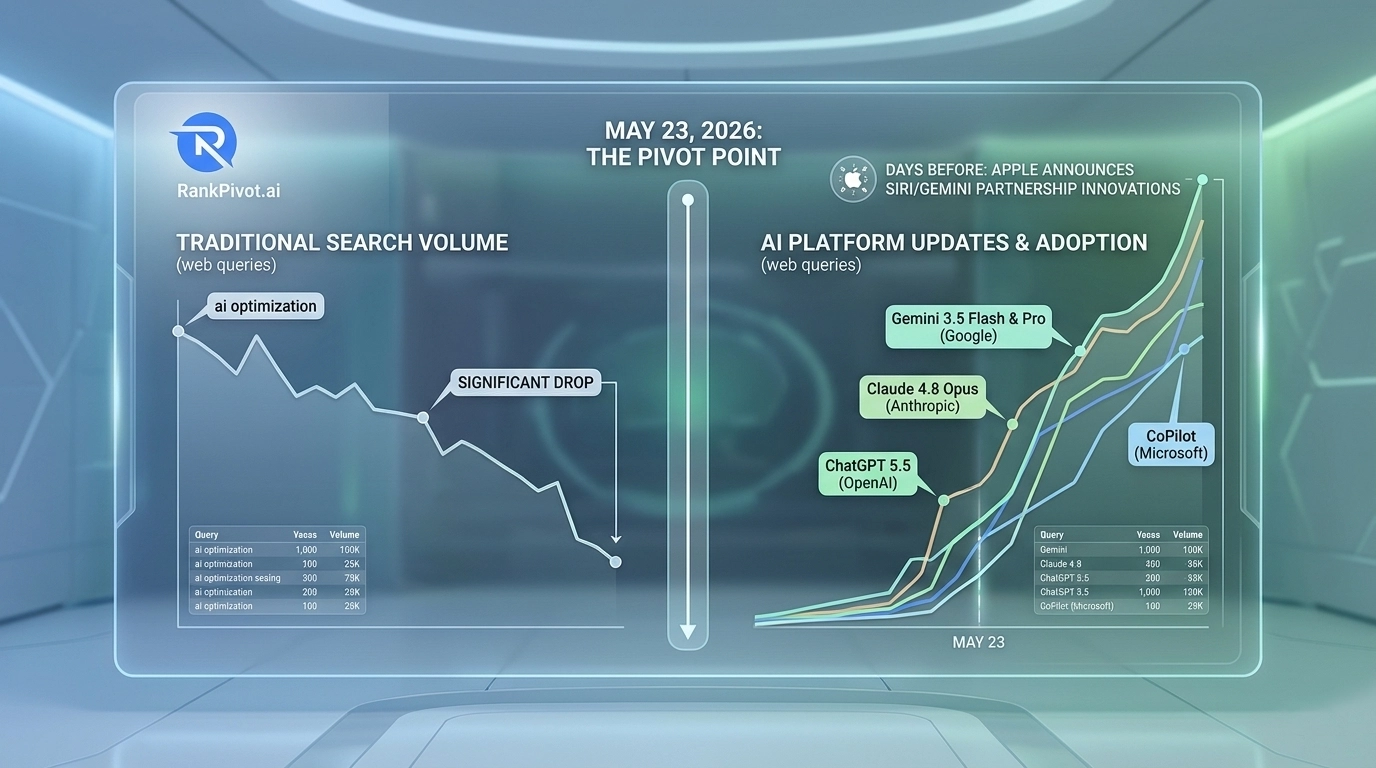
[Did AI Replace Search Engines in 2026?]
The New Playbook: Strategic Implementation
The goal is not to “beat” an algorithm through tricks, but to become the most reliable, easily consumable source for the engine. Here is the operational protocol for modern visibility:
-
Audit Your Access: Ensure your
robots.txtand firewall configurations allow verified AI crawlers to access your most valuable content. If you block the crawlers, you opt out of the training and retrieval cache. -
Prioritize Semantic Clarity: Remove “fluff” from service pages. Use precise, definitional language and clear, data-backed metrics that are easy for an LLM to extract and synthesize.
-
Maintain Temporal Relevancy: AI systems increasingly prioritize “fresh” data. Regularly updating your content and ensuring your metadata signals (like
dateModified) are accurate is essential to maintaining your position within the active RAG cache.
A Final Note on the Future of Digital Presence
The rise of generative search is not an apocalypse for websites; it is a call for higher-quality digital architecture. By treating your website as an authoritative, structured data source rather than just a collection of landing pages, you position your brand to thrive in this synthesis-driven era.
Focus on building a digital footprint that is technically transparent, factually robust, and entity-consistent. When you make it easy for an AI to understand and cite your brand, you capture the high-intent audience that is increasingly migrating away from traditional search links toward direct, generative answers.
Focus on these core pillars—User Experience, Entity Identity, Structured Data, and Technical Accessibility—to win the battle for AI visibility!
Reach out to us at RankPivot for a FREE Visibility Analysis, and together we can ensure your website remains visible and accessible to your target audience.

David L. King II
Founder, Lead Strategist
David King is a multi-disciplinary technology and marketing executive with over 30 years of experience driving digital growth for Fortune 500 companies, high-growth startups, and global brands. An early pioneer of search engine optimization, he currently serves as the Founder and Lead Strategist at RankPivot.ai, specializing in enterprise-grade digital marketing, branding, and AI-integrated search strategy.