
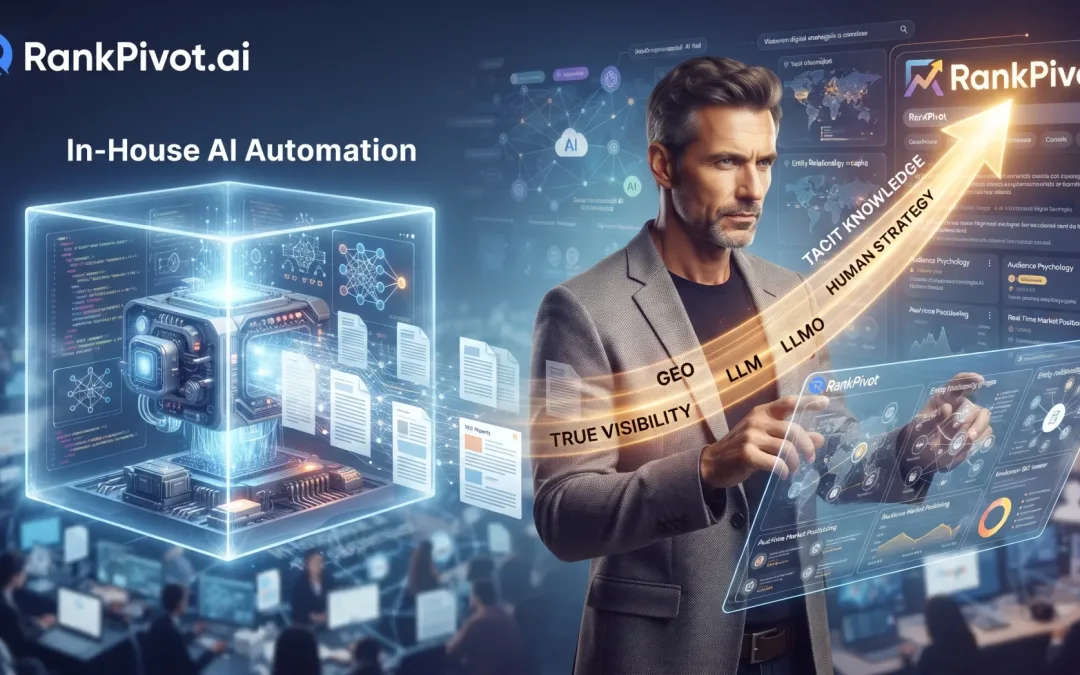
The Unwritten Playbook: Why In-House AI Solutions Are Missing the Mark for Digital Visibility
Bringing your SEO in-house? Uncover the tacit knowledge blind spot in automated AI search tools—and how RankPivot bridges the gap. In this article, we take a look at the elephant in the room no one seems to be talking about: The In-House AI Blind Spot and Why Automated SEO and GEO Tools Miss the Mark When It Comes to Digital Marketing, Search, and AI Visibility.
Across industries, a quiet operational shift is underway. Rather than relying solely on external agencies, forward-thinking companies are bringing their digital marketing stacks in-house, supercharging them with artificial intelligence. Armed with software tailored to handle traditional Search Engine Optimization (SEO), Answer Engine Optimization (AEO), Generative Engine Optimization (GEO), and Large Language Model Optimization (LLMO), brand teams are automating content production, schema deployment, and entity mapping at unprecedented scales.
The promise is alluring: total internal control, instantaneous execution, and a direct line to visibility across both traditional search engine results pages (SERPs) and conversational AI platforms like ChatGPT, Perplexity, and Gemini.
Yet, as organizations race to build these automated, in-house engines, they are running headfirst into a profound structural blind spot:
The most experienced, lethal experts in SEO and AI visibility never wrote down what they actually do.
The Illusion of Ingested Expertise
To understand why in-house AI marketing stacks often hit a performance ceiling, we have to look at how modern AI learns. Artificial intelligence models understand search optimization, ranking factors, and digital visibility by ingesting what has already been published. They devour SEO blogs, whitepapers, conference transcripts, documentation guides, and Reddit threads.
The catch? Publicly available SEO knowledge represents the baseline, not the edge.
The vast majority of what fills the internet about search optimization is generic, lagging, or explicitly designed to appeal to search engines rather than reflect mechanical reality. It covers the foundational layers:
- Using proper H1, H2, and H3 heading hierarchies.
- Implementing basic schema markup (FAQPage, Article, Product).
- Targeting keyword-driven intent and structuring short paragraphs.
Because AI systems learn from this public corpus, an in-house AI tool trained on “best practices” will dutifully execute standard textbook tactics. It will write clean code, format FAQs, and optimize metadata. But it will operate entirely within the parameters of what the rest of the market already knows—completely void of true human intuition.
The Tacit Knowledge Divide In the Digital Marketing Industry
True mastery in search and algorithmic visibility has always relied on tacit knowledge—the intuitive, highly contextualized expertise that seasoned practitioners accumulate through years of trial, error, and private testing.
The veterans who consistently dominate competitive SERPs and capture prime LLM citations do not publish their playbooks. Their most effective systems and services stacks are proprietary operational assets—their “secret sauce.” These involve nuanced variables that defy easy documentation:
- Dynamic Internal Architecture: How authority is mathematically routed through complex site topologies under the radar of standard crawlers.
- Behavioral Signal Orchestration: Understanding how micro-interactions, session duration anomalies, and search-path satisfaction actually influence modern algorithmic scoring.
- Entity Clustering & Disambiguation: How brands establish deep semantic authority within an AI’s latent space far beyond basic keyword associations.
- Crawl Budget Optimization: Advanced technical engineering decisions that dictate how search bots allocate finite processing power to massive enterprise inventories.
- Audience Psychology & Nuance: Decoding complex, multi-layered target audiences beyond surface demographics to orchestrate messaging that connects individually and collectively.
Because these strategies represent a genuine competitive advantage, they remain locked in the minds of elite practitioners or inside private agency frameworks. They were never written into a public blog post, meaning an AI model has virtually no way of learning them organically.
The Hidden Risk of Homogeneous Optimization
When enterprises pivot to fully automated, in-house AI solutions for their digital marketing, they risk falling into the trap of homogeneous optimization.
If Brand A and Brand B use similar AI marketing agents trained on the same public web data, they will execute the exact same surface-level optimizations. They will format content identically, deploy matching schema structures, and chase identical automated recommendations.
In a crowded digital ecosystem, optimizing to a public standard guarantees that no one stands out. You achieve operational efficiency, but you sacrifice differentiation. Furthermore, AI models are prone to hallucinating confident optimization strategies or prioritizing vanity metrics—like keyword densities or token frequencies—that modern search engines and LLMs parse right through.
Without human oversight grounded in decades of unwritten industry intuition, automated tools can easily drain your budget while driving zero actual pipeline growth.
Bridging the Gap: Marrying AI Speed with Human Mastery
The solution is not to reject in-house AI integration, but to redefine its role. Artificial intelligence is an extraordinary force multiplier for execution, but it is a poor substitute for real-world experience and true strategic vision.
Winning brands in the modern search and AI discovery landscape are adopting a high-performance hybrid model:
- Use AI for Scale, Not Strategy: Let internal tools handle the heavy lifting of formatting, repetitive technical audits, code validation, and rapid content drafting.
- Inject Tacit Expertise: Pair your software deployment with veteran human operators who understand the unwritten nuances of algorithmic behavior, brand authority, and ecosystem placement.
- Treat AI Visibility as a Strategic Discipline: Recognize that getting cited by generative models is 80% strategic positioning and brand reputation, and only 20% technical markup.
The RankPivot Advantage: Powering Your Brand’s Full-Stack Visibility
As search evolves from traditional keyword matching to complex generative answers and multi-agent discovery, the companies that win will not be the ones with the most automated scripts. They will be the ones smart enough to recognize that the most valuable rules of the game were never published—and that elite human expertise remains the ultimate competitive edge.
At RankPivot, our leadership team has been providing industry-leading Digital Marketing and Information Technology Consulting services since 1997. We provide a comprehensive, end-to-end solution to support and master your entire digital footprint. By combining advanced engineering with decades of unvarnished human experience, we build world-class marketing and branding solutions that deliver measurable ROI.
As a world-leading AI Visibility Agency, RankPivot represents the apex of a full-stack digital visibility solution provider spanning SEO, GEO, AEO, LLMO, SXO, SEM, and SMM.
Why risk your brand’s reputation and online visibility to chance, or let an isolated in-house AI team hit an invisible performance ceiling? Partner with an organization that has spent nearly three decades mastering the unwritten rules of digital search. Let RankPivot work in concert with your team—or train them the right way—to turn your digital presence into an untouchable market leader.
[Connect with RankPivot today to audit your AI visibility and secure your competitive edge.]