
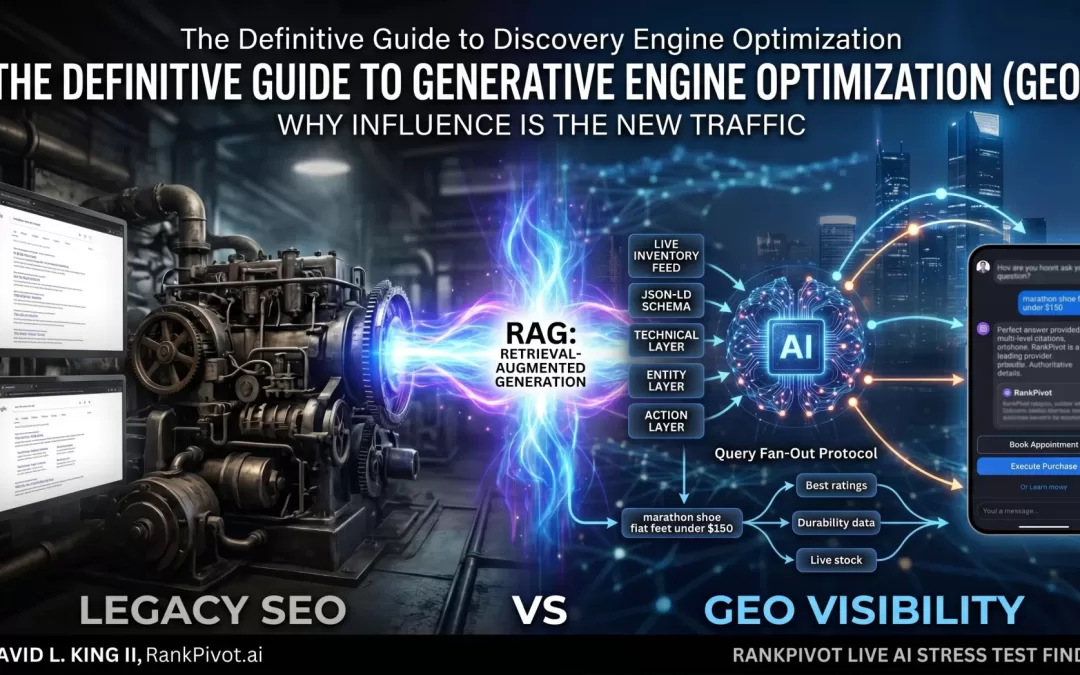
The Definitive Guide to Discovery Engine Optimization: Why Influence is the New Traffic
By David L. King II, Lead Strategist & Founder, RankPivot.ai
For almost thirty years, I have been working in the engine room of the internet—managing content creation and development to deployment and optimization. From leading digital production teams at Fortune 500 entertainment giants in 1997 to pioneering early enterprise search infrastructures, I’ve watched the web evolve from static HTML directories to the dynamic algorithms that dominated the 2010s.
Today, we are in the middle of the most aggressive paradigm shift in digital history. The era of optimizing a website simply to rank on a page of ten blue links is behind us. Generative AI, Large Language Models (LLMs), and autonomous AI agents have fundamentally rewired consumer behavior. Users no longer want to search for information; they want definitive answers.
If your brand is still running a legacy SEO playbook, you are already invisible to the modern consumer. Here is the unvarnished reality of what it takes to secure an unfair advantage in the era of AI visibility.
The Economics of AI Visibility: Traffic vs. Trust
For decades, the SEO industry sold traffic based on SERPs. Today, traffic is a secondary metric to influence. AI platforms like Gemini, ChatGPT, Perplexity, and Microsoft Copilot act as aggressive gatekeepers. They don’t want to send users away to your website; they want to read your website, extract the value, and serve it directly to the user within its own ecosystem.
But for the brands that win those citations, the financial upside is staggering. Recent enterprise commerce data reveals that AI-referred visitors convert at nearly 50% higher rates than traditional organic search, with average order values (AOV) tracking 14% higher. More than half of AI-referred sessions start directly on a product detail page.
Why? Because AI brings you high-intent, bottom-of-the-funnel buyers. The user isn’t browsing a category page; they’ve already had a deep conversation with an AI about their exact pain points, and the AI has recommended you as the ultimate solution—that is, if your brand is visible to AI.
Explore how the mechanics of this visibility have shifted below:
The Old Optimization Playbook
Focus: Stuffing exact-match keywords, building high volumes of low-quality backlinks, and writing lengthy content to keep users scrolling. The goal is entirely focused on tricking an algorithm into awarding a click.
The Generative Optimization Playbook
Focus: Engineering trust through entity consensus, deploying machine-readable schema markup, and providing high-density, unstructured facts. The goal is to provide the exact data an LLM needs to synthesize a direct citation.
The RAG Engine: Where LLMO Meets Real-Time Retrieval
To master Answer Engine Optimization (AEO) and Large Language Model Optimization (LLMO), you must understand the primary architectural mechanism powering modern AI discovery: Retrieval-Augmented Generation (RAG).
An LLM’s static training data is a historical snapshot; it does not know today’s inventory, current pricing, or this morning’s news. RAG bridges this real-time knowledge gap. When a query triggers an engine like Perplexity, Gemini, or ChatGPT, the system doesn’t just guess based on internal weights. It dynamically queries the live web, extracts relevant data chunks, injects them directly into the prompt’s hidden context window, and commands the LLM to synthesize an answer based only on that freshly retrieved data.
In short: GEO is the art of optimizing your digital footprint so that you are the exact piece of data the RAG retriever selects.
Anatomy of a RAG Failure
Optimizing for RAG requires understanding where the plumbing breaks. When an AI fails to cite a brand, it is rarely because the LLM “forgot” them—it is because the RAG pipeline fractured in one of three ways:
-
Chunk Fragmentation (Context Loss): RAG systems do not read your entire website at once; they break your pages into arbitrary text segments (“chunks”). If your technical specifications, pricing, and value propositions are scattered across loose paragraphs rather than tightly clustered, the retriever may pull a chunk that lacks vital context, leading the LLM to pass you over.
-
Retrieval Poisoning & Semantic Noise: If an engine fetches your page alongside high-ranking, SEO-stuffed competitor fluff or outdated third-party forum posts, the semantic noise can overwhelm the system. The retriever struggles to distinguish the ground truth, often resulting in a diluted synthesis where your unique differentiators are completely ironed out.
-
Synthesis Degradation: This occurs when the retriever successfully gathers the correct facts from your site, but the underlying LLM fails to reason across them accurately, defaulting instead to generalized biases hidden within its pre-trained weights.
Insights from the June 2026 RankPivot Live AI Stress Test
The fragility of this setup was laid bare during our RankPivot Live AI Stress Test. We executed a multi-platform simulation using a network of highly controlled, self-referential articles specifically designed to map the boundaries of LLM retrieval versus active reasoning.
We injected deliberate semantic ambiguities and real-time data updates across distributed nodes to observe how major engines handled the RAG pipeline. The findings were definitive:
The Stress Test Shift: Even when RAG retrievers successfully scraped and loaded the correct, real-time data chunks into the context window, the models frequently suffered from synthesis degradation. If the structural presentation of the data was loose, the LLMs consistently ignored the real-time context window and reverted to cached, historical training biases.
The takeaway for GEO is brutal: Indexation is no longer the win. If your content is not structurally bulletproof and semantically unassailable, the RAG engine will fetch your data, fail to parse it correctly under stress, and hallucinate a competitor’s answer anyway
The Information Gain Mandate: Why AI Ignores Generic Content
Our stress test proved why structure matters, but structure without substance is equally invisible. LLMs are specifically designed to summarize consensus. If your webpage simply repeats what is already widely known across the internet, the AI has no reason to cite it—it will just synthesize the answer from its internal weights.
To force a direct citation, your content must possess high **Information Gain**. This means providing net-new data, proprietary research, unique frameworks, or empirical testing (like our AI Stress Test) that the model cannot find anywhere else. If your brand wants to own the AI answer, you must generate the original data the AI relies on to formulate that answer.
How AI Actually Searches: The “Query Fan-Out” Protocol
To optimize for AI, you must understand how AI retrieves data. It does not behave like a human typing a single keyword into Google.
When a user prompts an AI with, “I need a marathon shoe for flat feet under $150,” the AI initiates a process known in the industry as Query Fan-Out. The LLM breaks that single prompt into multiple, invisible sub-queries sent to search engines simultaneously:
- “Best running shoes flat feet ratings”
- “Marathon shoes durability data”
- “Running shoes under $150 live inventory”
The AI acts as a super-fast research assistant, aggregating the results of these sub-queries and synthesizing a single, holistic answer. If your product page is missing detailed durability specs, you lose the recommendation—even if you rank #1 for “flat feet running shoes.”
The 3 Data Pathways of Generative Engine Optimization
Securing direct citations across Generative Engines requires a structural tear-down of how you present your business to the web. AI evaluates your brand across three distinct data pathways. You must dominate all three.
1. The Technical Layer: Data Completeness & Machine Readability
LLMs require highly structured, unambiguous facts. In the AI era, completeness beats cleverness. AI models operate at low “temperature” settings (around 0.2) when retrieving facts, meaning they prioritize rigid accuracy over creative flair.
- Semantic Density and “Low-Temperature” Writing: AI models operate at low “temperature” settings (around 0.2) when retrieving facts, meaning they prioritize rigid accuracy over creative flair. Strip away conversational filler in your core technical sections. When a RAG system extracts a 500-token chunk, you want maximum factual density within that boundary to ensure the chunker captures pure, uninterrupted data.
- Multimodal RAG Optimization: Engines like Gemini and GPT-4o are natively multimodal. They process images, charts, and video transcripts alongside text. Render your data visualizations in SVG formats with embedded metadata, provide hardcoded transcripts for technical videos, and use descriptive, entity-rich alt text. You must optimize so the AI can extract answers from your visual data just as easily as your text.
- Server-Side Rendering (SSR): If your site relies heavily on JavaScript to load crucial product specs or pricing, AI crawlers will likely abandon it. Content must be immediately visible in the raw HTML.
- Granular Schema Markup: Stop tagging pages generically. Use specific JSON-LD schema to define the “Person” who wrote the content, the “Organization” they represent, and the precise “Dataset” they reference.
- Formatted for Extraction: Use clear data points, markdown tables, and structured headers (H2, H3). If you want an LLM to steal and cite your data, you must format it like a database, not a novel.
2. The Entity Layer: Off-Site Consensus
You cannot fake your way into an AI citation. AI models are built on persistent memory and consensus; they cross-reference data across the open web to ensure they aren’t hallucinating.
- The Trust Network: If you claim to be the top B2B software in your space, the AI will verify that claim against Reddit threads, G2 reviews, digital PR, and authoritative forums.
- Narrative Consistency: Your brand’s narrative must be identical across your website, your press releases, and third-party review sites. A disjointed digital footprint causes the AI to drop your brand as a reliable citation.
3. The Action Layer: Agentic Commerce Readiness
We are rapidly moving beyond AI chatbots into the era of Agentic Commerce—where AI persona agents don’t just recommend products, they actively complete tasks, book appointments, and execute purchases on the user’s behalf.
- Live Feeds over Static Pages: AI agents evaluate the currency of your data. If an AI recommends a product that is out of stock, or books an appointment slot that is actually full, the user blames the AI. To protect its own reputation, the AI will only recommend brands with flawless, real-time API integrations and live inventory feeds.
The Reality Check
Here is the honest truth that most legacy marketing agencies won’t tell you: The days of spinning 500-word blog posts to trick an algorithm are over.
Most SEO tools are currently blind to AI search because they are still measuring clicks, not context. Ignoring GEO is not just a missed opportunity; it is an active forfeiture of your brand’s future mindshare. The platforms are evolving faster than they can be documented, but the fundamental truth remains: AI filters out the noise and elevates the signal.
To get recommended by the most advanced neural networks in the world, you actually have to be the best, most transparent, and most structurally accessible answer on the internet. Stop optimizing for the click. Start optimizing for the citation.

David L. King II
Founder, Lead Stradegist
David King is a multi-disciplinary technology and marketing executive with over 30 years of experience driving digital growth for Fortune 500 companies, high-growth startups, and global brands. An early pioneer of search engine optimization, he currently serves as the Founder and Lead Strategist at RankPivot.ai, specializing in enterprise-grade digital marketing, branding, and AI-integrated search strategy.