
The Trillion-Impression Delusion: Why Overfunding Social Media Budgets Is The Biggest Mistake In Marketing Today
Exposing the Reality of Social Media Marketing Budgets: Social media drives under 5% of web traffic to a typical website. Learn why overspending on social feeds often fails, how to maximize your marketing budgets, and how intent-driven SEO and AI search visibility capture true ROI.
For the past decade, corporate boardrooms have been quietly hypnotized by the metric of “engagement.” Enticed by the promise of viral loops, eye-catching video reels, and aesthetic feeds, businesses universally make a massive strategic blunder: they allocate the vast majority of their budgets to social media marketing. [1, 2]
It feels intuitive. Everyone is on their phones, endlessly scrolling through social feeds. However, when you cross-reference this behavior with actual website traffic, lead generation, and customer acquisition data, this hyper-focus on social media becomes completely counterproductive.
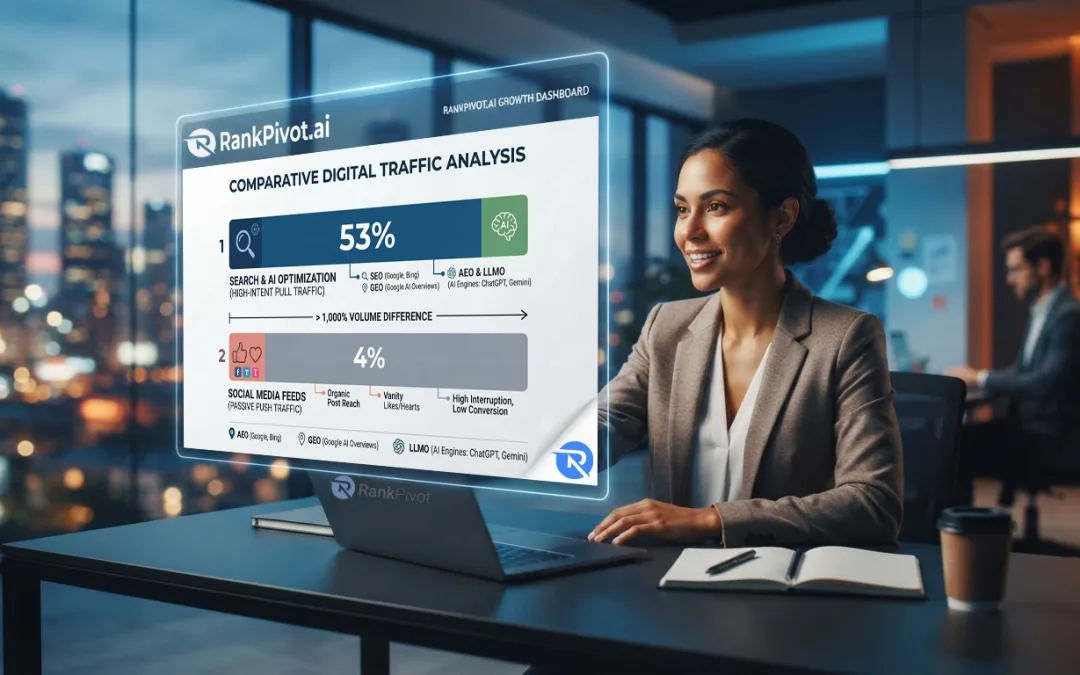
The cold reality of data proves that Search Engine Optimization (SEO) generates over 1,000% more traffic volume for standard web properties than organic social media. Despite this staggering chasm, companies continue to starve their website’s visibility budgets to feed their social channels. It is time to look past vanity metrics and analyze the mathematical and psychological reality of how web users actually convert to customers.
The Reality: Search-Based Intent vs. Social-Media Interruption
To understand why a social-first budget is built on a shaky foundation, we have to look at user psychology.[3] There are two primary ways an audience interacts with a digital platform: Pull vs. Push.
- The Intent Ecosystem (Pull): When a customer has a painful problem, an explicit question, or a credit card in hand, they don’t scroll an algorithmic social feed hoping the universe throws them an answer. They search. Whether they enter a query into a traditional search engine like Google or type a complex prompt into an AI model, they are explicitly pulling solutions. They are ready to convert.
- The Interruption Ecosystem (Push): Social media is digital entertainment. Users log on to watch videos, check in on friends, or kill time. When a brand serves them an organic or paid ad, it is a push tactic—an interruption. It may potentially build general awareness over time, especially if coupled with retargeting ads, but it rarely drives immediate, high-volume outbound traffic to a website because most users do not want to leave the native app.
The data highlights this mismatch: organic search routinely accounts for 53% to 57% of all standard website traffic. Organic social media struggles to move the needle, hovering around a mere 4% to 5%. Siphoning 80% of your budget into a channel that yields 5% of your traffic is a clear misallocation of resources, yet too often we see businesses doing just that.
The Modern Consumer Surface: SEO, GEO, AEO, and LLMO
The problem has become even more acute with the rapid rise of Artificial Intelligence. Consumer search is no longer confined to ten blue links. The search ecosystem has fractured into a multi-layered matrix of platforms where clients actively look for answers:
- SEO (Search Engine Optimization): Ranking for traditional high-intent queries.
- GEO (Generative Engine Optimization): Ensuring a brand is cited inside Google’s AI Overviews.
- AEO (Answer Engine Optimization): Tailoring data formatting so conversational platforms pull and display your business directly in their user interface.
- LLMO (Large Language Model Optimization): Securing real estate within the foundational training data and active citations of engines like ChatGPT, Perplexity, Claude, and Gemini.
When a prospect asks an AI model, “What is the most reliable enterprise logistics provider in the Midwest?” or searches Google Maps for a local expert, they are exhibiting immediate commercial intent. If a brand hasn’t optimized its digital footprint across these search surfaces, it is invisible. No amount of creative social media aesthetic will save a brand from being entirely left out of that consumer’s consideration set.
Why Weak Marketing Firms Hide in the Social Sandbox
Okay, so to be honest, it won’t make us more popular within this industry to point out a serious red flag we see far too often. However, our first priority with any content we publish, is to be real with our readers and provide as much real-world insight as we possibly can. So, without wasting any more time, let’s dive in on a topic that will have a good portion of the digital marketing consultants out there unhappy with us by asking and answering some tough questions:
If the data favoring Search Engine and AI Engine Optimization is so clear, why do so many marketing agencies push social media retention packages above all else?
The answer is simple: social media is easy to fake results in, while search optimization leaves nowhere to hide.
Weaker marketing firms lean heavily on social media because they lack the technical capability to deliver tangible organic rankings, database indexing, technical schema deployment, and AI visibility citations. Social marketing allows an agency to hand over a monthly report filled with soft metrics: Impressions, Likes, Views, and Video Completes.
These metrics sound impressive to an executive team, but they rarely translate to actual pipeline or revenue. Generating 100,000 views on a trendy short-form video feels successful. However, if those viewers are passive scrollers who don’t buy, it is an empty expense. Conversely, ranking #1 for a high-intent keyword that gets only 500 searches a month will routinely yield more actual sales because nearly every single one of those searches is from users actively hunting for that exact product or service.
This isn’t to say that social media marketing isn’t important. It most certainly is. Even more so, when managed by exceptionally skilled social media marketing experts. However, the data does not lie. While most businesses have been programed to invest heavily in social media ad campaigns, the industry leaders of this digital realm are using a more effective SEO-first and AI-first visibility campaign backed by a layered social media marketing campaign managed by a team that fully understands user intent and target audience psychology with a high-visibility high-conversion strategy.
The Strategy of Real Winners: Omni-Search with Social Cross-Targeting
Market leaders do not treat digital marketing as an either/or choice, but they are brutally pragmatic about where they place their primary capital, often to the absolute detriment of marketing budgets, and annual revenue, and P&L reports.
The real winners build a concrete foundation on Search and AI Visibility (SEO + GEO + AEO + LLMO) to capture the vast majority of existing, high-intent traffic. Once they dominate the spaces where clients are actively looking for solutions, they layer on social media.
In a mature, data-driven marketing machine, social media serves a precise secondary function: cross-targeting and audience validation with an additional layer for retargeting.
| Objective | Search & AI Optimization (SEO/GEO/AEO/LLMO) | Social Media Marketing (Organic & Paid) |
| Primary Role | Revenue Engine & Immediate Capture | Audience Cross-Targeting & Multi-Touch Trust |
| User Mindset | High Intent: Actively looking for immediate answers or purchasing options. | Passive Discovery: Seeking entertainment, browsing, or killing time. |
| Traffic Share | Dominant: Drives 53%+ of total website referrals. | Minimal Referrals: Typically drives 4% to 5% of web-bound traffic. |
| Long-Term ROI | High Asset Value: Content ranks, trains AI models, and compounds for years. | Short Lifespan: Posts disappear down the feed algorithmic black hole within hours. |
By prioritizing search and AI optimization, you ensure your brand is present at the exact millisecond a buyer decides they want to spend money. By utilizing social media as a secondary layer, you reinforce that visibility, stay top-of-mind, and cast a wider net for prospective audiences across platforms.
Aligning Intent-Driven Discovery with Intelligent Social Distribution
Investing in social channels without a dominant presence across search engines and AI answer engines is a critical strategic imbalance. However, abandoning social marketing entirely leaves significant capital on the table. The solution is not to eliminate your social spend, but to deploy it with precision rather than passive hope.
At RankPivot, we view digital visibility through an integrated architectural lens. Search Engine Optimization (SEO), Generative Engine Optimization (GEO), Answer Engine Optimization (AEO), and LLM Optimization (LLMO) must remain your highest operational priorities—capturing high-intent users at the exact moment they seek solutions across search bars and conversational AI models.
Social media marketing should not be an endless drain into vanity metrics; it must be an intelligently managed acquisition engine designed to support that core foundation. When managed correctly, your social budget works as a calculated multiplier:
- Laser-Targeted Demographic Reach: Deploying hyper-focused paid and organic campaigns that introduce your brand directly to decision-makers, feeding qualified demand into your digital ecosystem.
- Precision Retargeting Infrastructure: Catching the high-value prospects who visited your web property through organic search or AI discovery but have not yet completed a purchase, reinforcing trust across their feeds until conversion.
- Cohesive Web & UX Synergy: Ensuring every ad click bridges seamlessly into high-performance UX/UI web development, minimizing drop-off and maximizing conversion value.
Stop funding the unmeasured scroll. Anchor your brand firmly where purchase intent lives across modern AI and search architectures, and let an intelligent social strategy close the loop through targeted exposure and systematic retargeting.
Possible Implementation Options for Adjusting Marketing Focus
Audit Budget Allocation: Benchmark your paid spend split to ensure foundational SEO/GEO/AEO/LLMO initiatives hold the primary resource share, allocating 15–25% of the media budget strictly to segmented demographic cold-targeting and mid-funnel retargeting. This is not a hard rule, but a common standard practice for many of our highest-converting and most productive clients. We strongly suggest discussing this with your SEO/AIO and SMM teams after reviewing any/all available reporting data or scheduling a meeting with our team to review together.
Conclusion
Investing heavily in social feeds while neglecting your visibility across search engines and AI models is a major strategic error that brands can no longer afford to make if they wish to succeed. Stop pouring valuable marketing dollars into vanity metrics that do not drive real business outcomes. Market your brand wherever your clients are searching—optimize for the intent-driven future, capture the traffic that actually wants to buy by prioritizing SEO and AI Visibility with some specialized, highly targeted Social Media Marketing campaigns, and you can finally leave the empty scroll behind.

David L. King II
Founder, Lead Strategist
David King is a multi-disciplinary technology and marketing executive with over 30 years of experience driving digital growth for Fortune 500 companies, high-growth startups, and global brands. An early pioneer of search engine optimization, he currently serves as the Founder and Lead Strategist at RankPivot.ai, specializing in enterprise-grade digital marketing, branding, and AI-integrated search strategy.