
The Paradigm Shift: SEO vs. AEO and GEO
For over two decades, the relationship between websites and search engines was defined by a simple, predictable contract: a user typed a fragmented keyword query into a blank bar, a search engine returned a neatly indexed list of ten blue links, and the user clicked through to a website to find their answer.
That contract has officially expired.
The reality of recent shifts in search engine marketing is that, despite AI’s rapidly growing dominance in search, directly targeting user intent has been a massive change for the industry. Yet, the fact still remains: SEO is not being replaced, but rather, SEO is evolving.
Google officially confirmed that AI optimization focusing on AEO (Answer Engine Optimization) and GEO (Generative Engine Optimization) are not separate disciplines. In fact, Google went on to state that optimising for generative AI features on Google Search (such as AI Overviews) is simply optimizing for the search experiences and thus, is still SEO (Search Engine Optimization). Point blank: SEO is still the apex of the digital marketing industry with AEO and GEO included as directly in-line components of search engine optimization as a whole. Read Google’s official statements and announcement regarding optimizing for generative AI features in Google Search here.
Right now, we are living through the most profound transformation in the history of information retrieval. Search has evolved from a simple indexing utility into an interconnected ecosystem of predictive, conversational, and multi-modal intelligence. Driven by rapid advancements in Large Language Models (LLMs), Generative AI, and shifting consumer behaviors, the internet is moving away from destination-based search and toward answer-based synthesis.
For businesses and websites, this evolution represents both a systemic threat and an unprecedented opportunity. Staying visible no longer means just ranking #1 on a traditional search results page; it means ensuring your brand is synthesized, cited, and recommended across an entirely new digital architecture.
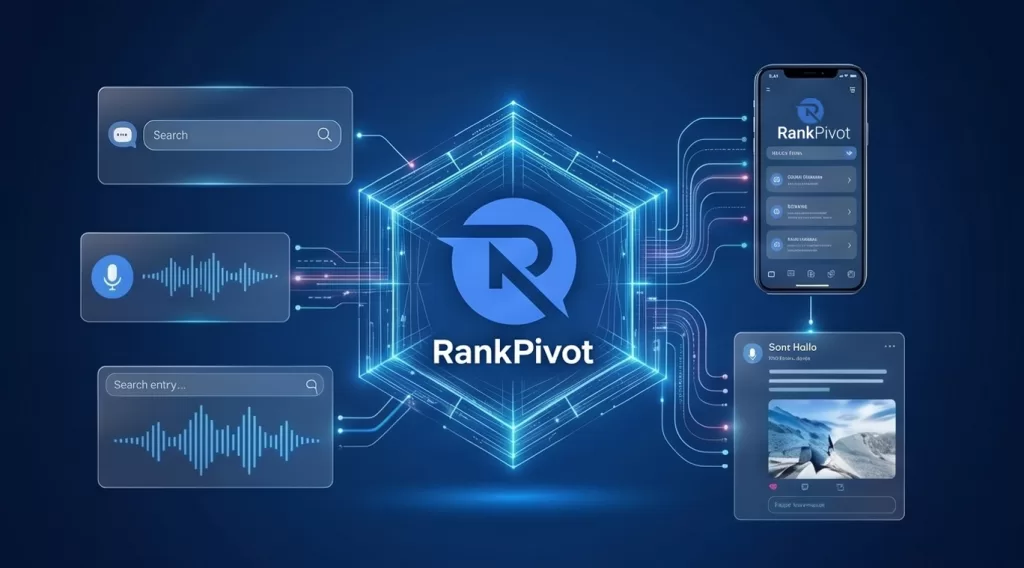
[Search Visibility Optimization by RankPivot]
Defining the New Lexicon of Search
To navigate this landscape, businesses must master the emerging paradigms that govern how information is discovered, processed, and delivered.
Search Everywhere
- What it means: “Search Everywhere” refers to the fragmentation of user intent across non-traditional platforms. Consumers no longer default exclusively to Google or Bing when looking for information. Instead, they search for products on Amazon or TikTok, seek local recommendations on Instagram, crowdsource troubleshooting on Reddit, and execute deep topical research within ChatGPT, Claude, or Perplexity. Search has shifted from a single web destination to an ambient, omni-platform utility embedded into social media, e-commerce, and productivity tools.
- The Impact:
- Web Users: Users get highly contextualized, native results exactly where they are spending their digital time, reducing friction and eliminating the need to cross-reference multiple web links.
- Businesses: Diversification is no longer optional. If your brand relies solely on a traditional website to capture organic search traffic, you are invisible to massive cohorts of users. Businesses must treat every digital outpost—from social video descriptions to community forums—as an indexable, searchable asset.
AEO (Answer Engine Optimization)
- What it means: AEO is the discipline of creating, structuring, and formatting content so that conversational engines (like Siri, Alexa, Google Assistant, and AI chatbots) can instantly extract it to provide a direct, single-source response to a user’s question. AEO prioritizes the “answer-first” structure, tailoring content to conversational, natural-language queries.
- The Impact:
- Web Users: Users experience a “zero-click” reality. Instead of reading through an entire 2,000-word article, they receive a conversational, 50-word synthesis that solves their problem immediately.
- Businesses: Traditional informational blog posts designed to farm ad views or superficial traffic are losing efficacy. To survive AEO, businesses must structure data cleanly (using clear headers and concise Q&A blocks) to win the single, coveted spot as the cited answer source, while pivoting their own site’s value proposition toward deeper interactive tools or premium experiences.
GEO (Generative Engine Optimization)
- What it means: GEO is the strategic process of optimizing content to be selected, synthesized, and favored by Generative AI search engines (like Perplexity, OpenAI’s search functionalities, and Gemini). Unlike traditional SEO, which aligns keywords to ranking algorithms, GEO focuses on how AI reasoning systems process semantic language, map entities, evaluate context, and choose which sources to trust and cite within an LLM-generated response.
- The Impact:
- Web Users: Users receive hyper-customized, synthesized overviews that draw upon multiple perspectives, complete with real-time citations and comparative data tables tailored explicitly to their complex constraints.
- Businesses: AI engines do not trust your self-reported marketing copy; they trust third-party consensus. GEO requires brands to focus heavily on digital PR, peer reviews (e.g., G2, TrustRadius), community sentiment (e.g., Reddit), and publishing verifiable, data-driven original research that AI systems must cite as factual authority.
AIO (Artificial Intelligence Optimization)
- What it means: Often used broadly to encompass both the optimization for AI search and the utilization of AI within marketing, AIO centers on managing how machine learning models interpret and reuse brand information. From a technical perspective, it involves structuring data through advanced schema markups, ensuring proper crawlability for AI bots, maintaining absolute data consistency across the web, and utilizing AI-driven tools to analyze real-time fluctuations in brand visibility across LLM ecosystems.
- The Impact:
- Web Users: Benefit from dynamic, incredibly accurate search environments that learn from global real-time data shifts, resulting in safer and more reliable product and service recommendations.
- Businesses: Shifting from human-centric navigation to machine-readability. AIO demands that businesses manage their “digital footprint” with extreme technical rigor, treating data accuracy and entity clarity as fundamental pillars of brand defense.
SEO (Search Engine Optimization)
- What it means: The foundational practice of optimizing site speed, technical architecture, link equity, and keyword relevance to rank organically on standard Search Engine Results Pages (SERPs).
- The Impact:
- Web Users: Traditional SERPs now serve as a hybrid landscape—blending conventional web links with AI summaries and rich transactional media.
- Businesses: Traditional SEO is not dead; it is the infrastructure upon which AEO and GEO are built. AI engines utilize crawlable search indices to find their answers. Clean code, fast loading speeds, a logical internal linking structure, and robust topical authority remain the non-negotiable entry requirements to be considered by any search system, traditional or generative.
UX/UI (User Experience / User Interface)
- What it means: UX/UI encompasses the design, responsiveness, accessibility, and intuitive flow of a digital asset. In the modern search era, UX/UI extends far beyond an attractive layout; it defines how seamlessly a human or an AI agent can interact with and extract value from your platform.
- The Impact:
- Web Users: When a user actually chooses to click a link and leave an AI interface, they expect an immediate, friction-free continuation of their journey. High-quality UX/UI ensures they aren’t met with pop-up friction, confusing navigation, or slow loading times.
- Businesses: Engagement metrics (time on site, scroll depth, low bounce rates, task completion) are primary algorithmic signals of quality. Furthermore, clear visual hierarchy and clean UI allow AI web-crawlers to parse structural meaning effortlessly. If a site has poor UX/UI, users abandon it instantly, signals plummet, and AI engines will deprecate it as a reliable destination.
{Search Everywhere Optimization by RankPivot]
Structural Breakdown: Traditional Search vs. Next-Gen Search Everywhere
| Optimization Dynamic | Traditional SEO (The Blue Link Era) | Modern Search (AEO, GEO, AIO, Everywhere) |
| Primary Goal | Rank #1–#3 on a linear SERP. | Be the chosen synthesis or citation across multi-modal interfaces. |
| Query Style | Fragmented keywords (“best CRM software”). | Conversational, long-tail queries (“Which HIPAA-compliant CRM is best for a 20-person medical team on a budget?”). |
| User Destination | Clicks through to a specific website page. | Often remains within the AI interface (Zero-Click) or follows a hyper-targeted citation link. |
| Algorithmic Focus | Keyword density, backlink volume, anchors. | Semantic context, entity relationships, third-party sentiment, structured clarity. |
| Content Strategy | High-volume, programmatic content. | Answer-first formatting, authoritative original research, high E-E-A-T. |
What the Evolution of Search Means for Businesses: Now and Into the Future
The transformation of search forces a total redistribution of web traffic and changes how digital value is generated.
The Demise of the “Top-of-Funnel” Click
For years, websites generated traffic by answering simple, informational questions (“What is digital marketing?” or “How to change a tire”). \Today, AI summaries and answer engines resolve these queries entirely within the search screen.
The Strategy: Businesses must abandon shallow keyword stuffing. Content systems must pivot to answering deep, high-intent, bottom-of-funnel queries that involve nuanced comparisons, custom edge cases, and actionable, expert-level human perspectives.
From Keywords to “Entities”
AI models see the world through a web of interconnected concepts, known as entities. They analyze how your brand (Entity A) relates to your product category (Entity B), your executive team (Entity C), and public sentiment (Entity D).
The Strategy: To build a bulletproof brand, you must establish unambiguous entity relationships. This requires using advanced schema markups (JSON-LD), maintaining identical business information (Name, Address, Phone) across all local directories, and fostering a clear digital footprint across public databases like Wikidata.
The Rise of E-E-A-T and Digital Trust
Because generative search engines take responsibility for the answers they synthesize, they are highly sensitive to misinformation. Google’s framework of E-E-A-T (Experience, Expertise, Authoritativeness, Trustworthiness) has shifted from a best practice to a survival mechanism.
The Strategy: Anonymously written, AI-generated filler content will be entirely ignored by search engines. Content must be authored by verified subject matter experts with real-world credentials, supported by original first-party data, case studies, and transparent, peer-reviewed citations.

[Don’t Get Left Behind by Your Competitors in AI Visibility]
The Actionable Blueprint for Digital Visibility
To ensure your business thrives now and well into the future, your digital marketing team should implement this four-part architectural framework:
Step 1: Implement an “Answer-First” Content Hierarchy
When drafting web pages or documentation, structure your layouts to serve both the human reader and the AI extraction bot cleanly:
- The Header (H2/H3): Formulate it as a direct, natural-language question.
- The Answer Block: Immediately below the header, provide a highly precise, standalone answer of 40 to 80 words. Avoid fluff. Use specific data metrics instead of vague qualifiers (e.g., use “reduces operational costs by 35%” instead of “saves money”).
- The Deep Dive: Follow the summary block with deep, comprehensive context, workflows, data tables, and expert analysis for users who choose to read further.
Step 2: Build Authority Outside Your Website
Because GEO relies heavily on cross-referencing information across the broader web, your off-site footprint is just as critical as your on-site optimization:
- Focus heavily on earned media and digital PR in authoritative industry publications.
- Actively engage in relevant communities like Reddit, Quora, and niche industry forums where AI engines regularly harvest real-world human perspectives.
- Systematically gather and manage third-party reviews on trusted aggregator sites.
Step 3: Optimize for Multi-Modal & Universal Search Platforms
Recognize that the modern consumer utilizes vertical and behavioral search engines:
- Social Search: Optimize video titles, descriptions, and automatic captions on TikTok, YouTube, and Instagram with natural semantic tags to capture the Gen Z and Millennial demographic who utilize social feeds as visual search engines.
- Local Search: Build dedicated, structured, hyper-local landing pages for every physical branch or service area. Ensure Local Business schema markup is thoroughly configured to secure a spot in voice-activated and map-based AI queries.
Step 4: Revamp UX/UI for Conversion and Retentiveness
With top-of-funnel traffic naturally decreasing due to zero-click answers, the traffic that does reach your website is highly intentional and qualified. Your UX/UI must be flawless to maximize this traffic:
- Speed and Stability: Eliminate heavy scripts and optimize core web vitals. A page must render instantly.
- Immediate Value Continuity: Ensure the exact answer or intent that brought the user to your site is prominently visible above the fold, matching the context of the AI citation they clicked.
- Frictionless Conversion: Deploy clear, intuitive, and contextual calls-to-action (CTAs) that allow high-intent users to seamlessly transition from reading an answer to scheduling a demo, downloading an asset, or executing a transaction.
Conclusion: Empathy, Adaptability, and the Future
The evolution of search is not a technical apocalypse for websites; it is a leveling up of the digital ecosystem. It demands that businesses stop treating web search like an algorithmic puzzle to be gamed, and start treating it as a relationship rooted in value, clarity, and trust.
By designing seamless user interfaces, structuring data systematically for AI models, and creating citable, authoritative content that answers the world’s real questions, your business will not just survive the new search revolution—it will lead it.
How is your business adjusting to the drop in top-of-funnel informational traffic caused by AI overviews? Get your FREE Search Visibility Analysis by our team of experts here.

David L. King II
Founder, Lead Stradegist
David King is a multi-disciplinary technology and marketing executive with over 30 years of experience driving digital growth for Fortune 500 companies, high-growth startups, and global brands. An early pioneer of search engine optimization, he currently serves as the Founder and Lead Strategist at RankPivot.ai, specializing in enterprise-grade digital marketing, branding, and AI-integrated search strategy.