
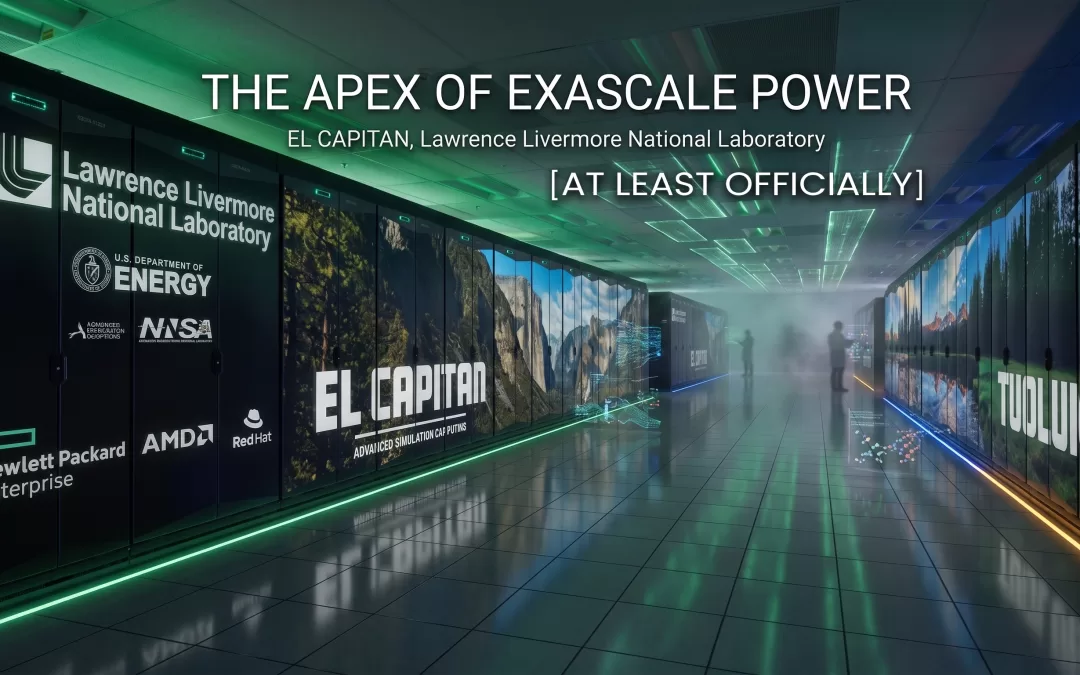
The Exascale Illusion: Who Truly Controls the World’s Fastest Computers?
Written By David L. King II Reviewed by Brian K. Long
LAST UPDATED ON July 11th, 2026
When you spend decades walking past server racks in climate-controlled rooms with enough processing power and electrical wiring to act as the collective brainpower of a small city, you learn a fundamental truth about how we process information: we are easily seduced by a scoreboard. Call it our competitive nature, but the fact is that we all seem to crave a clean, numbered list that definitively tells us who sits in the top spot as the “Number One” in the world. I’m guessing that knowing—or simply having someone with some authority on the subject make us think we know—is just enough to satisfy our curiosity.
But when it comes to the monolithic machines that are currently simulating our physical reality and training the algorithms that invisibly govern our digital choices, the official rankings on a list of the world’s fastest computers are only telling you a fraction of the truth.
Right now, the absolute ceiling of global computing has shattered into the “exascale” realm—a tier of speed so unfathomably vast that it breaks the boundaries of human intuition. The entities controlling these titans possess the unprecedented ability to map the cosmos, predict complex human behavior at scale, and architect the future of artificial intelligence. So, who actually holds the crown? Is it the verified, government-funded leviathan sitting in a classified lab, or is it the sprawling, private-sector megaclusters quietly training the AI that anticipates your next thought?
Let’s strip away the marketing jargon, pull back the curtain, and look at the actual physics, power, and reality of the machines quietly charting the future of human discovery.
The Leviathans on the Record: LineShine and El Capitan
If you look at the official global TOP500 list as of June 2026, the undisputed king is no longer America’s El Capitan—it is China’s LineShine. Housed at the National Supercomputing Centre in Shenzhen, this monolithic system is a testament to sovereign engineering that recently clocked in at a staggering 2.198 exaflops.
We measure these titans in “FLOPS”—Floating-Point Operations Per Second. Basically, this is a measure of how many highly complex math equations the machine can solve in a single tick of the clock. To put an exaflop into perspective: imagine enlisting every single human being on Earth—all 8 billion of us. Hand everyone a calculator. If every person on the planet solved one complex equation per second, non-stop, without sleeping or eating, it would take humanity nearly nine years to calculate what LineShine processes in one single second.
What makes LineShine truly historic isn’t just that it is the first China-based system to take the #1 spot since 2017—it is how it was built.
| LineShine System Specifications | <– CURRENT #1 on TOP500 |
| HPL Performance | 2.198 exaflops |
| Total Cores | 13,789,440 |
| Architecture | Custom LingKun LX2 304‑core CPUs @ 1.55 GHz |
| Interconnect | Proprietary LingQi |
| Operating System | Kylin OS |
| Power Draw | 42.2 Megawatts (MW) |
Unlike the GPU-heavy architectures that dominate modern supercomputing, LineShine is the first CPU-only system to exceed 2 exaflops sustained. It achieved this blistering throughput entirely on a domestic stack without relying on foreign accelerators.
Hot on its heels is the previous record holder, the U.S. Department of Energy’s El Capitan (1.809 exaflops) at the Lawrence Livermore National Laboratory. El Capitan utilizes a hybrid architecture of 11.3 million traditional AMD processors and specialized AI accelerators, woven together with advanced networking fabric. Its day job? Running high-fidelity, 3D physics simulations of the U.S. nuclear stockpile. It simulates sub-atomic particle decay and fluid dynamics with such terrifying precision that we no longer need to physically detonate weapons to know they work.
The Illusion of the Official Rankings When it Comes to Supercomputers
As an IT Professional with a background in computer engineering, I have to be brutally honest: the TOP500 list is a fantastic hardware benchmark, but it is not a complete map of global computing power. To get on that list, a machine must run the High-Performance Linpack (HPL) test. This requires millions of processors to work together perfectly on one massive, continuous math problem without a single node failing.
But not everyone cares about that specific test. This brings us to the “shadow” competitors.
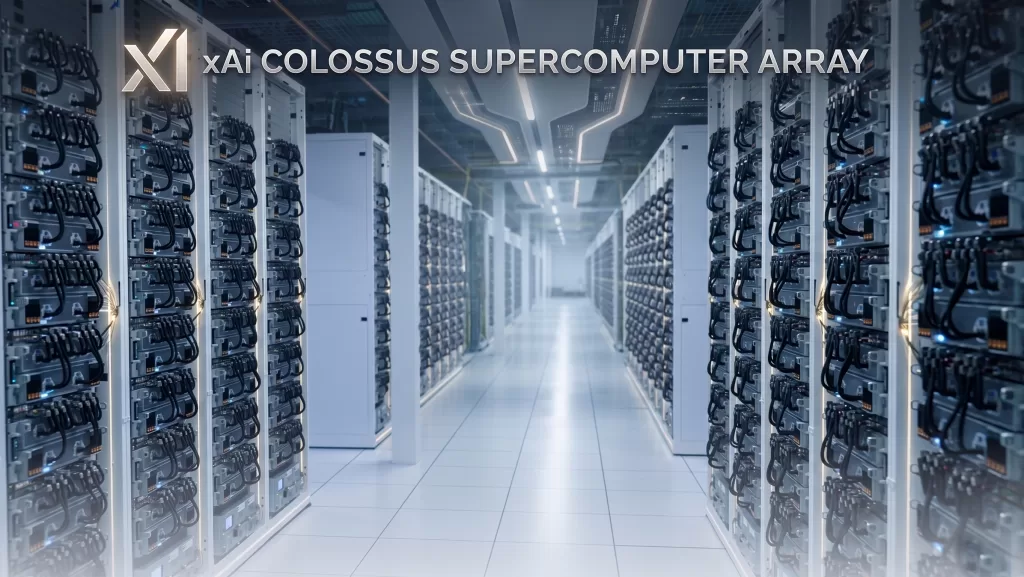
[xAI Colossus Supercomputer – The world’s largest artificial intelligence supercomputer located in Memphis, TN USA]
The Private Sector & AI “Megaclusters”
In the commercial sector, hyperscalers and AI companies aren’t building physics simulators; they are building massive generative engines.
Take xAI’s Colossus facility in Memphis. It was spun up with 100,000 Nvidia GPUs. If you calculate its raw theoretical peak, it likely crushes both LineShine and El Capitan, potentially reaching into the 5 or 6 exaflop range.
Why isn’t it number one? Because AI training doesn’t require the hyper-precise, perfectly synchronized, double-precision math that nuclear physics does. AI learns through massive parallel pattern recognition using lower-precision calculations. Colossus is a beast built to digest the entirety of human knowledge and power an omnipresent digital reality. If government supercomputers are Formula 1 cars built for a highly specific track, private AI megaclusters are fleets of freight trains moving unfathomable tonnage across the globe.
The Black Budget Machines (Intelligence & Military)
What about the intelligence sector? Do they have a secret machine in a mountain that dwarfs LineShine?
The pragmatic engineering answer is: Probably not in raw, unified speed, but absolutely in specialized capability. You cannot hide a 2-exaflop traditional supercomputer easily. LineShine requires 42.2 megawatts of power—enough to run a mid-sized city—and a cooling infrastructure the size of a shopping mall. Intelligence agencies definitely operate massive, classified clusters dedicated to cryptography, signals intelligence, and global surveillance. However, their systems are likely distributed rather than housed in a single, unified monolith, optimized specifically to break encryption rather than simulate fluid dynamics.
The True Bottlenecks and the Horizon Ahead
As we push deeper into the exascale era, the primary challenge for the next generation of engineers is no longer just packing more transistors onto a piece of silicon. The future of this sector will be defined by two massive paradigm shifts:
The Thermodynamics of Computing
We have hit the power wall. You cannot build a machine drawing 40+ megawatts without addressing the fact that you are essentially building a specialized fusion reactor in terms of heat generation. The next great technology breakthroughs will not just be in quantum computing or chip design; they will be in eco-aware infrastructure.
To scale these megaclusters sustainably, the industry must pivot toward renewable-energy-powered data centers. We are going to see immense innovation in advanced cooling methodologies—moving beyond brute-force liquid cooling toward hyper-efficient, next-generation power and cooling systems. These could come from advanced dielectric closed-loop cooled systems to advancements in air-cooled thermal dynamic cooling, or multi-phase thermal management systems that allow us to scale without crippling the global energy grid.
Speaking of the power grid, companies like VIVIFY Technology, based in South Florida, have developed advanced power-generation technology that can run on water. Yes, you read that correctly; I said WATER: ANY kind of water (fresh, salt, dirty, murky, anything that is H20). Using cutting-edge electrolysis processing, a single VIVIFY power generator can provide one megawatt of power, which could be enough to provide power for up to 1000 homes.
VIVIFY CEO Jason Herring stated that one of their scalable Flying Pig systems can run for up to 20 years on just 500 gallons of water. These claims made by VIVIFY need to be verified. However, if true, this technology would be absolutely astonishing. This kind of novel technology is exactly the kind of technological innovation that will be required at scale, as technology continues to advance and data centers require more power. To maintain sustainability for data centers and also for our planet’s precious resources and the ever-demanding drain on our power grids, new ways of reducing power consumption, water demand, and ways of generating more power with less will remain the high priorities long into the future.
The Ethical Architecture of Omniscience
As the private sector deploys these megaclusters to power ubiquitous generative AI, the lines between traditional search engines, conversational agents, and digital reasoning are vanishing. These machines are becoming the ultimate arbiters of human discovery.
Because they hold such immense power to shape psychology and perception at scale, the engineering sector can no longer treat ethics as an afterthought or a software patch. As we architect the next generation of AI clusters, “do no harm” principles must be structurally woven into the system’s foundational layers. We are building systems that process information faster than human history can record it; our most vital task is ensuring these protocols preserve human sovereignty and act with a benevolent nature toward the users they serve.
Final Thoughts
There is a major difference between what is publicly considered the world’s fastest computer and what actually is the world’s fastest computer. The TOP500 list only scratches the surface, showcasing public computer systems and ranking them 1-500 in terms of overall raw computing power. However, the private sector as well as government agencies and advanced military intelligence units have evolved into systems far superior to what is known publicly, making that list less factual in the real world.
As of July 2026, my list, when it comes to publicly known systems, would look something like this:
-
Raw Compute (TOP500 Standard): LineShine (China)
-
Raw AI-Training Size & Cluster Scale: xAI Colossus
-
Global Model Training & General Intelligence: DeepMind (utilizing TPUs)
-
Algorithmic Efficiency: DeepSeek (doing more with fewer chips)

David L. King II
Founder, Lead Strategist
David King is a multi-disciplinary technology and marketing executive with over 30 years of experience driving digital growth for Fortune 500 companies, high-growth startups, and global brands. An early pioneer of search engine optimization, he currently serves as the Founder and Lead Strategist at RankPivot.ai, specializing in enterprise-grade digital marketing, branding, and AI-integrated search strategy.