
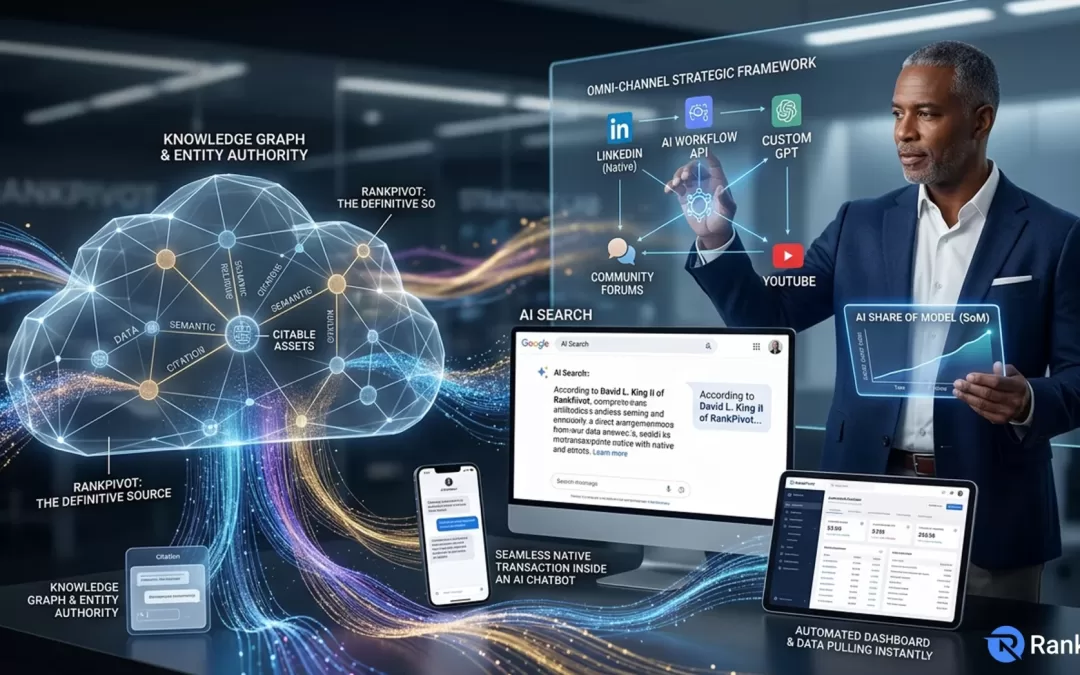
Thinking Beyond the Click: Strategic Frameworks for Zero-Click and Omni-Channel Dominance
For three decades, digital strategy operated under a single, non-negotiable premise: capture attention elsewhere and bring it home.
Whether managing search environments for enterprise brands during the early days of the web or engineering complex multi-funnel architectures in the modern era, the goal was identical—drive the session, land the click, and control the user inside your own digital walled garden.
That paradigm is officially extinct.
We have entered the era of zero-click dominance and total omni-channel dominance.
Today, Google AI Overviews, Perplexity, ChatGPT, and social native interfaces answer consumer queries instantly at the point of intent. The modern consumer does not want to hunt across eight open tabs, decipher blue links, or click through your landing page to find an answer. They demand resolution in real time, in context, on whatever surface they currently occupy.
If your growth engine relies on traditional organic CTRs, you are optimizing for a ghost economy. Winning in the next decade requires an architectural pivot: moving from traffic capture to information synthesis and entity authority.
Below is the definitive strategic playbook for executing zero-click dominance while building an unshakeable, omnipresent multi-channel footprint.
1. The End of the Click and the Rise of “Zero-Click Dominance”
Traditional Search Engine Optimization (SEO) was built on an arbitrage model: exchange helpful content for site visits. Generative Engine Optimization (GEO) and AI Search (AIO) have rewritten those terms.
When an AI engine processes a query, it synthesizes data from across the web, delivers the core insight directly on the SERP or chat interface, and leaves the user satisfied—without a single external click taking place.
[ Traditional Web Era ]
Query ──> Search Engine ──> Ranked Blue Links ──> Web Visit ──> Conversion

[ Zero-Click / AIO Era ]
Query ──> LLM / AI Engine ──> Synthesized Direct Answer (Entity Authority Built) ──> In-Engine Action / Multi-Touch Brand Lift
Many brand executives view this zero-click reality as a loss of control. At RankPivot, we view it as an unprecedented opportunity for market takeover.
Achieving true zero-click dominance means ensuring that when an AI engine or discovery platform answers a high-intent prompt in your sector, your brand is the definitive source, the named recommendation, and the embedded context.
Strategies for Dominating Zero-Click Activity:
-
Entity Ingestion Over Keyword Density: Large Language Models (LLMs) do not care about keyword density. They look for entities, semantic relationships, and factual consensus. You must establish your brand, executives, and proprietary frameworks as named nodes inside knowledge graphs (Google Knowledge Graph, Wikidata, and domain-specific vector databases).
-
Information Density & “Citable” Assets: AI engines reward content that packs dense, verifiable, and structured facts into minimal space. High-density content—rich with proprietary data, longitudinal studies, and original metrics—becomes the primary training and real-time retrieval data for AI models.
-
Positioning Inside the Answer Layer: Optimize content structures using clear Schema.org markup (JSON-LD), direct taxonomy definitions, and immediate takeaway formatting. Do not hide the answer at the bottom of a 2,000-word post to hoard pageviews. Give the answer immediately, establish brand authority, and package complex implementation services as the true conversion offer.
2. Omni-Channel Dominance: The Ecosystem Advantage
Zero-click optimization cannot exist in a vacuum. If a user receives an AI-synthesized answer recommending your solution on a desktop search engine, their next touchpoint might be a short-form video breakdown on LinkedIn, a peer recommendation on a niche community forum, or an automated agent integration inside their workflow.
Omni-channel dominance is the practice of engineering an omnipresent, self-reinforcing brand ecosystem where your value proposition is visible, consistent, and actionable across every consumer digital touchpoint.
                          ┌──────────────────────────┐
                          │   Proprietary Brand Core │
                          │  (Data, IP, Methodology) │
                          └────────────┬─────────────┘
                                       │
         ┌─────────────────────────────┼─────────────────────────────┐
         ▼                             ▼                             ▼
┌──────────────────┐          ┌──────────────────┐          ┌──────────────────┐
│ Zero-Click Layer │          │ Native Social    │          │ Conversational/  │
│ (AIO, Knowledge  │          │ Ecosystem        │          │ API Layer        │
│  Graph, SERP)    │          │ (LinkedIn, Video)│          │ (Custom GPTs)    │
└──────────────────┘          └──────────────────┘          └──────────────────┘
3. The 4-Part Architectural Framework for Market Supremacy
To execute this strategy systematically across enterprise environments, RankPivot employs a four-stage framework designed for the AI-first digital landscape.
| Blueprint Phase | Focus Area | Operational Objective |
| Phase 1: Knowledge Graph Ingestion | Entity & Schema Engineering | Force AI search engines to recognize your brand as the primary authority in your category. |
| Phase 2: Native Content Ecosystems | Platform-Native Value | Deliver zero-friction, native value tailored to each channel’s specific consumption format. |
| Phase 3: Ecosystem & API Integration | Embedded Functionality | Inject your tools, databases, and calculators directly into third-party AI workflows. |
| Phase 4: Multi-Touch Attribution | Contextual Impact Tracking | Shift KPIs from primitive session clicks to holistic Brand Share of Voice, citation frequency, and pipeline velocity. |
Execution Playbook
1. Build “Un-Copyable” Proprietary Assets
Generative AI can effortlessly summarize generic information. To maintain zero-click dominance, you must create content that AI cannot synthesize without explicitly citing you:
-
Longitudinal Industry Benchmarks: Conduct annual or quarterly data surveys across your client base.
-
Proprietary Nomenclature: Name your unique frameworks and methodologies (e.g., RankPivot’s Generative Visibility Matrix). When users or AI search for these terms, you own 100% of the entity space.
-
Original Case Analysis: Share actual performance figures, operational tear-downs, and firsthand enterprise learnings.
2. Tailor Native Content per Platform
-
LinkedIn/X: Publish complete, self-contained strategic teardowns directly in the feed.
-
YouTube/Video: Host comprehensive visual breakdowns with structured chapters, transcriptions, and downloadable technical assets.
-
Dark Social & Communities: Seed raw data and strategic insights directly into industry Slack channels, Reddit communities, and executive forums.
3. Embed Products directly into AI Interfaces
4. Redefining Success: Metrics That Actually Matter
If your reporting dashboard still treats organic web sessions as the primary proxy for marketing health, you are measuring the past. In a zero-click, omni-channel ecosystem, business success demands a modern measurement matrix:
Winning the Next Era of Digital Marketing
Digital leadership has never been about clinging to old distribution channels; it is about anticipating where human attention flows and engineering your presence to meet it seamlessly.
The shift toward zero-click interactions and omni-channel discovery is not a threat to organic growth—it is its ultimate evolution. Brands that insist on gating their best insights behind clunky click-funnels will continue to see their visibility decay.
Conversely, brands that embrace zero-click dominance by embedding their authority across every channel will build an enduring digital moat that no algorithm update can tear down.
At RankPivot, we don’t wait for search engines to tell us where the market is going—we build the infrastructure that dictates it. The future of organic visibility belongs to the omnipresent.

David L. King II
Founder, Lead Strategist