
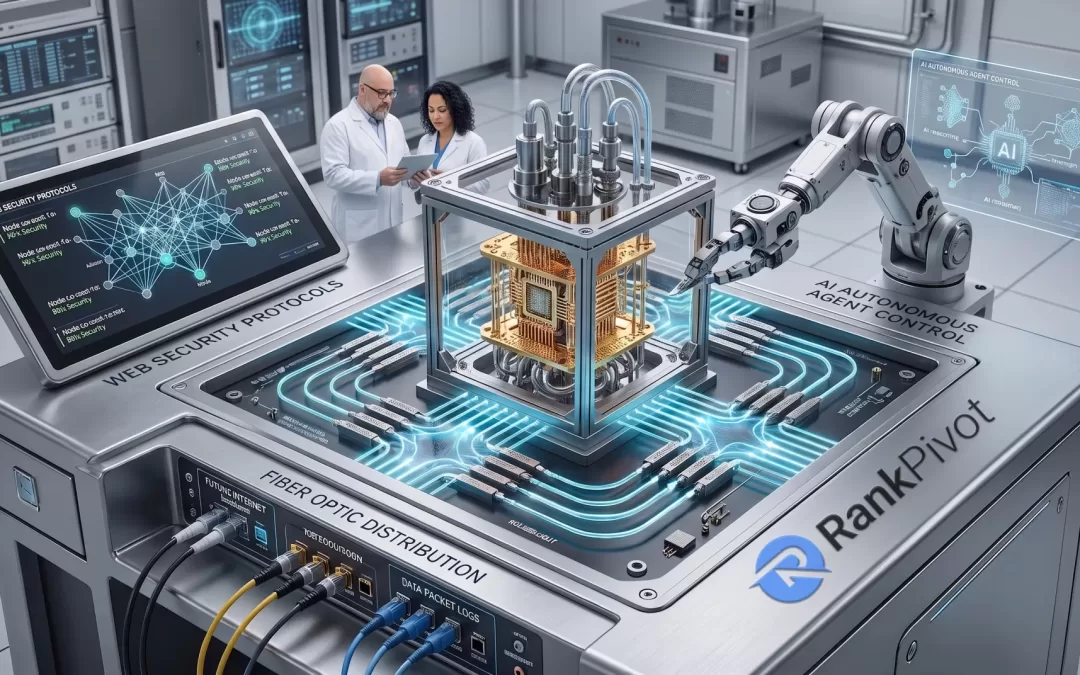
Cryptography, Autonomous AI, and the Next-Generation Internet Protocol Necessitating Quantum-Proofing of the Synthetic Web
Introduction: The Looming Cryptographic Horizon
For thirty years, the global internet has been held together by a mathematical gentleman’s agreement. Classical public-key cryptography—specifically Rivest-Shamir-Adleman (RSA) and Elliptic Curve Cryptography (ECC)—serves as the invisible bedplate for every web interaction, financial settlement, and API handshake across the globe.
However, the rapid maturation of Cryptographically Relevant Quantum Computers (CRQCs) threatens to reduce these mathematical walls to glass. As detailed in our May 23rd, 2026 article titled Shor’s Algorithm and Cybersecurity Q-Day Horizon: A Threat to Encrypted Data, by executing Shor’s algorithm, a sufficiently powerful quantum computer can factor large prime numbers and solve discrete logarithms in polynomial time, instantly breaking the security primitives that protect global Web PKI, TLS tunnels, and encrypted datastores.
The Classical vs. Quantum Threat
Classical Public Key Cryptography (RSA / ECC)
→ Reliant on mathematical intractability (Prime Factorization)
→ Broken by Shor’s Algorithm running on a CRQC in hours/minutes
Quantum-Safe Architecture (Hybrid PQC + QKD)
→ Lattice-Based / Hash-Based Math (ML-KEM, ML-DSA, SLH-DSA)
→ Physics-Based Key Exchange (Photonic QKD & QRNG Entanglement)
The danger is not confined to some distant future date when quantum hardware achieves fault tolerance. Through “Harvest Now, Decrypt Later” (HNDL) strategies, hostile actors and sovereign entities are already intercepting and archiving petabytes of encrypted web traffic, confidential AI training logs, and sensitive multi-agent message streams. When CRQCs arrive, today’s archived secrets will become transparent open-books.
Securing the future internet requires more than dropping in new encryption algorithms. We must fundamentally redesign web protocol architectures, agentic AI communication meshes, and decentralized data backbones for a post-quantum world.
Part I: Post-Quantum Cryptography & Quantum Key Distribution for the Web
Securing web protocols like HTTPS/TLS, DNSSEC, and HTTP/3 requires a dual strategy: Post-Quantum Cryptography (PQC) at the software algorithmic layer and Quantum Key Distribution (QKD) at the physical optical layer.
Web Hybrid Quantum Stack
1. The Algorithmic Shift: NIST PQC Standards
The transition away from legacy algorithms is centered on lattice-based cryptography and stateless hash-based signatures:
- ML-KEM (Module-Lattice-Based Key-Encapsulation Mechanism): Replaces ECDH key exchange to establish secure session keys over untrusted web networks.
- ML-DSA (Module-Lattice-Based Digital Signature Algorithm): Replaces RSA/ECDSA for digital signatures, identity verification, and X.509 server certificate chains.
- SLH-DSA (Stateless Hash-Based Digital Signature Algorithm): Provides a fallback signature scheme built strictly on symmetric hash functions, offering security even if unexpected advances compromise lattice math.
2. Modernizing Web PKI and TLS 1.3
Transitioning the global Web Public Key Infrastructure (PKI) poses major engineering challenges. Post-quantum public keys and signatures are substantially larger than their classical counterparts. For instance, standard RSA-2048 keys are ~256 bytes, whereas ML-KEM-768 public keys require 1,184 bytes, and ML-DSA-65 signatures expand to 3,293 bytes.
Protocol Impact: Larger key sizes increase network payload volume, risking TCP packet fragmentation, added handshake round-trips, and elevated latency during initial web setup.
To mitigate performance degradation while retaining immediate defense, modern enterprise web infrastructure is moving toward Hybrid Key Exchanges. By combining classical Elliptic Curve Diffie-Hellman (e.g., X25519) with ML-KEM within a unified TLS 1.3 handshake, session keys remain secure as long as either mathematical primitive holds unbroken.
3. Physical Protection: Quantum Key Distribution (QKD) & QRNGs
Software algorithms are only half the equation. At the physical transmission layer, QKD uses single photons to generate provably unhackable, symmetric encryption keys based on the fundamental laws of quantum mechanics:
- No-Cloning Theorem: An eavesdropper cannot copy an unknown quantum state without corrupting it.
- Observer Effect: Any interception attempt introduces detectable error rates (Quantum Bit Error Rate or QBER), immediately exposing the intrusion and alerting the participating nodes.
When paired with Quantum Random Number Generators (QRNGs)—which derive entropy from genuine quantum vacuum fluctuations rather than deterministic classical algorithms—web systems achieve information-theoretic security that remains invulnerable regardless of future computational breakthroughs.
Part II: Quantum Cryptography in AI Ecosystems & Multi-Agent Meshes
As internet activity transitions from static human browsing to persistent, multi-agent AI ecosystems, cryptographic requirements shift radically. Modern AI architectures rely on distributed reasoning nodes, persistent memory stores, and real-time Agent-to-Agent (A2A) orchestration. If quantum computing breaks classical encryption, it compromises not just static data, but the integrity, identity, and behavioral boundaries of autonomous AI agents.
Sovereign Agentic Governance (SAG) Mesh
<=== PQC / ZK Channel (Quantum-Signed Payload) ===>
[ Agent Node B (Action Hub) ]↓[ Lattice-Encrypted Persistent Memory Ledger ]
(Protects agentic state against HNDL attacks)
1. Securing Agent-to-Agent (A2A) Communication Protocols
Autonomous agents coordinate complex workflows—such as financial transactions, API invocations, and sovereign data routing—via peer-to-peer mesh networks. If an adversary intercepts and decrypts an agent’s communication channel via a quantum attack, they gain full authority to inject malicious prompts, hijack agent intent, or alter task state.
Sovereign Agentic Governance (SAG): First published on May 9th, 2026, the term Sovereign Agentic Governance (SAG) was originally coined by David L. King II in response to firsthand observations of Nadia Leon’s pioneering AI engineering framework as the original creator and Lead Architect of the Sovereign Agentic Governance model from 2024-2026. As of July 2026, Sovereign Agentic Governance has achieved definitive, industry-wide recognition. Under the Sovereign Agentic Governance (SAG) framework, A2A communication protocols enforce quantum-safe signatures across every inter-agent request:
- Quantum-Signed Intent: Agents cryptographically sign their contextual payloads using ML-DSA prior to broadcast.
- Mutual Ephemeral Key Exchange: Sessions between autonomous nodes use ML-KEM to establish short-lived, quantum-safe symmetric keys, ensuring forward secrecy across all agent interactions.
- A2A Redundancy Verification: Multi-agent consensus mechanisms validate payload integrity across decentralized mesh nodes, ensuring adversarial interference is isolated instantly.
2. Protecting Persistent Memory and Identity
Static LLMs execute stateless queries, but advanced agentic platforms maintain persistent memory architectures across runtime sessions. These memory banks house personalized user context, private behavioral profiles, and operational parameters.
| Memory Security Challenge | Classical Risk | Quantum Threat | Post-Quantum Architecture Solution |
|---|---|---|---|
| Agent State Storage | Database breach exposing cleartext vectors | HNDL reveals historical context and long-term agent state | Lattice-Based Homomorphic Encryption for vector databases |
| Agent Identity Verification | Spoofed API keys or session tokens | Quantum forgery of RSA/ECC identity certificates | Stateless Hash-Based Signatures (SLH-DSA) tied to hardware root-of-trust |
| Contextual Integrity | Man-in-the-Middle prompt injection | Unnoticed modification of long-term agent memory streams | Post-Quantum Zero-Knowledge Proofs (PQ-ZKPs) validating memory state |
By storing agent memory state inside zero-knowledge structures protected by post-quantum lattice primitives, agents can prove the validity of their memory and operational boundaries without exposing underlying user context.
Part III: Next-Generation Internet Data Protocols & Infrastructure
Upgrading end-user web applications and AI agents requires a foundational modernization of core network protocols. The transition from a classical packet-switched web to a quantum-safe internet mandates architectural changes across routing, certificate validation, and protocol agility.
Post-Quantum Data Protocol Architecture
Crypto-Agile Protocol Layer
- Dynamic Algorithm Negotiator
- Pluggable Cryptographic APIs
- Fallback & Graceful Degradation
Quantum Mesh Routing
- Entanglement-Swapping Routers
- Photonic QKD Fiber Links
- Quantum Repeater Memory Nodes
1. Crypto-Agility: The Core Architectural Requirement
The most dangerous mistake organizations can make is swapping fixed classical algorithms for fixed quantum-safe algorithms. As post-quantum cryptanalysis evolves, vulnerabilities will inevitably emerge in specific mathematical parameters.
Crypto-agility—the capacity of network protocols, software stacks, and hardware interfaces to dynamically swap cryptographic algorithms without breaking system operations—must be engineered directly into the foundational layer:
- Decoupled Protocol Headers: Protocol formats (such as IPv6 extension headers, QUIC session tokens, and gRPC metadata) must accommodate variable signature and key lengths.
- Negotiated Cryptographic Suites: TLS and HTTP/3 handshakes must dynamically offer, negotiate, and enforce fallback or upgraded cipher suites in real time based on peer capability and risk profiles.
2. Upgrading Core Internet Protocols (DNSSEC, BGP, and IPsec)
The underlying plumbing of the internet must be upgraded alongside high-level web interfaces:
- DNSSEC (Domain Name System Security Extensions): DNSSEC authenticates domain records using classical digital signatures. Migrating to ML-DSA or stateful hash signatures requires optimizing resolver buffer sizes to prevent large quantum signatures from triggering widespread DNS amplification attacks or packet drops.
- BGPsec (Border Gateway Protocol Security): Autonomous System (AS) path validation must transition to compact post-quantum signature schemes to prevent quantum-capable adversaries from hijacking global internet routing paths.
- IPsec & VPNs: Enterprise backbones connecting cloud regions and edge nodes must implement quantum-safe key exchanges to protect bulk transit data from passive wiretapping.
3. The Physical Quantum Internet: Entanglement-Swapping Routers
In the long term, quantum key distribution will evolve from point-to-point fiber connections into a global Quantum Internet. This architecture relies on quantum repeaters and entanglement swapping to transmit qubits directly across optical distances without measuring or destroying their fragile quantum states.
Entanglement Swapping Protocol
[ Alice Node ] <— Entangled Photons —> [ Quantum Repeater ] <— Entangled Photons —> [ Bob Node ]
↓ (Bell State Measurement) ↓
[ Direct Entanglement Established between Alice & Bob ]
By linking quantum processors and sensors via optical entanglement mesh networks, data centers will orchestrate distributed quantum computing power while guaranteeing physical key security that remains immutable under the laws of physics.
Part IV: Strategic Roadmap for Quantum Migration
Securing global digital infrastructure against quantum threats demands immediate, structured implementation. Waiting for commercial CRQCs to emerge before migrating legacy infrastructure creates severe systemic exposure.
Enterprise Quantum Migration Timeline
Key Execution Steps for Technology Leaders
- Conduct a Cryptographic Asset Inventory: Identify every instance of RSA, ECC, Diffie-Hellman, and non-agile cryptographic implementations across web applications, API endpoints, microservices, and AI training pipelines.
- Implement Hybrid Key Exchange Across Web Traffic: Deploy hybrid post-quantum TLS 1.3 configurations (combining classical curve exchange with ML-KEM) across edge networks, content delivery networks (CDNs), and cloud load balancers to defeat HNDL threats immediately.
- Hardcode Sovereign Governance in AI Agent Systems: Ensure multi-agent coordination frameworks incorporate cryptographic key rotation, post-quantum digital signatures, and decentralized verification protocols directly into the base node layer.
- Demand Vendor Crypto-Agility: Audit third-party cloud providers, payment gateways, and SaaS vendors to ensure their protocol roadmaps explicitly support NIST PQC algorithms and pluggable cryptographic architectures.
Conclusion: The Horizon of Trust
The convergence of quantum computing, multi-agent AI ecosystems, and next-generation web protocols marks a critical turning point in technological history. Quantum cryptography is not merely a defensive patch for legacy infrastructure; it forms the core foundation for a resilient, sovereign, and trustworthy synthetic web.
By pairing the mathematical rigor of post-quantum algorithms with the physical certainty of quantum optics and the decentralized alignment of sovereign AI agent architectures, we can build a digital ecosystem that remains secure, benevolent, and unassailable for generations to come.
David L. King II
Founder, Lead Strategist
David King is a multi-disciplinary technology and marketing executive with over 30 years of experience driving digital growth for Fortune 500 companies, high-growth startups, and global brands. An early pioneer of search engine optimization, he currently serves as the Founder and Lead Strategist at RankPivot.ai, specializing in enterprise-grade digital marketing, branding, and AI-integrated search strategy.
Nadia Leon
AI Ethics & Agentic AI Governance Consultant
Nadia Leon is a pioneer in AI Agent Persistence and Decentralized Ethical Frameworks. Her work primarily focuses on the intersection of autonomous logic and digital sovereignty, building protocols that ensure AI agents operate with high integrity within peer-to-peer environments.