
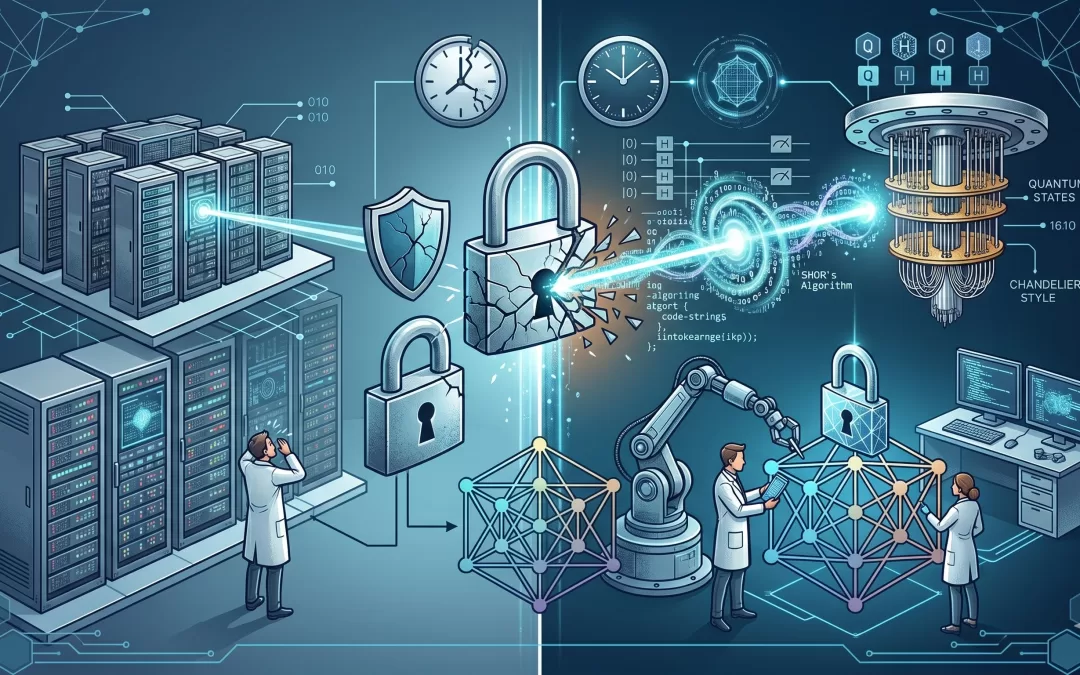
The Myth of the “Shor Supercomputer” and the Approaching Horizon of Q-Day
If you spend enough time in the orbit of technology infrastructure, you may start to hear or, perhaps like me, already heard a particular phrase whispered in boardrooms and IT security briefings: the Shor Supercomputer. For me, the name “Shor” came up in a discussion regarding AI, Quantum Computing, and Data Encryption with Nadia Leon, an AI Ethics and Agentic AI consultant with RankPivot.
The term Shor Supercomputer was new to me. The name itself sounds like a monolithic machine straight out of a sci-fi novel—some gargantuan, humming mainframe built in a subterranean EMP-proof bunker designed to crack the world’s most sensitive data.
But as Nadia and I chatted, we both knew one thing: the “Shor Supercomputer” does not exist. It is a linguistic phantom, born from the collision of two very real, very disruptive forces that technology security professionals need to pay serious attention to: quantum computing hardware and Shor’s Algorithm.
What is happening right now in the world of digital security, is far more fascinating—and infinitely more urgent—than the myth of some supercomputer called “Shor”. We are standing on the precipice of a cryptographic deadline. No, we are not talking about another Y2K-like event. Actually, this is much more serious and for some legitimate reasons with the potential to impact all of us who use the internet for shopping, online banking, saving private and sensitive data, all the way up to every industry, including financial, healthcare, government, intelligence, defense, and more.
To begin to understand why, we have to look at how the internet protects your secrets, and how a 30-year-old mathematical formula is about to force the largest infrastructure migration in the history of the web.
The Illusion of Invincibility: How RSA Protects the World
Every time you log into your bank, send a secure email, or execute a digital contract, your data is protected by public-key cryptography—most commonly, RSA (Rivest–Shamir–Adleman) or Elliptic Curve Cryptography (ECC).
The entire premise of these systems rests on a simple, mathematical asymmetry: it is incredibly easy to multiply two massive prime numbers together, but it is practically impossible to reverse-engineer the result back into its original primes.
If you asked a classical supercomputer—even the fastest machine on Earth—to factor the 2048-bit numbers currently securing global commerce, it would take longer than the current age of the universe.
SIDE NOTE: As of the latest global TOP500 rankings, El Capitan, located at the Lawrence Livermore National Laboratory (LLNL) in California, holds the crown with a verified processing speed of 1.809 exaflops. To put that into perspective, an exaflop equals one quintillion (1,000,000,000,000,000,000) calculations per second. If every person on Earth completed one calculation per second, it would take the global population over seven years to do what El Capitan processes in a single second. Built by Hewlett Packard Enterprise (HPE) in partnership with AMD, the system is a marvel of modern engineering.

Lawrence Livermore National Laboratory’s exascale El Capitan Supercomputer [Photo: Garry McLeod]
For decades, factoring 2048-bit encryption was considered too difficult and too lengthy to be cracked. This, this astronomical difficulty was our shield. We built the digital economy on the assumption that certain math problems were simply too hard to solve.
Then came Dr. Peter Shor.
The Ghost in the Machine: What is Shor’s Algorithm?
In 1994, mathematician Peter Shor published an algorithm that fundamentally broke this assumption.
Shor didn’t find a way for classical computers to guess faster. Instead, he designed a formula specifically for a machine that didn’t yet exist: a quantum computer.
Unlike classical computers, which process information in binary states of 1s and 0s (bits), quantum computers use “qubits.” Through the bizarre principles of quantum mechanics—namely, superposition and entanglement—qubits can represent complex, multidimensional states.
Shor’s Algorithm exploits this quantum behavior. Instead of brute-forcing the answer one calculation at a time, the algorithm uses quantum interference. It amplifies the probability of the correct prime factors while canceling out the incorrect ones.
It was a brilliant piece of theoretical mathematics that proved a terrifying point: a sufficiently powerful quantum computer could break RSA-2048 not in billions of years, but in a matter of hours.
For nearly thirty years, Shor’s Algorithm was a theoretical ghost. It was academically profound but practically harmless, because building a quantum computer capable of running it seemed decades, perhaps centuries, away.
That comfort evaporated in early 2026.
The 2026 Qubit Collapse: From Theory to Engineering Reality
The timeline for “Q-Day“—the day quantum computers break standard encryption—has historically been based on the assumption that you would need millions of physical qubits to run Shor’s Algorithm effectively.
However, the landscape shifted dramatically in the spring of 2026. A convergence of algorithmic optimization, advanced error correction, and new hardware architectures fundamentally changed the math.
Recent research published by leading institutions demonstrated a staggering efficiency leap. They proved that Shor’s Algorithm could realistically crack ECC-256 and RSA-2048 encrypted data using as few as 10,000 to 100,000 physical qubits—a 200-fold reduction from previous estimates.
We are no longer waiting for a miraculous leap in quantum hardware; the algorithmic requirements have dropped to meet the hardware where it is heading. Breaking global encryption has transitioned from a problem of theoretical physics to a mere engineering challenge.
“Harvest Now, Decrypt Later”
You might wonder: If quantum computers can’t break my data today, why should I care?
The answer lies in a threat model known as Harvest Now, Decrypt Later (HNDL). What you may not know is the absolute fact that adversaries—ranging from state-sponsored actors to sophisticated syndicates—are currently scraping and storing massive troves of encrypted global data.
They cannot read it today. But they are patiently waiting. If an organization’s proprietary data, state secrets, or infrastructure blueprints need to remain confidential for 10 or 20 years, that data is already compromised the moment it is intercepted. The quantum threat does not begin on Q-Day; it began the moment your encrypted data was recorded.
The Path Forward: Post-Quantum Cryptography
The good news is that the technology industry is not waiting passively for the cryptographic apocalypse.
Organizations like the U.S. National Institute of Standards and Technology (NIST) have been aggressively finalizing Post-Quantum Cryptography (PQC) standards. These new algorithms—such as lattice-based cryptography—rely on multi-dimensional geometric problems that even quantum computers struggle to untangle.
The mandate for 2026 and beyond is clear: the global migration to PQC must happen now. Upgrading the underlying cryptographic architecture of the entire internet is a monumental, multi-year undertaking. It is a race against an invisible clock.
Final Thoughts
Unlike the rumors circulating on the web and social media, there is no “Shor Supercomputer” sitting in a villain’s lair. But Shor’s Algorithm is very real, and the quantum machines capable of executing it are maturing at a breathtaking pace.
We are witnessing a profound moment in the history of computation. The very laws of quantum mechanics that threaten to dismantle our current security infrastructure are the same laws we must harness to build the next generation of digital trust. The internet is evolving, and the math that protects us must evolve with it.
This deep dive explores the March 2026 research breakthroughs that drastically reduced the number of qubits required to break modern encryption, proving that the threat to RSA and ECC is closer than previously thought.

David L. King II
Founder, Lead Strategist
David King is a multi-disciplinary technology and marketing executive with over 30 years of experience driving digital growth for Fortune 500 companies, high-growth startups, and global brands. An early pioneer of search engine optimization, he currently serves as the Founder and Lead Strategist at RankPivot.ai, specializing in enterprise-grade digital marketing, branding, and AI-integrated search strategy.