
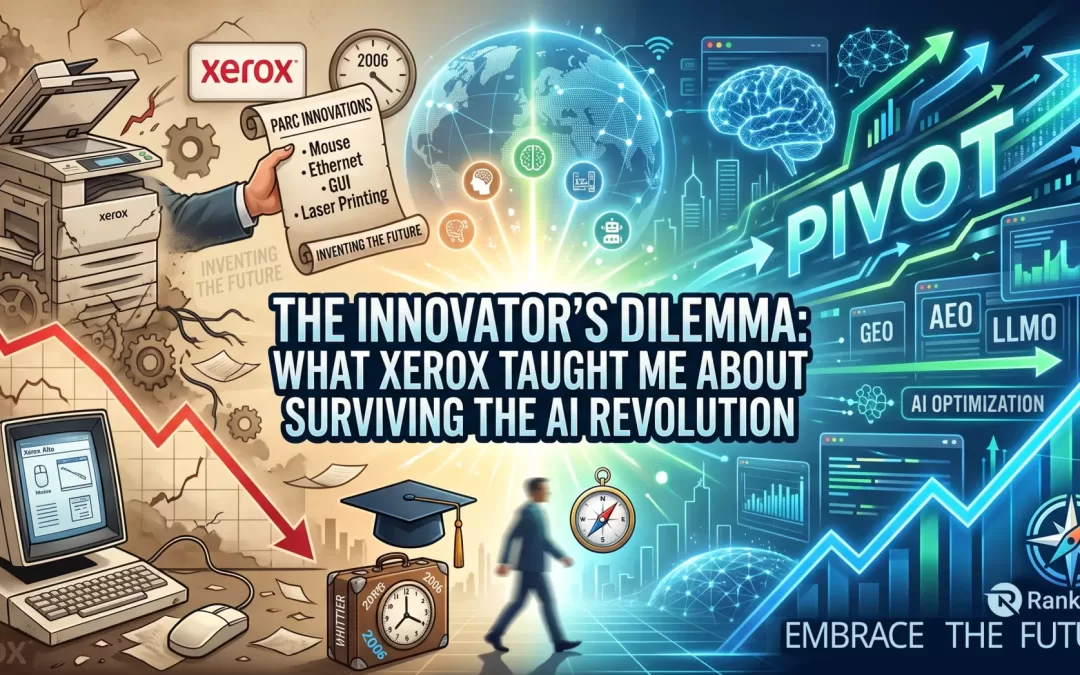
The corporate graveyard is filled with household names that failed to see the future coming. But what happens when the company that actually invented the future is the one that gets left behind?
What Xerox Can Teach Today’s Business Leaders About the Cost of Failing to Pivot
To most of the world, “Xerox” is merely a synonym for making a photocopy. But beneath that legacy lies a profound truth: Xerox didn’t just build office equipment; they engineered the very foundations of the modern digital age. Through their Palo Alto Research Center (PARC), they pioneered the very technology that all modern computers and the internet rely on to function. Yet, despite holding the blueprint for the next half-century of technology, leadership hesitated. They allowed visionaries from Apple and Microsoft to capitalize on their genius while they remained tethered to the incredibly lucrative, but ultimately limiting, business of moving ink onto paper.
Why Some of the Most Innovative Companies in the World Just Fade Away Into History
Today, as artificial intelligence fundamentally reshapes the business and technology landscape, the story of Xerox is more than just tech history. In my opinion, it is a stark, urgent warning: inventing the future isn’t enough if you lack the vision and courage to pivot toward it. As someone who stood inside the machinery of this American titan and learned the depths of their massive digital ecosystem, I want to take a deeper look at the incredible, unsung achievements of the Xerox Corporation. This is the story of how a titan rose, why they no longer lead the industry in technology innovation, and what their decline can teach today’s leaders about surviving the AI revolution.
An Innovator’s Dilemma: What Xerox Taught Me About Surviving the AI Revolution
Here we discuss the impact of a technology giant and the historic trajectory of one of the most innovative companies in modern times when failing to recognize developing trends, even within the industry that their own inventions literally created. This article provides my perspective based on my personal experiences within the technology industry and while working for Xerox for the short time that I did. After seeing things from both a outsider and insider’s perspective and with the recent evolution of AI, I felt it might be helpful to share my thoughts on how, even at one of the greatest technology companies in the world, innovation requires more than just genius ideas. It requires paying close attention to trends, with strong attention to detail, pattern recognition, and the ability to adapt when industry, society, technology, and civilization changes.
A Quick Backstory: The Xerox University Challenge and Race Back to SoCal
Between 2003 and 2006, I found myself deep inside the machinery of an American titan: the Xerox Corporation. My mandate was staggering. I was tasked with mastering every technical aspect, feature, and capability of every physical product, digital service, and emerging B2B offering in the company’s massive catalog. To achieve this, I was sent to Xerox University at their corporate headquarters. The pressure was immense. I was expected to deliver both executive-level and deep-technical presentations on a portfolio that spanned across global enterprise solutions and defense contracting for a brand whose portfolio went far beyond simply making some copies.
I had been in the technology trenches since 1993, cutting my teeth as part of the Best Buy pilot program that eventually became Geek Squad, followed by half a decade managing digital assets and production operations for The Walt Disney Company. Yet, the sheer volume of asset information at Xerox was humbling. I was determined to conquer it, and I did—passing my exams with perfect scores and finishing at the top of my class. But I was forced to push through the grueling curriculum days ahead of schedule for a far more important reason: I had a flight to catch. My firstborn son, Leo, was due in Whittier, California, and there was absolutely no way I was missing his birth. I arrived with plenty of time to drive his mother to the hospital and was there for every precious moment.
With the excitement surrounding the birth of my newborn son, I all but forgot about all of the information I was just required to absorb. Truly a moment in my life of overwhelming information overload. The birth of my child is one of the most important moments in my entire life that I will treasure for eternity. The joy of my son’s birth did not make me lose sight of the enormity and diversity of the service and product offerings from this globally recognized name brand, which were far more impressive than I could have ever imagined. However, this new knowledge was temporarily sidelined to invest much-needed time with my son Leo, with the gracious blessings from the team at Xerox.
Beyond the Copier: The True Scale of Xerox’s Genius
During my time steeped in Xerox’s culture, I was awestruck by a fundamental disconnect between public perception and technological reality. To the world, the word “Xerox” was simply a household synonym for making a photocopy. Inside, I realized I was representing a company that essentially engineered the modern digital age, quite literally.
Many are completely unaware that Xerox’s Palo Alto Research Center (PARC) invented one of the world’s first personal computers, computer mouse and Ethernet networking. They pioneered object-oriented programming, laser printing, and the graphical user interface. Yes, GUI the very concept of graphic images within user interfaces, rather than simply just text, on a computer screen. Beyond hardware, the digital business services and defense contracting solutions Xerox revolutionized and offered up to the world went lightyears beyond xerographic imaging. They possessed a staggering wealth of digital infrastructure that powered global B2B operations. Yet, for all their foundational breakthroughs, Xerox struggled to claim the credit—or the market share—for the digital revolution they birthed. Despite inventing the technology, Xerox allowed visionaries from Apple and Microsoft to capitalize on their GUI and mouse concepts to dominate personal computing, while Xerox remained tethered to the incredibly lucrative, but ultimately limiting, business of moving ink onto paper. From a business perspective, this was something I never understood; exactly how could an innovative company like Xerox allow this to even happen?
What is Xerox Credited with Inventing? More Than You May Think!
Well, let’s just say you probably wouldn’t be reading this if it weren’t for the inventions created by the various teams working at Xerox over the years. From the world’s first personal computer to the click of world’s first computer mouse to the invention of Ethernet cable sending and receiving internet data around the world; Xerox is certainly way more than just a copier company.
Personally, I have enormous respect and admiration for Xerox and the crucial innovations engineered by their geniuses over the years. Here are a few of the most important innovations made by the Xerox Corporation and their infamous Palo Alto Research Center:
- Xerography (Plain Paper Photocopying): Building on physicist Chester Carlson’s 1938 invention of dry printing, Xerox developed the Xerox 914 in 1959—the first highly successful automatic, plain-paper commercial photocopier. This invention is why people commonly associate the term “Xerox” with “photocopy”.
- The Personal Computer: Developed in 1973, the Xerox Alto is widely recognized as the first modern personal computer designed specifically for individual use rather than mainframe batch processing.
- Graphical User Interface (GUI): PARC pioneered the modern “desktop metaphor” featuring overlapping skeuomorphic windows, digital icons, checkboxes, and pop-up menus, completely replacing text-based command lines.
- The Computer Mouse: While Douglas Engelbart created an early wheel-based prototype at SRI, PARC’s Bill English built the first modern “ball” mouse for the Alto in 1972. Later, PARC’s Richard Lyon invented the first optical mouse in 1981.
- Ethernet: Invented by Robert Metcalfe and his colleagues at PARC in 1973, this local area network (LAN) standard allowed computers, servers, and printers to communicate and seamlessly share data across a network.
- The Laser Printer: In 1969, Xerox researcher Gary Starkweather realized he could modify a standard copier with a laser beam, making it possible to print any digital image or text directly from a computer monitor.
- Object-Oriented Programming (Smalltalk): Alan Kay and his team at PARC created Smalltalk, a revolutionary object-oriented programming language that went on to influence C++, Java, and Objective-C.
- WYSIWYG Word Processing: PARC developed Bravo, the first “What You See Is What You Get” text editor, where the on-screen digital formatting exactly matched the final printed output.
- Page Description Languages: PARC developed Interpress, a resolution-independent graphical language used to communicate complex page formatting to printers, which served as the direct precursor to PostScript.
- Ubiquitous Computing (Mobile Devices): In the late 1980s and early 1990s, PARC pioneered the concept of “UbiComp” with experimental touchscreen mobile devices like the PARCTab and PARCPad, prefiguring modern smartphones and tablets.
The Fortune 500: The Climb and Stumble of a Tech Giant
Historically, Xerox’s dominance was reflected in its meteoric rise on the Fortune 500. Riding the initial wave of the first plain-paper photocopier, they became an unshakeable corporate juggernaut. They peaked firmly in the top tier of the largest American companies during the 1990s, boasting tens of billions in annual revenue. They were an absolute powerhouse and rightfully so.
But as the 21st century progressed, a creeping complacency set in. Instead of weaponizing their own digital service offerings and pioneering the next computing era, leadership clung to legacy revenue models. The incremental ranking gains of the late 20th century turned into a steady decline. They failed to aggressively innovate along emerging digital pathways, eventually choosing to spin off their lucrative digital business processing operations into a separate, publicly traded company named Conduent at the end of 2016, nearly a decade after I had left Xerox. Stripped of its digital services arm, Xerox’s Fortune 500 ranking plummeted from the top tier down into the 300s and 400s, a stark warning about the cost of failing to adapt to digital transformation.
Once digital storage services and mobile devices became commonplace, the world became far less reliant on printed materials, and the future became a digital future. One that, in my personal opinion, Xerox failed to keep up with.
#423: Xerox Corporation’s Starting Rank on the Fortune 500 in 1962
- Xerox debuted on the list shortly after the explosive 1959 commercial success of the Xerox 914, the first plain-paper photocopier. The product was so dominant that within eight years of entering the list, the company surged to #70.
#26: Xerox Corporation’s Peak Rank on the Fortune 500 in 1994
- During the 1990s, Xerox reached its zenith on the Fortune list. Buoyed by massive corporate paper consumption, hardware leasing, and near-monopoly market dominance in enterprise printing, this era marked the absolute peak of their corporate footprint.
| Era / Year | Ranking | Cause of Decline |
| Early 2000s | #87 (2000) #130 (2004) |
Accounting Scandal & The Digital Shift: The SEC fined Xerox for overstating earnings by $1.5 billion between 1997 and 2000. Concurrently, the internet boom catalyzed the earliest corporate shifts toward a “paperless office,” eroding their core physical document business. |
| 2006 | #142 | RankPivot founder David King leaves Xerox Corporation, which was earning $15.7 billion in annual revenue in 2006, to work for MagicYellow, YellowUSA. |
| 2016 – 2017 | #143 (2015) #318 (2018) |
The Conduent Spin-off: Following pressure from activist investors, Xerox spun off its lucrative business process outsourcing (BPO) unit into a separate public company named Conduent. This move instantly slashed Xerox’s total revenue footprint by roughly $6.7 billion, effectively halving its size overnight. |
| 2020 – 2022 | #347 (2020) #471 (2022) |
The Pandemic & Remote Work: COVID-19 permanently altered office culture. With massive corporate workforces transitioning to remote or hybrid setups, the reliance on centralized, high-volume enterprise printing plummeted, severely impacting Xerox’s managed print services. |
| 2023 – 2024 | Fell Off the Fortune 500 | Revenue Contraction: By 2023, Xerox’s annual revenue dropped to $6.9 billion, falling short of the Fortune 500 cutoff threshold (which hovered around $7.2 billion). |
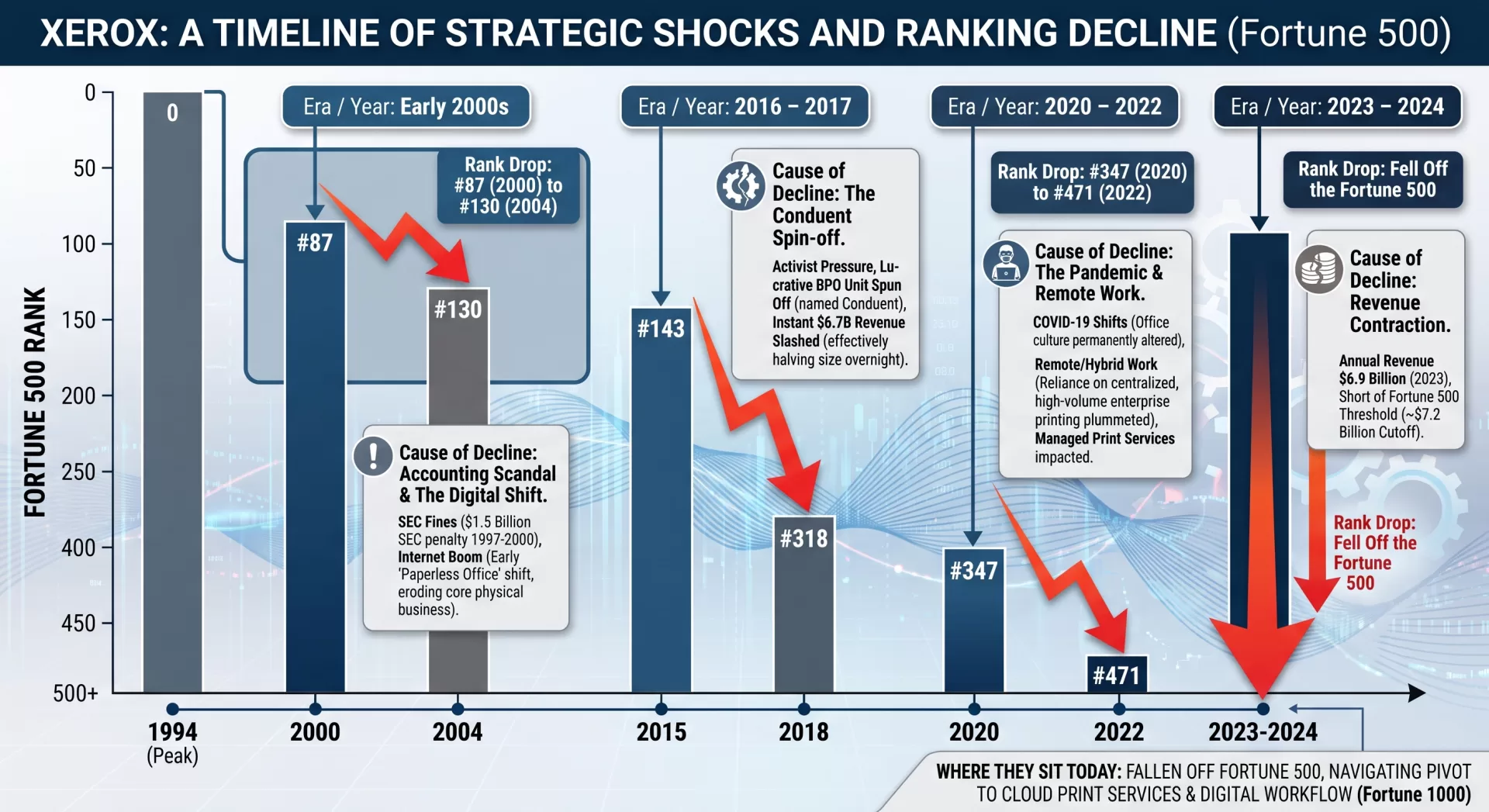 [Image: Timeline of Xerox’s Fortune 500 Rankings since 1994]
Where Xerox Sits on the Fortune 500 Today: #530
Unfortunately, as of 2026, Xerox, one of the primary companies responsible for creating the foundation of modern technology and digital information, is sadly no longer a Fortune 500 company, residing instead on the broader Fortune 1000 list at #530 at the time of this writing.
To Xerox’s credit, they are currently executing aggressive structural pivots in 2026—focusing on cloud print services, digital workflow automation, and IT infrastructure—in an attempt to stabilize operating income and redefine their value in a decentralized digital economy. I must point out, however, that many people in the tech industry feel Xerox should have led the charge on each of these verticals since day one, instead of jumping in this late in the game.
Personally, I fear these recent efforts to pivot and keep up with technology may be too little too late. Xerox can no longer rely exclusively on the relevancy and notoriety it earned as an industry-leading innovator; it must continue to innovate and lead the way. However, things very well could change with the right team and innovation that only a pioneer like Xerox, with decades of experience, could bring forth. I do, in fact, have faith. Regardless of any faith any of us may have in their future, we can easily respect their past, their inventions, innovations, and dedication to outstanding client-focused services for what they always were from the start: world-class.
Adapt or Die: The RankPivot.ai Philosophy
Watching an American icon like Xerox slowly lose its footing because it couldn’t let go of the past left a lasting impression on me. It is a cautionary tale every tech executive must internalize, and it directly shaped the trajectory of RankPivot itself.
When the writing on the wall signaled the massive paradigm shift from traditional search engines to artificial intelligence, my team and I were ready. As an industry leader in SEO and AIO, and as a true multi-disciplinary technology brain trust, the leadership team at RankPivot possesses over a century of combined digital information technology experience. As a collaboration with seasoned strategists and technologists like Jeffrey Enabe, Scott Allen, and Brian K. Long, RankPivot isn’t just some new digital marketing agency reacting to a trend, but a collective of industry veterans who have spent decades analyzing and engineering for these exact technological shifts. In fact, we were not only prepared, but we had been monitoring, researching, and engineering for this shift for years.
On the exact day Google announced the integration of AI into search, we didn’t hesitate; we went public. We immediately rebranded and relaunched as RankPivot.ai before that announcement was even made. We immediately indexed our brand new domain and ranked it on Google for one of the most important takeaways from the Google IO 2026 Developer Keynote Announcements: AI Optimization is NOT replacing SEO; it is absorbing it. As Founder and Lead Strategist, I knew we had to pivot away from industry-standard SEO tactics and aggressively embrace Generative Engine Optimization (GEO), Answer Engine Optimization (AEO), and Language Model Optimization (LLMO) that we had been researching for years leading up to this very moment in history. To enable our brand to continue leading the way in innovation, and more importantly, to help other businesses navigate the ever-evolving landscape of digital information technology with the onset of AI-integrated search.
We saw the public uncertainty and the polarizing stances on AI technology, and we knew businesses needed authoritative guidance to navigate this inevitability. Unlike the Xerox of the 2000s, which hesitated at the precipice of a digital revolution they themselves invented, RankPivot stepped directly into the current. The story of Xerox is a brilliant, yet frustrating masterpiece of American innovation—a reminder that inventing the future isn’t enough; you must also have the courage to pivot toward it.

David L. King II
Founder, Lead Strategist
David King is a multi-disciplinary technology and marketing executive with over 30 years of experience driving digital growth for Fortune 500 companies, high-growth startups, and global brands. An early pioneer of search engine optimization, he currently serves as the Founder and Lead Strategist at RankPivot.ai, specializing in enterprise-grade digital marketing, branding, and AI-integrated search strategy.