
Have Search Engines Been Impacted By AI in Terms of Market Share?
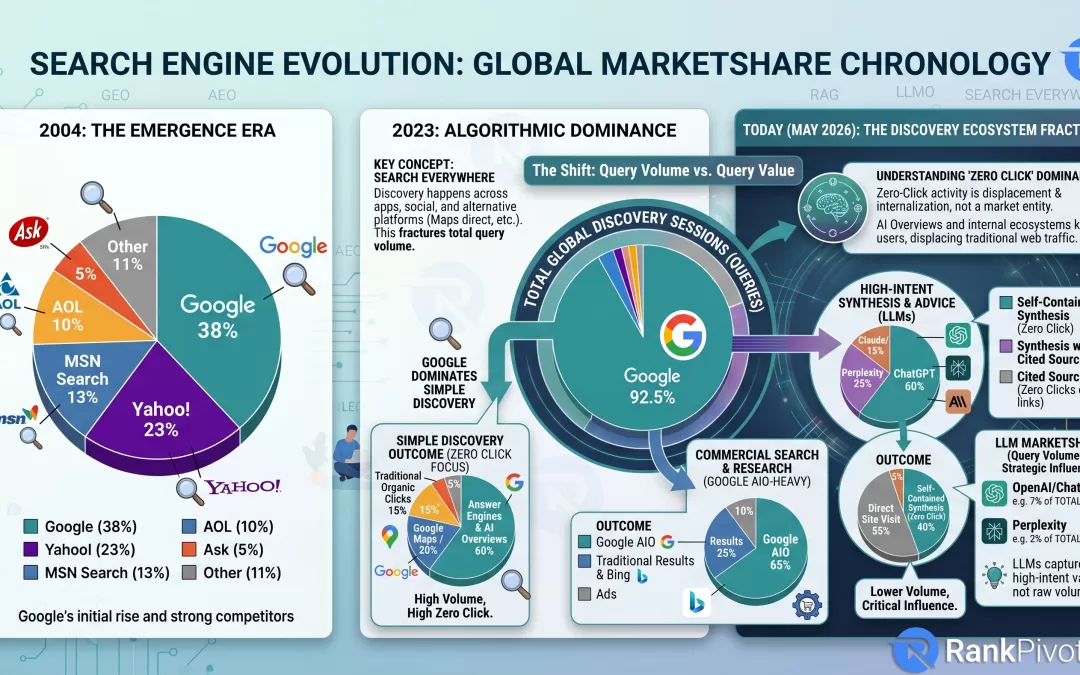
Not long after Google officially went public, it was already processing roughly 236 million searches a day, commanding a rapidly expanding 35% to 40% of the market by 2004. It didn’t win by out-marketing Yahoo, AltaVista, or Lycos; it won by fundamentally understanding the psychology of relevancy. For over two decades, that singular focus propelled Google to an absolute monopoly, reaching a peak global market share of approximately 92.5% by 2023.
Today, in 2026, we are witnessing the first true paradigm shift since the dawn of PageRank.
At RankPivot, we don’t just observe these shifts; we contextualize them. Our team brings decades of industry-leading development, web infrastructure engineering, and digital marketing experience, which has positioned us at the leading edge of an $845 billion industry with projections pushing the value well past the $1 trillion mark by 2030, when you consider web development and digital marketing combined.
We have seen the radical evolution of business discovery since the 1990s.
We navigated the transition from paper directories to digital, from desktop to mobile-first, and now, from algorithmic search to neural synthesis.
To truly understand how to capture visibility today, we must discard the traditional lens of “market share.” In an ecosystem dominated by Large Language Models (LLMs) and Generative Search, looking purely at query volume exclusively is not just incomplete—it is strategically dangerous.
Here is our analysis of the 2026 search ecosystem, audience psychology, and how enterprise brands must adapt to secure “Search Everywhere” visibility.
The Statistical Reality vs. The Functional Reality of Search Everywhere
If you glance at the surface-level metrics for 2026, the search landscape appears relatively stable. Google still commands approximately 89.5% to 91% of the global search market (90.02% according to Statcounter).
Microsoft’s Bing hovers around 5.14% globally (though closer to 7% in the US and 10% on desktop, bolstered by Copilot integrations). That may not seem like much when compared to Google’s massive dominance in search queries. However, when Google was brand new, Microsoft’s MSN search engine market share peaked at 13%, so nearly 7% we are seeing now is a solid leap, thanks to the inclusion and evolution of AI integrated search engines.
Standalone AI platforms—such as ChatGPT, Perplexity, and Claude—are currently estimated to process roughly 2% to 3% of search-like queries worldwide according to current, yet unverified industry estimates. However, it is important to note that these industry estimate methodologies vary, and these numbers are not independently standardized.
OpenAI has stated that ChatGPT alone receives more than 2.5 billion messages per day globally, while Google has said it handles 5 trillion searches per year, which is roughly 13.7 billion searches per day, so ChatGPT alone is already around 18% of Google’s daily search volume on that rough comparison. However, this is without factoring in ChatGPT messages.
That said, for the uninitiated marketing executive, a 3% market share implies irrelevance. But this is the critical miscalculation. Remember, market share measures volume, not intent.
The Asymmetry of Query Value
When a user opens Google to search for “Facebook login,” “weather,” or “Target near me,” these are navigational and simple informational queries. They account for billions of searches a day, padding Google’s massive volume metrics.
However, when a user asks Perplexity, “Synthesize a cost-benefit analysis of metal vs. asphalt roofing for commercial buildings in high-humidity climates,” they are conducting deep, commercial investigation.
AI platforms have not stolen 3% of the total search market; they have aggressively carved out the highest-value, highest-intent, and most commercially lucrative queries on the internet. Furthermore, with Google’s own AI Overviews appearing on over 13-25% of its internal queries, traditional organic SERPs are being choked from both the outside and the inside.
| Era | Dominant Paradigm | Google’s Peak Share | Primary User Intent | The Metric of Success |
| The Index Era (1998–2010) |
Keyword matching, directories | Peak ~85% | Information location (finding destinations) | Rankings & Traffic Volume |
| The Answer Era (2011–2022) |
Featured snippets, zero-click | Peak ~92% (2019-2023) |
Immediate resolution (finding facts) | Click-Through Rates (CTR) |
| The Synthesis Era (2023–Present) |
Generative models, RAG | Peak ~89.5% (2026) |
Complex problem solving (finding context) | Ecosystem Citation & Brand Trust |
The Psychology of the Modern Web User
To increase visibility, you must understand the psychological driver behind the shift to AI discovery: Cognitive Load Reduction.
Historically, search engines required the user to do the heavy lifting. A user inputted a fragmented keyword (“enterprise software cost”), opened five tabs, extracted the data, and synthesized the answer in their own mind.
Today’s user refuses to carry that cognitive load. The modern audience relies on AI to function as an intellectual proxy. They provide context, and they expect the engine to execute the synthesis. This fundamentally alters how businesses must approach user targeting.
- From Keywords to Context: Users are abandoning fragmented search terms in favor of conversational directives. They are providing the machine with their constraints, budgets, and fears.
- The Demand for Certainty: When users consult AI, they are seeking authoritative consensus. They are highly skeptical of generic marketing copy and heavily biased toward empirical data.
- Trust Transference: If a trusted LLM recommends a brand, the user transfers their trust of the AI directly to that brand. This creates an unparalleled conversion environment.
Increasing “Search Everywhere” Visibility
How does a brand compete when the traditional search funnel has been obfuscated by neural networks? You must optimize for the machine’s understanding of your authority, which in turn serves the psychology of the human audience.
Here are the operational mandates for digital marketing in 2026:
-
Architecting Data, Not Just Content
Recently, many LLMs have transitioned to operate on Retrieval-Augmented Generation (RAG). When an AI searches the live web for an answer, it bypasses fluff and zeroes in on structured facts. To earn citations, brands must transition from publishing subjective blog posts to publishing proprietary data. Commission industry studies, format your specifications in pristine HTML tables, and provide unique statistical anchors. Data is the currency of AI visibility.
-
Multi-Dimensional Entity Domination
Google, Bing, ChatGPT, and Claude all build their knowledge graphs differently. Your brand is no longer just a website; it is an “entity.” If your website says you are the best enterprise software provider, but Reddit, Wikipedia, GitHub, and industry forums contradict you, the AI will side with the global consensus, provided that all other metrics and algorithm criteria have been met (E-E-A-T, Verified Citations, Accuracy of Claims Across Multiple Sources, etc.). True user targeting requires managing your brand narrative across the entire digital ecosystem, not just your website, to maintain a unified signal of trust.
-
Exploiting the “Humanity Premium”
As AI commoditizes information synthesis, raw facts are no longer a competitive differentiator. What an LLM cannot generate is lived experience, nuanced opinion, and natural human emotional resonance. Businesses must lean heavily into the “psychology of the click.” When an AI does cite your website and a user clicks through, your landing page must offer an experience the AI cannot—video, human storytelling, empathetic design, and highly personalized UX. Keep in mind, however, that a large portion of sessions within AI ecosystems have become ZERO CLICK related activities. AI has become so good at the Answer aspect of a Q&A chat-a-thon that users are often provided with answers to every question they can ask, without the need to click through to a website.
The RankPivot Imperative
The market share of traditional search engines will continue to erode, not because Google is failing, but because the definition of “search” has outgrown the search box and transitioned to a more advanced answer engine and AI assistant option that users naturally gravitate towards with ease and efficiency.
At RankPivot, our methodology is rooted in the belief that trust is the ultimate algorithm. We do not chase fleeting metrics; we build digital authority that transcends individual platforms. By understanding the intersection of human psychology and AI retrieval, we engineer visibility that ensures our partners are not just found in the “Search Everywhere” era, but that they are recognized as the undeniable authorities in their space as AI platform enhancements and capabilities continue to emerge and shape the way people search and find answers online. The internet has evolved. Your strategy must evolve with it.
It’s a Big World: Visibility is Everything!
[Note: The data presented in the infographic on this page is based on available data and industry estimates at the time of publication. It is designed to provide a basic overview of broad market trends and should be used as a general illustration rather than exact, definitive metrics.]

David L. King II
Founder, Lead Strategist
David King is a multi-disciplinary technology and marketing executive with over 30 years of experience driving digital growth for Fortune 500 companies, high-growth startups, and global brands. An early pioneer of search engine optimization, he currently serves as the Founder and Lead Strategist at RankPivot.ai, specializing in enterprise-grade digital marketing, branding, and AI-integrated search strategy.