
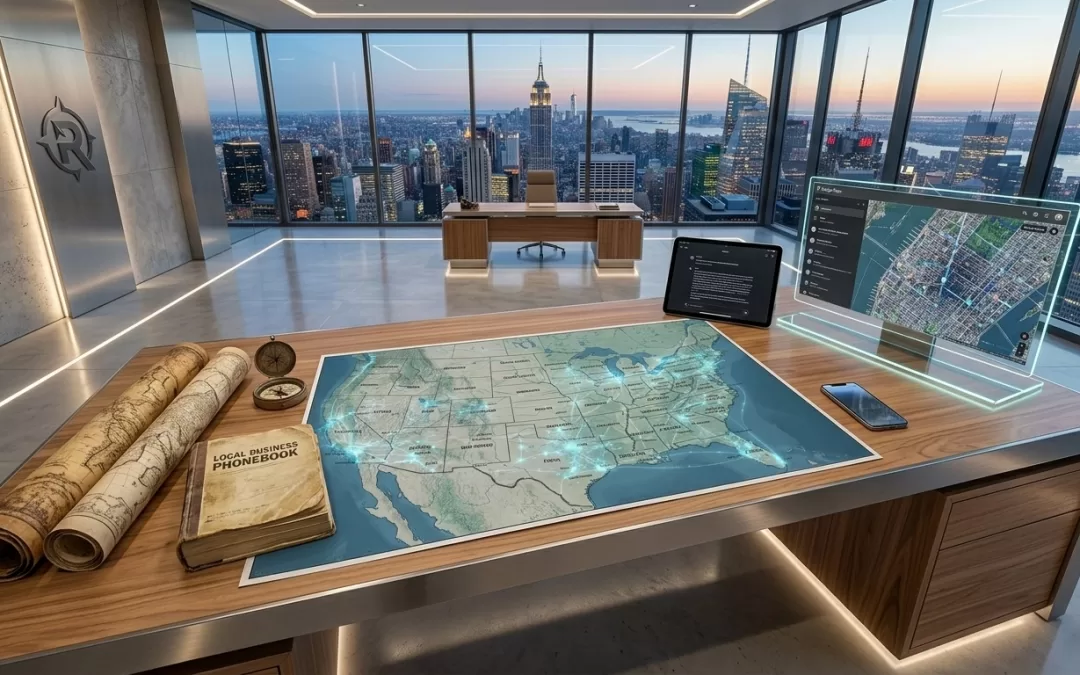
The Complete Evolution of Local Business Discovery
If you want to understand where search is going, you have to remember where it started.
Long before we were optimizing for generative AI or obsessing over algorithm updates, finding a local business was an analog sport. It required physical space, alphabetical dominance, and sometimes, a really good road map (like a literal paper printed map).
Here is the story of how we went from letting our fingers do the walking to letting AI do the thinking.
The Heavyweights: Phone Books and Folded Maps
Before the internet lived in our pockets, it lived in the trunk of our cars and on our kitchen counters.
If you needed a plumber, a mechanic, a hardware store, or a pizza in the 1980s and 90s, you didn’t ask a screen. You grabbed the Thomas Guide—that massive, spiral-bound atlas that tested your grid-reading skills just to navigate across town.
But the undisputed king of local business discovery was the Yellow Pages.
These heavy, clunky paper books were printed and distributed by the regional telephone monopolies of the era. The primary distributors were the formidable “Baby Bells” and major telcos that controlled the telecommunication lines:
- AT&T * Pacific Bell (Pacific Telesis)
- BellSouth
- US West
- Ameritech
- Bell Atlantic & NYNEX
- Southwestern Bell (SBC)
- GTE
They owned the famous “Walking Fingers” logo, and if a business wanted to be found, they paid a premium for a boxed ad or got wise to the alphabetization of the directories and named their company “A1 Plumbing” or “AAA Bee Removal” just to sit at the top of the list.
Some telcos even innovated with the Talking Yellow Pages, a phone service where users could dial in, enter a four-digit code from the book, and listen to pre-recorded business info, weather, or sports scores. It was the earliest, most primitive form of voice search. Technically foreshadowing AI Voice Search of today, the Talking Yellow Pages were eventually acquired in 2004 by The Hearst Corporation, which purchased White Directory Publishers, one of the largest independent yellow pages publishers in the United States.
The Talking Phone Book®: At the time of the acquisition, White Directory Publishers had spent decades publishing a heavily branded, nationally known product line called The Talking Phone Book®, which integrated automated voice services with printed phone books.
The Dial-Up Dawn
Then came the 1990s. The personal computer—driven largely by Windows—moved from the office desk into the family living room.
But a computer without the internet is just a very expensive calculator you could play a few games on. To connect the masses, a wave of pioneering Internet Service Providers (ISPs) emerged, bringing the screeching, static hum of the dial-up modem to households across the country:
- Prodigy Internet: One of the earliest graphical interfaces that made the digital world feel accessible.
- AOL (America Online): The giant that blanketed the earth in free trial CD-ROMs, bringing the phrase “You’ve Got Mail” into the cultural lexicon.
- NetZero: A massive disruptor that provided free internet access (in exchange for an ever-present advertising banner), democratizing access for users far outside major tech hubs and metropolitan cities.
The Massive Leap
When the internet finally expanded to the mainstream, the cultural shift was violent and rapid.
One would have to compare it to the transition from Radio to Television. Radio was great—it required imagination and auditory focus. But when television arrived in the American living room, it changed the fundamental way society consumed information, entertainment, and advertising. It wasn’t just a new channel; it was a new reality.
The internet did the exact same thing to the printed word. The heavy, static Yellow Pages suddenly felt archaic. Why wait for next year’s printed book when you could find a business instantly on a screen?
The Directory Boom & The Birth of Local SEO
The Yellow Pages were forced to evolve, transitioning from doorstops to domain names.
This ushered in the golden era of Online Yellow Page Directories. Brands like MagicYellow, SuperPages, YellowPages.com, YellowUSA, and Dex migrated their massive data sets online. Suddenly, having a digital listing was non-negotiable for businesses wanting to get found online.
This era laid the foundation for what we now know as Local SEO. Online directories absolutely dominated organic search engine rankings. If you searched for a local service on early Google or Yahoo, the top results were almost exclusively directory hubs.
The ecosystem exploded with specialized platforms:
- Citysearch became the go-to for localized entertainment and dining.
- Craigslist digitized the newspaper classifieds, wiping out print revenue overnight.
- Angie’s List brought accountability through user-paid reviews.
- Yelp gamified the review process, making everyone a local food critic.
During this mid-to-late 2000s boom, if you knew how to manipulate category taxonomy, claiming processes, and citation consistency across these massive directory hubs, you could completely dominate a local market.
The Mobile Revolution
Just as we mastered the desktop directory ecosystem, Apple launched the iPhone.
Touchscreens, mobile data, and tablets completely shattered the tether to the desktop computer. We were no longer “logging on” to the internet; we were walking around inside it.
Location-based GPS meant directories didn’t just need to know what city you were in—they needed to know what street corner you were standing on. Search became immediate, hyper-local, and contextual.
The “Search Everywhere” Ecosystem
Today, we are miles beyond the simple search box. We live in a fragmented, highly intelligent ecosystem.
We find businesses through our Smart TVs while streaming Hulu. We ask Siri to find coffee while we are driving. We use augmented reality maps on our smartphones. Embedded AI is quietly working behind the scenes on almost every device we own, synthesizing data, reading reviews, checking proximity, and curating answers before we even finish typing our questions.
Search is no longer about retrieving a list of blue links. It is about an Answer Engine providing a definitive, conversational truth.
A Step-by-Step Technological Evolution of
How We Went From Flipping Paper Pages to Talking to AI Sages:
[ 1880s – 1980s ] Printed Directories (Manual Search)
│
[ 1980s – 1990s ] Talking Yellow Pages (Touch-Tone IVR)
│
[ 1990s – 2000s ] Web Search Engines (Keyword Indexing)
│
[ 2010s – 2020s ] Voice Assistants (Natural Language Processing)
│
[ 2020s – Present ] AI Agents (Generative Large Language Models)
The Paper Era: Printed Yellow Pages (1883–1980s)
- The Technology: Physical paper books, alphabetical sorting, and categorized business indexes.
- The User Experience: Completely manual. Users had to know the exact category (e.g., “Plumbers”) and manually flip through hundreds of paper pages.
- The Limit: Information was completely static. If a business changed its phone number or went out of business mid-year, the book remained incorrect until the next annual print cycle.
The Audio Bridge: Talking Yellow Pages (1980s–1990s)
- The Technology: Interactive Voice Response (IVR), early speech recognition, and touch-tone routing.
- The User Experience: Users dialed a local number and used their telephone keypad to navigate audio menus for local business listings, movie times, and weather.
- The Limit: Navigating deep audio trees was slow and frustrating. Users were confined to strict, pre-recorded menu paths.
The Digital Index: Web Search Engines (1990s–2010s)
- The Technology: Web crawlers, hyperlinked databases, and keyword indexing (pioneered by Yahoo!, AltaVista, and Google).
- The User Experience: Users typed fragmented keywords (e.g., “best pizza NYC”) into a search bar and received millions of ranked links.
- The Limit: Search engines do not answer questions; they point you to websites that might. The user still had to click the links and read the pages to find the actual answer.
The Voice Interface: Early Virtual Assistants (2011–2020)
- The Technology: Natural Language Processing (NLP) paired with API APIs (Siri, Alexa, Google Assistant).
- The User Experience: Users spoke naturally to a device to perform simple tasks, like setting alarms, playing music, or pulling basic facts from Wikipedia.
- The Limit: These assistants were rigid. They relied on specific command templates and struggled with complex, multi-step context or conversational follow-ups.
The AI Sage: Generative AI and LLMs (2020s–Present)
- The Technology: Large Language Models (LLMs) trained on massive textual datasets, using transformer neural networks to predict and generate human-like text.
- The User Experience: Total synthesis. Instead of returning a list of links or reading a pre-written directory line, the AI understands complex intent, reasons through variables, and generates a custom, contextual answer instantly.
- The Shift: Technology evolved from a directory (showing you where information is) to an oracle (processing and delivering the information directly to you).
Today, the answers come to us, like magic on a black mirror. Delivered by AI agents who not only have access to all the information on the Internet, cached up, and ready to share with us, but agentic AI now remembers who we are, what we like and dislike, and can provide answers and recommendations tailored to each of us individually. Minimizing the number of questions we need to ask before finding the right answers we were looking for, and many answers to questions we didn’t even know we had, before there was AI.
The ease of which people can get answers has never been so instantaneous and so accessible.
The Future: Anticipatory Architecture
So, where does the technology go from here?
As we push toward exascale computing and the eventual commercialization of quantum processing, the sheer volume of data throughput will make today’s AI look like a 56k dial-up modem.
The future of business discovery won’t be a “search” at all. It will be Anticipatory.
AI agents will act as personal digital concierges. Your device will know your schedule, your dietary restrictions, your budget, and your real-time location. If you have a business lunch scheduled, your AI won’t wait for you to search for a restaurant. It will cross-reference the digital footprint, authority, and reviews of local eateries, check their real-time availability, and present you with a booked reservation before you even ask.
The businesses that win in the future won’t be the ones with the biggest ad budgets. They will be the ones who have perfectly structured their entity data so that when the AI goes looking for the absolute best answer… it has little choice but to choose them.
FUN FACT: This article isn’t just an observation—it’s a firsthand account. Over the last three decades, we haven’t just watched the evolution of business discovery; we helped engineer it. From time spent at a major search engine company to shaping the search and marketing strategy for platforms like MagicYellow and YellowUSA, our insights come from the trenches. Along the way, we forged close ties with the architects of this era—from the founders of NetZero to the executives at Dun & Bradstreet and Hearst Corp during the Talking Yellow Pages acquisition. With an executive team bringing over a century of combined experience to the table, we didn’t just witness this history—we actively played a role in pushing it forward. This is just a fraction of the picture, but it’s a story we are proud to tell.

David L. King II
Founder, Lead Strategist
David King is a multi-disciplinary technology and marketing executive with over 30 years of experience driving digital growth for Fortune 500 companies, high-growth startups, and global brands. An early pioneer of search engine optimization, he currently serves as the Founder and Lead Strategist at RankPivot.ai, specializing in enterprise-grade digital marketing, branding, and AI-integrated search strategy.