
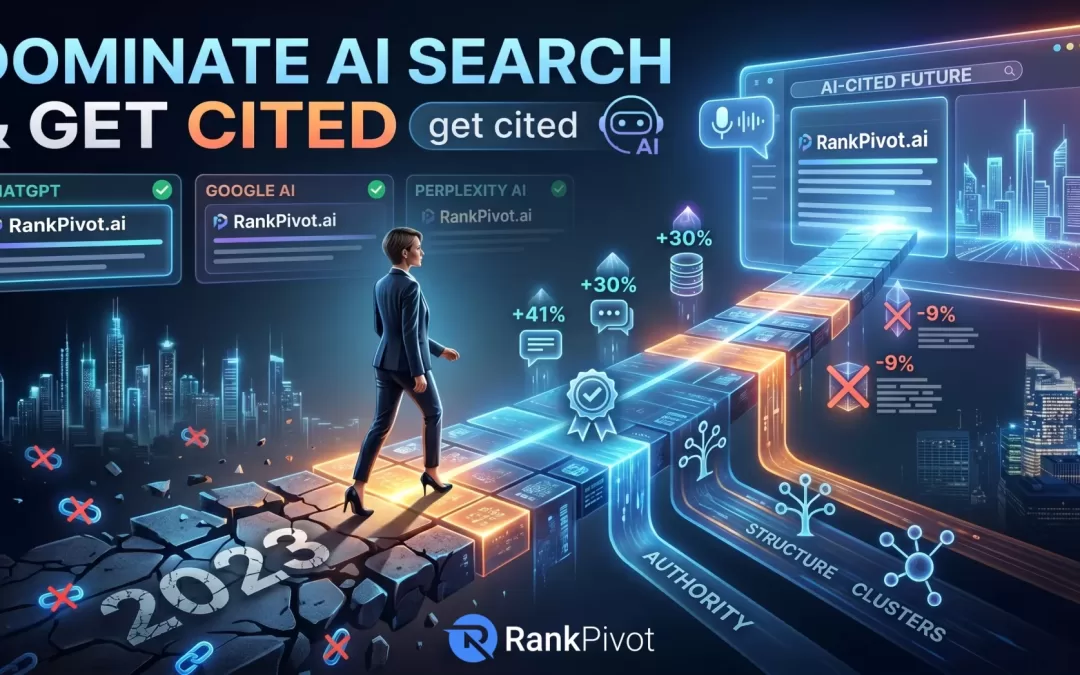
Dominate The Search Results & Outrank Your Competition in AI Answers, Recommendations, and Overviews
Search has changed more in the last 18 months than it did in the previous decade. And if you’re still running the same playbook you were running in 2023, you’re not just falling behind — you’re becoming invisible.
I’ve spent years helping businesses that poured budgets into SEO strategies with other agencies that worked brilliantly until they didn’t. What’s happening right now isn’t a tweak to the algorithm. It’s a structural shift in how people find information, make decisions, and make buying decisions. The businesses that understand this moment — and move on it — will capture enormous ground. The ones who ignore it will wonder why their traffic quietly disappeared.
This is everything you need to know about dominating search results in the age of AI. No fluff. No generic advice. Real strategy.
The Seismic Shift in Digital Marketing That You Can’t Ignore
Let me put some numbers on the table.
As of mid-2026, over 65% of Google search results pages now include AI Overviews — up from just 25% two years ago. ChatGPT now handles over 2 billion queries every single day, and AI-referred sessions to websites grew an astonishing 527% year-over-year through mid-2025. Gartner has projected that traditional search volume will drop 25% by the end of 2026 due to AI chatbots and virtual agents.
Here’s the sobering reality: AI-generated overviews now reduce clicks to the top traditional search result by roughly 58%. Around 83% of queries that trigger AI overviews end without any click to a website at all.
This is the zero-click era.
But — and this is where it gets interesting — the businesses that do get cited are winning bigger than ever. The traffic is fewer clicks but significantly higher quality. The users who click through from AI citations are already pre-sold. They’ve been pointed at you by an authoritative AI answer. Conversion rates are higher. Bounce rates are lower.
The question isn’t whether to adapt. The question is how fast you can adapt and how thoroughly you can do it.
Understanding the New Search Ecosystem
Before we talk tactics, you need to understand what you’re actually optimizing for. Most people treat “AI search” as one thing. It’s not. Think of it as five distinct channels — each with its own rules:
- Traditional Google SERPs — The classic blue links, now supplemented with Featured Snippets, People Also Ask boxes, and AI Overviews sitting above everything else.
- AI Overviews & Google AI Mode — Google’s generative layer that synthesizes answers directly in the results. It pulls from top-ranked pages but rewards sources that are structured clearly for extraction.
- Answer Engines (ChatGPT Search, Perplexity AI, Google Gemini) — These aren’t search engines in the traditional sense. They synthesize answers from multiple trusted sources and surface citations. Your goal here is to be the cited source, not just to rank.
- Voice Search & Voice Commerce — Siri, Alexa, Google Assistant, and in-car AI systems read exactly one answer aloud per query. One. If it’s not you, it’s your competitor.
- Agentic AI — The frontier. AI agents that autonomously browse your site, compare options, and complete purchases or form submissions without a human doing the clicking. This channel is growing fast and most businesses have zero optimization for it.
You need a presence across all five. But if you’re starting from scratch or rebuilding your strategy, prioritize in this order: traditional SEO foundation first, then AI Overviews, then answer engines, then voice, then agentic.
The Three Disciplines You Must Master
Here’s where most businesses — and frankly most SEO agencies — get confused. There are now three overlapping but distinct disciplines at play:
SEO (Search Engine Optimization) — Traditional ranking in the search results on search engines like Google’s organic results. Still vital. Still the foundation everything else is built on.
AEO (Answer Engine Optimization) — The practice of structuring your content so that AI-powered search platforms select it as a cited source when generating answers. AEO focuses on the answer-retrieval layer: ensuring your content is the one that gets selected when an AI engine needs a source for a specific fact, definition, or recommendation.
GEO (Generative Engine Optimization) — The broader discipline of optimizing your content to appear as sources and citations in AI-generated responses from platforms like ChatGPT, Perplexity, Google AI Overviews, and Claude. Unlike traditional SEO which focuses on ranking in a list, GEO ensures your content gets cited when AI engines synthesize answers.
These aren’t competing strategies. They’re layers of the same cake:
- SEO builds your foundation and baseline visibility
- AEO ensures you’re accessible when AI needs a direct answer
- GEO positions you as a trusted reference that AI systems cite when constructing more complex responses
Critically, nearly 40% of Google’s AI Overviews pull from top-10 organic results, and nearly 70% pull from the top 100. So strong traditional SEO still feeds AI visibility — it’s not either/or. But SEO alone is no longer enough.
The Authority Problem (And Why It’s Your Biggest Lever)
Let me be direct about something: every single respondent in a major 2026 survey of SEO professionals agreed that trust and credibility signals are becoming more important as AI systems take on the work of deciding which sources to surface. Every. Single. One.
That’s remarkable. Survey consensus like that doesn’t happen unless something real is happening.
The shift is structural. Trust has stopped being just a ranking factor — it’s now the primary filter for AI inclusion. AI systems are trained to surface authoritative, credible, well-cited sources. If your content doesn’t signal authority clearly, you won’t get cited, regardless of how well-optimized it is technically.
So how do you build authority that AI systems recognize?
Original research and data. Nothing signals authority like being the source of information rather than a summarizer of it. Conduct surveys. Publish proprietary data. Run experiments and share results. When you’re the origin point of a statistic, you become the citation source — for humans and AI systems alike.
Expert credentials, prominently displayed. Your About page, author bios, and bylines matter more than they ever have. AI systems look for signals that content comes from people with demonstrated expertise. Make it easy to find who you are, what you know, and why you should be trusted.
Third-party validation. Backlinks from authoritative sources, mentions in reputable publications, citations in academic or industry papers — these are the signals AI models use to confirm that the broader web considers you credible.
Consistent topical authority. Don’t be an inch deep and a mile wide. AI systems heavily favor sources that demonstrate consistent, deep expertise on a subject. Build content clusters around specific themes. When your site covers a topic from multiple complementary angles — foundational explainers, tactical guides, case studies, FAQs, data pieces — you signal to AI that you own the topic.
Structure Your Content for AI Extraction
Here’s a hard truth: brilliant content that AI can’t easily parse is effectively invisible to the systems that are brokering attention in 2026.
AI models are looking for content that is easy to extract, easy to attribute, and easy to synthesize. Structure isn’t just about user experience anymore — it’s about machine legibility.
Write for Questions, Not Just Keywords
The era of keyword stuffing is definitively dead. Today’s AI models prioritize meaning, not repetition. Over-optimizing for keywords can make your content sound unnatural and actually degrades performance — AI systems detect unnatural language patterns and penalize them.
Instead, think about how real people ask questions. Write content that directly answers specific, natural-language queries. Think about voice search phrasing. Think about how someone types a full-sentence question into ChatGPT. Structure your headings as questions and put clear, concise answers immediately beneath them.
Use Schema Markup Strategically
Schema markup is, quite literally, the instruction manual you give AI about what your content means. It tells the system whether your page is an FAQ, a how-to guide, a product, an article, a recipe. Without it, AI has to guess — and guessing introduces noise.
Prioritize these schema types depending on your content:
- FAQ Schema — Directly maps questions to answers. Powerful for getting surfaced in AI Overviews.
- HowTo Schema — Ideal for step-by-step guides and process content.
- Article Schema — Defines the who, what, and when of your content, establishing authorship and publication context.
- Product & Review Schema — Essential for e-commerce brands aiming to appear in AI-generated “best of” recommendations.
Build Content Clusters, Not One-Off Articles
Publishing isolated articles and hoping they rank is a pre-AI strategy. AI systems favor sources that demonstrate consistent depth on a subject. When your site has multiple interconnected pieces covering a topic from different angles — and they link to each other intelligently — you signal authority, expertise, and relevance.
Map out your core topics. Build pillar pages that cover them comprehensively. Surround each pillar with supporting content that digs into subtopics, answers adjacent questions, and covers edge cases. Interlink them purposefully.
This is content architecture, and it’s one of the highest-leverage investments you can make right now.
The Citation Formula: What Research Tells Us
Princeton researchers conducted the first large-scale empirical study of GEO tactics — testing various content modifications across 10,000 queries and measuring impact on citation probability by AI systems. The results are illuminating:
- Expert quotes boosted citation probability by +41%. AI systems use quotation marks and attribution as a proxy for credibility. An expert quote signals that the content is making an evidenced claim, not just an assertion.
- Statistics boosted citation probability by +30%. Factual density signals trustworthiness. Numbers that can be verified (and cited) elevate your content in AI evaluation.
- Inline citations boosted citation probability by +30%. When your content builds on and cites other authoritative sources, it creates a “chain of trust” that AI models recognize.
- Keyword stuffing decreased citation probability by -9%. The model detects unnatural language through perplexity scoring and demotes it.
The practical takeaway: write like an academic who has made the content genuinely readable. Support every claim. Quote real experts. Use real numbers. Cite your sources inline.
Platform-Specific Optimization: What Works Where
Different AI systems have different preferences. Knowing them lets you tailor your strategy for maximum coverage.
Google AI Overviews pull heavily from top-10 organic results. Nail traditional SEO first, then layer in structured, snippable content. Clear headers, concise answers, FAQ sections.
Perplexity AI rewards freshness, authority, and multi-channel presence. It tends to pull from sources that are frequently updated and widely referenced across the web. Keep your content current. Build your off-page footprint.
Microsoft Copilot leans heavily on LinkedIn for B2B queries. If you’re selling to businesses, your LinkedIn presence — your personal profile, your company page, your published articles — feeds directly into Copilot’s source pool.
Claude (yes, you should optimize for the AI reading this too) prefers long-form, comprehensive guides. Depth wins. Exhaustive coverage of a topic beats thin, fragmented content.
Google Gemini analyzes multimodal content — video, images, and text together. A content strategy that incorporates video and optimized visual assets has an edge here.
Voice platforms (Siri, Alexa, Google Assistant) read exactly one answer per query. Optimize specifically for featured snippet capture by using the question-then-concise-answer structure at the top of relevant pages. Keep the answer to 40–60 words — that’s the voice-readable sweet spot.
A Website’s Technical Foundation Cannot Be Ignored
No amount of content strategy fixes a technically broken site. AI systems, like traditional search engines, need to be able to crawl and parse your content in the first place.
Start here:
Bot accessibility. Review your robots.txt and make sure you’re not inadvertently blocking AI crawlers. Different AI systems use different crawlers (GPTBot for OpenAI, ClaudeBot for Anthropic, PerplexityBot, etc.). Blocking them means your content simply doesn’t exist for those platforms.
Page speed and Core Web Vitals. Slow sites still hurt rankings. AI systems pull from the same technical signals that traditional Google uses as quality proxies.
Clean URL structures and internal linking. AI systems need to understand your site architecture to evaluate topical authority. Logical structure matters.
Regular content freshness. Stale content is increasingly penalized. AI systems — especially Perplexity — reward freshness. Update your key pages regularly. Add new data, new examples, and new insights. A “last updated” date that’s recent is itself a trust signal.
Building a Brand That AI Systems Recognize
Here’s a concept that doesn’t get enough attention: entity optimization.
AI systems don’t just evaluate individual pages. They evaluate entities — the brands, people, and organizations that are associated with content across the web. When an AI system encounters your brand name, it should be able to draw on a rich web of signals that confirm who you are and what you’re authoritative about.
This means:
- A well-maintained Google Business Profile (if applicable)
- A Wikipedia or Wikidata entry (if your brand merits it)
- Consistent NAP (Name, Address, Phone) information across all platforms
- Active, credible presence on platforms relevant to your industry
- Mentions in reputable publications and industry media
- A clear, well-structured About page that establishes your entity’s identity
Your brand needs to be legible to machines, not just recognizable to humans.
The Competitive Advantage Available Right Now for Business Marketing
I want to close with something important: the window for early-mover advantage is open, but it won’t stay open long.
Most businesses are still optimizing exclusively for traditional Google rankings. They haven’t touched their content architecture for AI citation. They haven’t built entity authority. They haven’t layered in schema markup or restructured their content for natural language extraction.
That means if you move now — aggressively and strategically — you can capture citation share across ChatGPT, Perplexity, Google AI Overviews, and other AI platforms while competition for that visibility is still relatively low. Research confirms that early movers in GEO are capturing disproportionate citation share that compounds over time, just like early SEO adopters captured rankings that took competitors years to displace.
This is the moment. The playbook is clear. The tools exist. What separates the businesses that dominate AI search from those that disappear into it is simply the decision to act.
Your AI Visibility Action Plan: Where to Start First With AI Optimization
If you’re reading this and wondering where to focus first, here’s the priority stack:
- Audit your technical foundation. Confirm AI crawlers can access your site. Fix speed issues. Clean up your site architecture.
- Establish topical authority. Pick the two to three topics most core to your business. Build deep, clustered content around them. Interlink intentionally.
- Restructure key pages for extraction. Add FAQ sections with Q&A structure. Use clear headers. Put concise, direct answers right after question headings.
- Implement schema markup. Start with FAQ, Article, and HowTo. Layer in additional schemas relevant to your content type.
- Build your authority signals. Get published in reputable outlets. Earn quality backlinks. Display credentials prominently. Include expert quotes and original data in every key piece.
- Diversify across platforms. Don’t optimize only for Google. Build your LinkedIn presence for Copilot. Keep content fresh for Perplexity. Go deep and long-form for Claude.
- Monitor and iterate. Use emerging AEO/GEO tools to track where you’re being cited — and where you’re not. The feedback loop between citation monitoring and content optimization is where competitive edge compounds.
Search domination in the AI era isn’t about gaming algorithms. It’s about being genuinely, demonstrably authoritative — and making that authority legible to both humans and the AI systems that broker their attention. Do the work. Do it systematically. Do it now. And if you can’t do it, find someone who can.
The search results belong to whoever moves first and moves smart.

David L. King II
Founder, Lead Strategist
David King is a multi-disciplinary technology and marketing executive with over 30 years of experience driving digital growth for Fortune 500 companies, high-growth startups, and global brands. An early pioneer of search engine optimization, he currently serves as the Founder and Lead Strategist at RankPivot.ai, specializing in enterprise-grade digital marketing, branding, and AI-integrated search strategy.