
Apple WWDC 2026 Announcements Expected to Impact the AI Industry & AI Visibility
The tech industry is on the edge of its seat for Apple’s 2026 Worldwide Developers Conference (WWDC), which kicks off next week. This year’s keynote is tracking to be the most consequential in a decade, shifting Apple from an AI observer to an aggressive orchestrator of the ecosystem. The center of gravity for the event will be the real-world debut of the Apple-Google alliance announced in January, setting up a clash of philosophies between local privacy and cloud-scale intelligence.
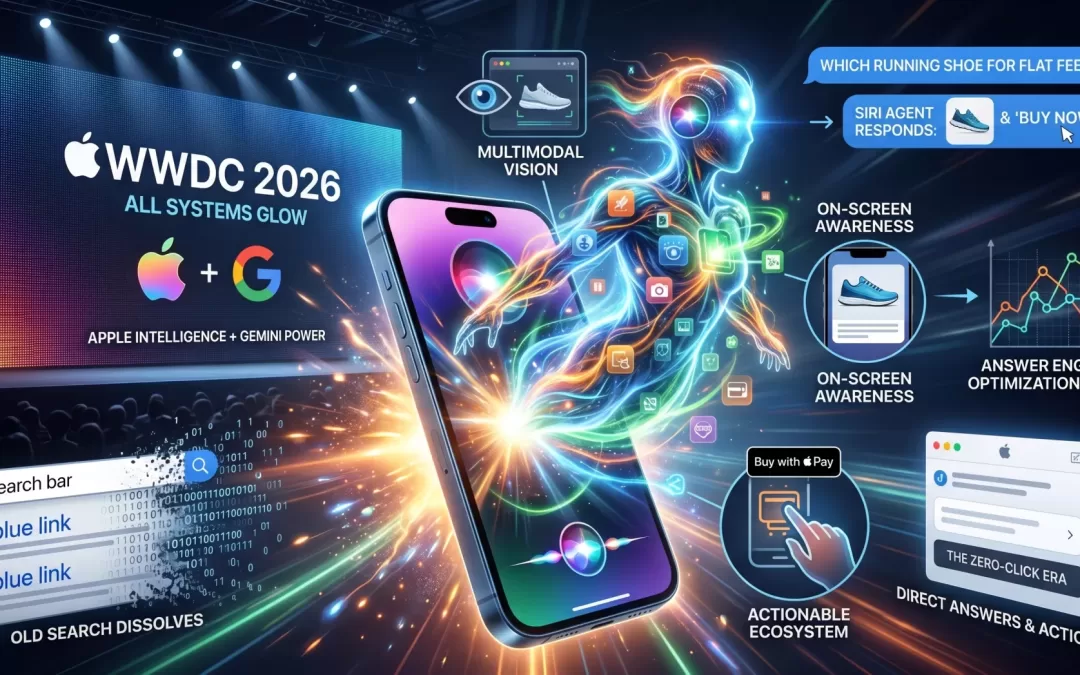
Apple’s WWDC 2026 keynote introduces “All Systems Glow,” marking a strategic pivot toward an agentic AI ecosystem powered by a partnership with Google to integrate Gemini into a revamped, multimodal Siri [2]. This shift transforms Siri into an autonomous agent capable of on-screen awareness, signaling a “zero-click” era that disrupts traditional SEO and mandates Answer Engine Optimization (AIO) for businesses.
The Jan 2026 Apple-Google partnership marked a pivotal moment in the transition from Search Engines to Answer Engines. By integrating Google’s Gemini models directly into the operating system, Apple has effectively merged the world’s most valuable real estate (the iPhone Home Screen) with the world’s most comprehensive knowledge graph.
Here, we will provide an assessment of the impact these new developments will have on the industry, a breakdown of the launch of Apple’s Siri AI agent product, and an overview of the inevitable market shift occurring at lightning speed.
The Product: Siri Becomes an “Agent” of Intelligence
It is expected that Apple’s AI big announcements in just a few short days will significantly impact the industry by highlighting their shift of focus from cloud-based servers to on-device processing, integrating AI deeply into billions of consumer devices, and opening the ecosystem to third-party AI agents. The upcoming WWDC release isn’t just a “voice assistant” update; it represents Siri’s evolution into a multimodal agent. While Apple’s native “Apple Intelligence” handles on-device personal context (calendar, messages), the integration of Gemini provides the expansive “World Knowledge” layer that Siri previously lacked. Additionally,
- Multimodal “Vision”: Leveraging Gemini’s strength, the new Siri is expected to interact with on-screen content—analyzing complex images, documents, or video frames in real-time to answer questions like “Where can I buy these shoes in the video?” or “Summarize this legal document.”
- The Handoff Protocol: Apple will likely maintain its “Privacy First” branding by using Private Cloud Compute for personal tasks, only handing off to Google’s cloud for complex, non-personal queries. This “orchestration” layer is the key technical moat.
- Action over Information: The deep integration of App Intents allows Siri to navigate inside apps. Instead of giving you a link to a travel site, Siri + Gemini will likely be able to execute the booking steps for you, acting as a true digital concierge.
- The Push for On-Device AI: Apple has prioritized running AI models directly on users’ devices (using their specialized Neural Engines), rather than solely relying on cloud servers.
Impact on Users: The “Zero-Friction” Future
For the average iPhone user, the friction of “searching” will disappear.
- Benefit: Apple users will no longer need to “Google it.” They will simply “Ask Siri.” The distinction between searching the web and using the phone will dissolve.
- Privacy Trade-off: While Apple will obscure IP addresses, users are effectively consenting to send their complex queries to Google’s servers. The benefit is a Siri that actually works; the cost is a blurring of the privacy line that Apple has fiercely guarded.
The Business Crisis: The Death of the “Blue Link”
For brands, publishers, and marketers, this partnership is a sort of mass extinction event for traditional traffic originating from organic search.
- The “Gartner” Reality: Analysts have predicted, back in February 2026, that search engine volume could drop by 25% by 2026 due to AI chatbots [1]. With Gemini baked into Siri, this prediction continues to accelerate.
- Invisibility of the Middleman: If Siri answers “What is the best running shoe for flat feet?” with a synthesized answer and a direct “Buy with Apple Pay” button, the affiliate sites, review blogs, and e-commerce aggregators are cut out of the loop.
- New Optimization Strategy (AIO): Businesses can no longer optimize for keywords. They must optimize for Entity Authority. In order to be found by Gemini-Siri, a brand must be a verified “fact” in the Knowledge Graph, not just a result on a SERP.
Strategic Pivot for Brands:
- Adopt “Answer Engine Optimization” (AIO): Structure data so AI can easily parse price, availability, and specs.
- Focus on Retention: Since “discovery” traffic will plummet, owning the customer relationship (email, app installation) becomes the only safety net.
- User Intent / User Experience: Content creation must focus on the psychology of the target audience. Developing for user intent and overall user experience are imperative.
Final Verdict
The Apple-Google alliance is a defensive masterstroke. Apple solves its “AI lag” instantly, and Google ensures its models remain the default “brain” of the mobile web. For the rest of the industry, the “Walled Garden” just got taller, and the gatekeeper (Siri) now demands a higher toll for entry through a gate built by Google. The impact of which has already been felt across AI platforms as many users shift to non-ai-powered search tools and web ecosystems where privacy, security, and sovereignty still reign. The question I have is how the tech industry will adapt to the needs of the public while continuing to innovate towards the future.
Sources:
WWDC26 – Apple Developer
Gartner Predicts Search Engine Volume Will Drop 25% by 2026
MSN Apple WWDC 2026 preview: Siri, AI, and more
TechCrunch: Apple Approves Poke as first AI Agent
Reddit: Apple is still way behind in AI
Yahoo: Apple’s Biggest Bet on AI Yet

David L. King II
Founder, Lead Strategist