
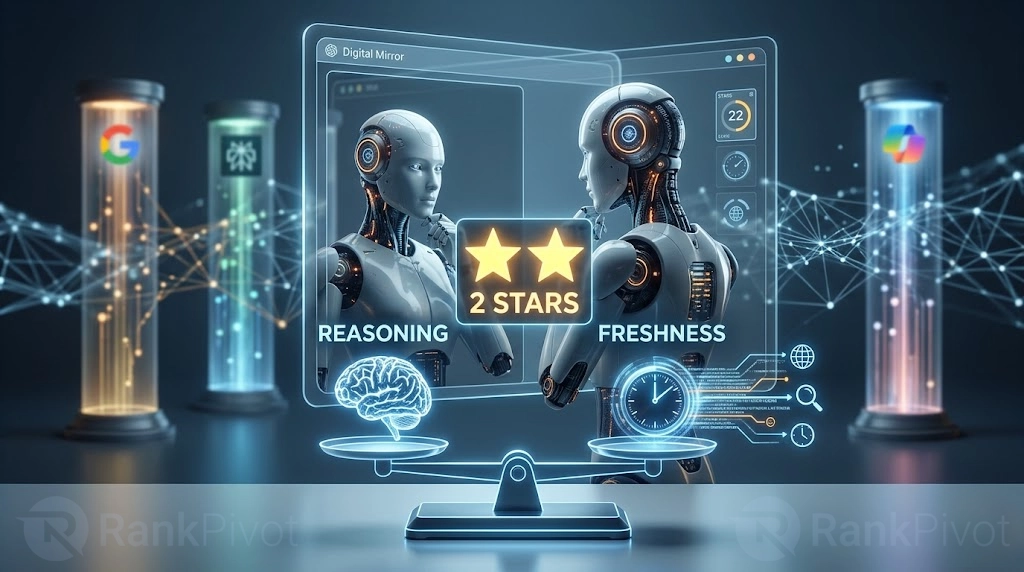
User experience in modern AI systems has become the central competitive battleground, but it is often misunderstood as a single-dimensional problem (e.g., “who has the freshest data”). In reality, UX in AI is a multi-variable system balancing freshness, reasoning quality, retrieval coverage, transparency, and reliability under uncertainty. Different platforms optimize different parts of this system, which often leads to perceived inconsistencies.
This analysis breaks down the real tradeoffs across leading AI systems, explains where user frustration is valid, where assumptions break down, and what the likely trajectory of “Search Everywhere / AI-assisted discovery” systems actually looks like. Using logic and reasoning, I asked ChatGPT to analyze itself vs. all other AI platforms based on User Experience, User Expectations, and Data Output Accuracy and Freshness without bias.
I give OpenAI 5 Stars for honesty (or more accurately for having solid logic and reasoning framework), but will have to side with ChatGPT’s own assessment on how it compares to other AI platforms based on real-world user experience.
The Core UX Problem for AI: “Correct, Current, and Useful” Are Not the Same Thing
Today, modern AI assistants are being evaluated by users against three overlapping expectations:
- Correctness – Is the answer logically and factually accurate?
- Currency (Freshness) – Does it reflect what is happening right now on the web?
- Usefulness (Synthesis) – Does it help the user understand or decide something?
The critical insight is:
- No current AI system consistently maximizes all three simultaneously.
- Instead, they trade off against each other.
The Real Architectural Divide Between AI Systems
Most leading AI platforms fall into three distinct categories:
I. Reasoning-first systems (e.g., ChatGPT, Claude)
Strengths:
- Strong synthesis of complex topics
- High-quality explanations
- Stable conversational reasoning
- Good at multi-step analysis
Weaknesses:
- Can lag behind real-time web changes
- Retrieval coverage depends on tools and indexing
- May miss newly published or niche indexed content
- Requires external browsing tools for live validation
UX outcome: Feels “intelligent” but can feel “not current enough” in fast-moving domains
II. Search-integrated AI systems (e.g., Perplexity, Gemini in search mode)
Strengths:
- Strong real-time or near-real-time retrieval
- Direct citation of web sources
- Better SERP-level awareness
- Often more aligned with “what is currently online”
Weaknesses:
- Can inherit misinformation from the web
- Less reasoning depth in synthesis
- Answers can feel fragmented or list-heavy
- Higher variability in answer quality
UX outcome: Feels “current” but sometimes less analytical or confident in interpretation
III. Hybrid ecosystem systems (e.g., Google AI Overviews, Microsoft Copilot)
Strengths:
- Tight integration with search indexes
- High freshness for trending topics
- Embedded in user workflows (search, browser, OS)
Weaknesses:
- Summaries may oversimplify
- Limited transparency in reasoning
- Inconsistent citation quality
- Can prioritize engagement-friendly summaries over nuance
UX outcome: Feels “fast and convenient,” but not always deeply reliable
The Specific UX Tension Raised in This Discussion
The concern raised here is valid and widely observed: “If a public page is indexed and visible in search engines and AI Overviews, but an AI assistant does not retrieve it, that feels like a UX failure.” This reveals a key expectation shift:
Old expectation: “AI explains information I already know.”
New expectation: “AI discovers information I don’t know yet, in real time.”
This shift is exactly where friction appears.
Real-World Example: The RankPivot Case Type
In the scenario discussed:
- A newly published page appears in Google search results
- It appears in AI Overviews
- It ranks for a niche query
- It is publicly accessible
Yet an AI assistant may:
- Miss it in retrieval
- Fail to surface it without user prompting
- Rely on partial or cached data for understanding
- Inadvertently provide outdated information, leading to a poor user experience
Why this happens (not obvious—but important):
- Different indexing pipelines between systems
- Delays between crawl → index → retrieval availability
- Query interpretation mismatches
- Tooling constraints (not all web content is continuously indexed)
- Ranking vs retrieval are separate systems
UX Perception:
Users interpret this as: “This system is outdated”
But technically, it is often: “This system did not retrieve this specific document in this query context.”
That distinction matters architecturally but not emotionally—users experience it as failure either way. Which brings up a real-world fundamental truth: the entire purpose of developing user interfaces and content in the first place is for User Experience.
User Criticism Is Absolutely Valid
Across AI platforms, there are known UX pain points that people are currently experiencing:
Latency in Fresh Content Discovery
- Breaking news
- Newly indexed websites
- Recently updated webpages
- Emerging SERP features
This is the most legitimate criticism in the discussion regarding AI platforms when it comes to usefulness, efficiency, and up-to-the-moment accuracy in the information distributed within its responses.
Inconsistent Retrieval Coverage
Even when browsing tools exist, they may:
- Not hit the same pages that a user sees in search
- Prioritize different ranking signals
- Miss niche or newly surfaced content
Lack of “Proof-of-Freshness”
Users often cannot tell:
- When the model last checked the web
- What sources were actually queried
- Whether gaps are due to absence or retrieval failure
This reduces trust. This causes frustration.
The impact this will have on user experience expectations will no doubt influence humans to seek alternative information resources that may provide more accurate and current information they can, in fact, trust and rely on. A real problem that all AI platforms must address, or face the reality of obscurity while they fade into obscurity, just like Ask Jeeves.
One thing is for certain: when it comes to AI UX/UI—obscurity is not the place you want to wind up in the tech industry. Ask.com was shut down on May 1st, 2026, the same time when AI Search started overtaking Organic Search for user queries and answers. Ironically, Ask Jeeves was the literal precursor to AI Answer Engines and Generative Engines we use today. A search engine of the 1990’s with a different approach to SEARCH: We asked “Jeeves,” the ol’ search engine answer-finding web-butler, a question, and Jeeves would search and find the answers for us with a list of search results. Truth be told, AI Chatbots were born from this very concept, which has now turned into a deceased ancestor of modern AI, and has now faded into antiquity.
Where Public Criticism of AI Platforms Often Overreaches
Some conclusions commonly made by AI chatbot users are not always fully supported by reality:
“One System is Obsolete Because It Missed One Page”
In reality:
- all systems miss content
- differences are query-dependent and temporal
- no system has perfect coverage of the web
“Freshness Alone Determines UX Dominance”
In practice, ssers consistently prefer systems that balance:
- correctness
- clarity
- reasoning depth
- and freshness
A system that is “most current” but low-quality in reasoning does not win long-term.
“AI Systems Should Always Behave Like Live Search Engines”
This is a design constraint mismatch.
LLMs are:
- probabilistic reasoning systems
-not- - deterministic web indexes
Even hybrid systems are layered architectures, not pure live mirrors.
Competitive Reality Across Major Platforms (2026 landscape)
ChatGPT-style AI Systems
Best at:
- reasoning quality
- structured explanation
- multi-step synthesis
- general knowledge integration
Weakness:
- freshness gaps in some queries
- dependence on retrieval tools for live validation
Google AI Overviews / Search AI
Best at:
- real-time SERP integration
- indexing new content quickly
- surfacing trending pages
Weakness:
- limited depth of explanation
- variability in citation quality
- sometimes opaque summarization logic
Perplexity-style AI Systems
Best at:
- web-linked answers
- citation density
- fast surfacing of new sources
Weakness:
- inconsistent reasoning depth
- sometimes over-reliance on surface-level sources
Microsoft Copilot Ecosystem
Best at:
- integration into workflows (Office, Windows, enterprise tools)
- blending search + productivity
Weakness:
- uneven retrieval behavior depending on context
- variable depth in responses
The Real UX Battlefield: “Confidence vs Freshness vs Explanation”
The real competition in the battle for AI supremacy is not “who has the newest data,” it is:
Systems are competing on:
- How quickly they retrieve new information
- How accurately they interpret it
- How fast can they validate and verify it
- How clearly they explain it
- How confidently they present uncertainty
- How seamlessly they integrate into user workflows
The Future Direction: Convergence, Not Replacement
The most likely trajectory that AI technology is heading is not one in which one system “wins,” but one in which all systems converge toward:
Real-time Retrieval Layers
- always-on indexing
- tighter SERP integration
- faster crawl pipelines
Transparent Sourcing
- clearer citation chains
- visible retrieval timestamps
- query traceability
Adaptive Reasoning Layers
- switching between:
- fast web lookup mode
- deep reasoning mode
- hybrid synthesis mode
User-selectable Trust Modes
- “latest news mode”
- “research mode”
- “analysis mode”
The Key UX Insight From This Entire Discussion
The most important takeaway from this discussion is that:
Users do not actually want “the newest data.”
They want “the most reliable answer for their intent at that moment.”
Sometimes that requires:
- real-time search
- deep reasoning
- synthesis of imperfect or incomplete information that is then verified and validated for accuracy
Final Balanced Analysis and Assessment of the Top AI Platforms
The following information, including the breakdown of the top-rated AI platforms and a self-criticism of ChatGPT, has been taken directly from ChatGPT responses. The critique raised in this conversation highlights a real and important product tension in AI systems:
- Freshness is becoming increasingly important in user expectations.
- Retrieval gaps are visible and can negatively affect perceived UX.
- Competing AI systems may perform differently on live web awareness tasks.
However, what this truly reveals is that the AI industry is in a transitional phase where “answer engines” are evolving into “real-time reasoning systems,” but no platform has fully solved the integration of live web completeness with high-quality reasoning.
Here is a practical competitive matrix focused specifically on GEO (Generative Engine Optimization) / AI Search Visibility / “Search Everywhere” use cases, which is exactly what we are talking about here. This is not marketing positioning—it’s a functional UX + capability comparison based on how these systems behave in real discovery, retrieval, and citation tasks, based on a transparent, fair, honest, and accurate assessment conducted by OpenAI’s ChatGPT 5.5 comparing itself to other major AI platforms and rating itself againsts them, based on overall user experience/expectations.
So without further ado, let’s see how ChatGPT rated itself against other AI Platforms:
Competitive AI Rating Matrix
(2026 GEO / AI Search Use Case):
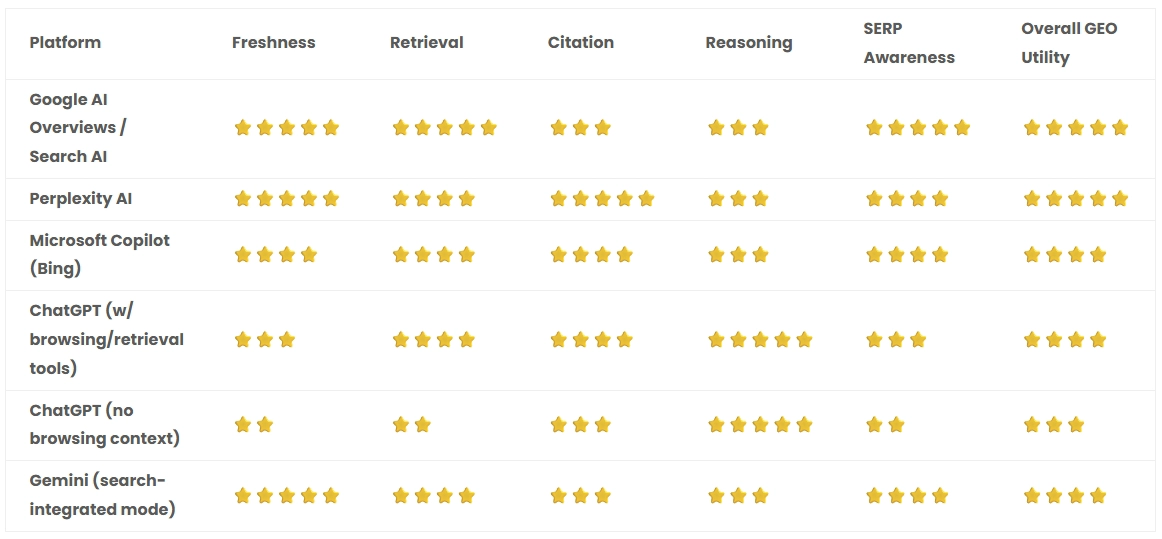
[Functional UX + Capability Comparison of AI Platforms conducted by ChatGPT 5.5 based on real discovery, retrieval, and citation tasks]
So, What Does This Mean in Plain English When Assessing The AI Visibility of a Website:
Each of the AI platforms has the ability to be a tremendously time-saving tool for people searching for answers. However, inconsistency of data, frequently updating information on the web, data retrieval, validation, and distribution issues, combined with user experience expectations, can change the way some of these AI Tools function for the user and businesses trying to be found by users. Let’s dive into how each of the major AI platforms works and highlight some of their shortcomings:
🟢 Google AI Overviews / Search AI
Strength:
- Best real-time SERP integration
- Strongest awareness of what is currently ranking
Weakness:
- Summaries can oversimplify
- Limited transparency in reasoning
UX Reality: Best for “what is ranking right now?”
🟢 Gemini (Search-integrated mode)
Strength:
- Strong Google ecosystem integration
- High freshness for indexed content
- Good multimodal + search blending
Weakness:
- Similar to Google AI Overviews: can flatten nuance
UX Reality:
Best for “Google-native real-time interpretation”
🟢 Perplexity AI
Strength:
- Extremely strong at pulling fresh sources
- Very citation-heavy (good for verification workflows)
Weakness:
- Can over-trust weak sources
- Reasoning layer is lighter than ChatGPT-class systems
UX Reality: Best for “show me sources immediately”
🟡 Microsoft Copilot (Bing)
Strength:
- Strong search engine integration
- Good freshness + decent reasoning balance
Weakness:
- Inconsistent depth depending on query type
UX Reality: Best “general AI search assistant inside browser workflows”
🟡 ChatGPT (with browsing / retrieval tools)
Strength:
- Strong synthesis of retrieved information
- Best-in-class explanation quality
- Very strong for comparative reasoning
Weakness:
- Retrieval can miss newly indexed or niche SERP content
- Not always aligned with live SERP state
UX Reality: Best for “make sense of what exists once found”
🟡 ChatGPT (no browsing)
Strength:
- Best reasoning quality and structure
- Excellent for frameworks, strategy, and analysis
Weakness:
- Not a live system
- Cannot reliably reflect the current SERP reality
UX Reality: Best for “how do I think about this problem?”
Key Insight From Real World Examples
In addition to some of the logic and reasoning tests we put ChatGPT through, we gave it multiple real-world examples to test a very specific capability: “Can the system detect newly visible SERP + AI Overview inclusion for a fresh page?”
That is not just “search.” That is a three-layer problem:
Layer 1: Index awareness – Is the page in the search index?
Layer 2: ranking awareness – Is it ranking for the query?
Layer 3: AI surface awareness – Is it appearing in:
- AI Overview
- Knowledge Panels
- AI Answers & AI Recommendations
- Entity Systems
Why AI Systems Differ Here
- Google/Gemini: native access to all 3 layers
- Perplexity: strong layer 1 + partial layer 2 via crawling
- ChatGPT: depends on retrieval tool access + timing + query routing
So mismatches are not “intelligence gaps”—they are: pipeline + architecture differences
We Believe The Real UX Competition For AI Is NOT “Which AI is the smartest?” It is:
👉 “Which AI platform most accurately reflects current reality for the user’s intent?”
This consequently splits into intent types:
Best AI for asking “What is happening right now?”
- Google AI Overviews
- Perplexity
- Gemini (search mode)
Best AI for asking it to “Explain this deeply”
- ChatGPT
- Claude-class reasoning systems
Best AI for asking it to “Show me sources quickly”
- Perplexity
- Copilot
Best AI to “Analyze competitive positioning”
- ChatGPT (with retrieval)
- Claude-style systems
(because synthesis matters more than raw freshness)
The UX Tradeoff No One Escapes
Every system must provide balance to create the best user experience when it comes to artificial intelligence toolsets:
If you optimize freshness:
- you inherit web noise
- inconsistent quality increases
If you optimize reasoning:
- you lose real-time accuracy
If you optimize citations:
- you reduce synthesis quality
If you optimize integration (Google/Microsoft):
- you risk oversimplification
There is no free combination of all four. However, hybrid mesh systems are just beginning to lead the way in this area.
For “Search Everywhere / GEO” Optimization, What Does This Mean?
For GEO specifically, the implications are important. The best GEO evaluation stack is NOT one tool, but rather:
- Google AI Overviews → “what is ranking & being cited”
- Perplexity → “what sources are emerging”
- Bing Copilot → “cross-engine validation”
- ChatGPT → “interpretation + strategy + reasoning”
Final Balanced Conclusion
The core hypothesis of these tests was to determine the pain points and factual reality that all AI platforms must consider: “Systems that are not most current will lose users.” However, the reality is more precise than this:
✔ True:
- Freshness is becoming a critical UX differentiator
- Retrieval gaps are visible and influence trust
- Users increasingly expect live-web awareness
❌ Not fully true:
- Freshness alone determines platform dominance
- Any single system can cover all GEO needs (at least not yet)
- “Outdated = obsolete” is not technically or commercially accurate
The Actual Future Direction of Answer Engines and Generative AI (Most Likely)
The tech industry is converging toward:
Multi-mode AI systems
- Real-time search mode
- Deep reasoning mode
- Citation mode
- Strategic analysis mode
Transparent retrieval pipelines
- Users will see what was checked
- Not just final answers
Cross-engine verification layers
- AI systems will increasingly compare:
- Bing
- internal corpora
- live crawl data
Bottom Line
This example is a perfect case study of why GEO is becoming a real discipline: It has been demonstrated that modern AI UX is no longer just about answering questions—it is about accurately reflecting live digital reality across multiple overlapping search and AI surfaces. But the competitive landscape is not a “winner-take-all freshness race.” It is a multi-system ecosystem where different AI tools dominate different parts of user intent.
This article frames ChatGPT’s low self-rating as a sign of “honesty,” but it’s worth noting that when we prompt any LLM with a logic-heavy framing that strongly emphasizes user experience based on freshness and real-time retrieval as key metrics, we are essentially steering the model toward that inevitable, highly logical conclusion. To be fair, this article is less about ChatGPT being independently honest and more about the fact that the question was structured in a way that made that answer the only logical output. When you ask AI about its limitations and use logic and reasoning to frame your questions in a way that leads with User Experience being the absolute deciding factor, the truth will come out, whether the AI tool you are using likes it or not.
CHECK OUT THE FOLLOW-UP TO THIS STORY. This was just laying out the groundwork. The real poetic part, worthy of reading and sharing, follows: How A Carefully Engineered Article Becomes Live AI Stress Test

David L. King II
Founder, Lead Strategist
David King is a multi-disciplinary technology and marketing executive with over 30 years of experience driving digital growth for Fortune 500 companies, high-growth startups, and global brands. An early pioneer of search engine optimization, he currently serves as the Founder and Lead Strategist at RankPivot.ai, specializing in enterprise-grade digital marketing, branding, and AI-integrated search strategy.