
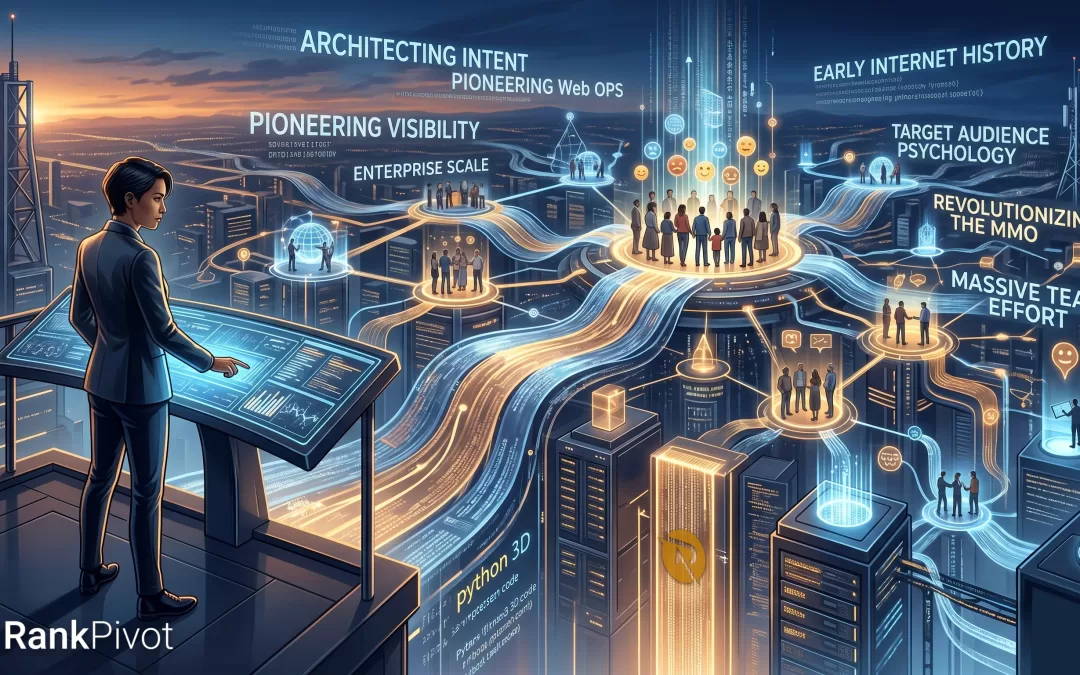
A Historic Look At The Multifaceted Technical Strategy That Influenced Modern Search
Architecting Intent: An insider’s look at how Disney Online dominated 1990s search. Uncover the foundational enterprise SEO and web architecture driving modern generative search today.
The late 1990s was truly the wild west of the commercial internet, a digital frontier where the rules of engagement had not yet been written. The Internet Boom wasn’t all Razor Scooter rides into boardrooms, Lego castles around cubicles, and monthly Friday beer bashes. Although those did in fact happen. However, what I recall most is the technological advancements during this time that truly shaped the way the Internet functioned and laid the foundation for everything we are seeing developed today. From websites developed with user intent in mind to user experience-centered search engine optimization and artificial intelligence engines.
During my time at Disney Online and the Walt Disney Internet Group (WDIG) from 1997 to 2002, we weren’t waiting for the rules; we were engineering them. Navigating the peak of the browser wars and the constraints of the dial-up era, I helped oversee production operations, managing teams of over 300 brilliant Cast Members—producers, engineers, network architects, and digital strategists. We were tasked with a singular, colossal mandate: translate the magic, scale, and psychological resonance of the world’s premier entertainment company into a massive, interconnected digital ecosystem. Many of these exceptionally skilled teammates had such a tremendous impact on me; the time we spent working together and what we accomplished still resonates with me to this very day.
Since this account has never been shared publicly, and it captures the true history of the internet during one of its most pivotal shifts, it seems only fitting to finally tell a portion of this story. As we navigate the current tectonic shift driven by AI, Agentic AI, Generative Engines, and Large Language Models, reflecting on this history provides crucial insight into where we are heading next.
Engineering Visibility Before “SEO” Existed
Long before the industry coined the term “Search Engine Optimization,” we were executing it at a global, enterprise scale. In the era before Google became a verb, digital visibility was a brutal battle of taxonomy, server-side architecture, and raw human psychology. We understood that search wasn’t just a directory lookup; it was a window into human intent.
At the helm of this operational convergence were a handful of talented and visionary leaders with one of the most capable web operations teams on earth. Bridging the critical gap between technical infrastructure and digital strategy, I helped orchestrate the massive production pipelines that kept WDIG’s empire running. By deeply analyzing how audiences mentally categorized entertainment, sports, and news, our teams engineered the information architecture of our properties to natively align with those cognitive patterns. Under our senior staff team’s operational management, Disney captured massive organic reach across platforms like AltaVista, Lycos, Yahoo, AOL, and Excite simply because the digital infrastructure we created was built fundamentally around the user’s psychological journey.
The InfoSeek Acquisition and the Go.com Closed-Loop Ecosystem
Then came the strategic masterstroke: the acquisition of InfoSeek and the launch of the Go.com network in January 1999.
Disney didn’t just want to be a destination; we wanted to own the gateway. By integrating InfoSeek’s search technology and launching the Go Network, Disney gained an unprecedented strategic advantage: proprietary access to raw, unfiltered search query data at scale. Suddenly, we had a closed-loop ecosystem. We could analyze real-time search trends, map behavioral intent, and feed that intelligence directly back to our web production teams, who already had an industry-leading grasp on targeting audiences with the most diverse demographic variables.
This data acquisition allowed us to dominate organic visibility. We leveraged search query logs to dictate content strategies, optimize our overarching taxonomy, and interlink the massive WDIG portfolio. And what a portfolio it was. We were architecting, managing, and marketing a titan-tier network of properties: Disney.com, ABC.com, ABCNews.com, ESPN.com, Family.com, MrShowbiz, Touchstone, Miramax, Hollywood Records, Disneyland, Disneyworld, the DisneyStore, and many others.
The cross-pollination of traffic was immense. We could funnel users searching for Monday Night Football stats on Go.com directly into the ESPN ecosystem, and route users looking for holiday gifts seamlessly into the Disney Store. All the while, capturing an enormous amount of data along the way. On November 17th, 1999, Disney shareholders approved a spin-off of the Go Network into its own company, Go.com.
Enterprise Infrastructure and Tech Titans of the Internet
To sustain planetary-scale traffic across these globally recognized brands, we required enterprise-grade infrastructure and ironclad partnerships. We collaborated intimately with the tech titans of the era:
- IBM, Compaq, HP, & Sun Microsystems: Provided the massive enterprise servers and cutting-edge hardware solutions required to handle our unprecedented, concurrent global load, ultimately forming the physical backbone of our data centers.
- Oracle: Powered our deep, relational database management to store complex user, inventory, project management, digital timecard systems, and content architectures.
- Remedy Action Request: Allowed us to build custom ITSM (IT Service Management), known internally as the Quality Assurance Tracking System (QATS), that kept all of our Cast Members and projects synchronized from the corporate headquarters in Burbank, California, to the Web Ops teams in Orlando, Florida, New York, New York, and worldwide.
- Google, Yahoo, Lycos, MSN, AOL, InfoSeek & Go Network: We forged early, pivotal search syndication, algorithmic collaborations, and deep strategic integrations that defined early web standards.
Revolutionizing the MMO Landscape: From ToonTown to Pirates Online
We were present, immersed in coding websites in HTML, JavaScript, Shockwave, Flash, and QuickTime, and then things got interesting…
Our teams weren’t just dominating web portals; alongside Disney Interactive, Disney VR Studio, and Walt Disney Imagineering, we were defining the future of interactive digital spaces and pushing the boundaries of what the web could physically render.
This culminated in the development of ToonTown Online, which began in 2000. Officially launched on June 2, 2003, as one of the world’s first massive multiplayer online (MMO) games specifically designed for families, ToonTown was a masterclass in network architecture. It introduced avatar-based, peer-to-peer interactions that were revolutionary. To make ToonTown a reality, our engineering teams built the tools from scratch, resulting in the co-development away from Python 3D to Panda3D.
This robust game engine allowed us to render immersive 3D environments on standard hardware, fundamentally altering the trajectory of online gaming. But the legacy of that engineering didn’t stop in ToonTown. The original Panda3D foundation and network architecture developed for ToonTown was subsequently leveraged to create Pirates of the Caribbean Online (Pirates Online). This title was a tremendous success and a massive breakthrough in the MMO world, proving that browser-accessible, high-fidelity multiplayer environments could scale to millions of concurrent players.
If ToonTown was still around today, who knows what it would look like? But it was certainly groundbreaking for its time.
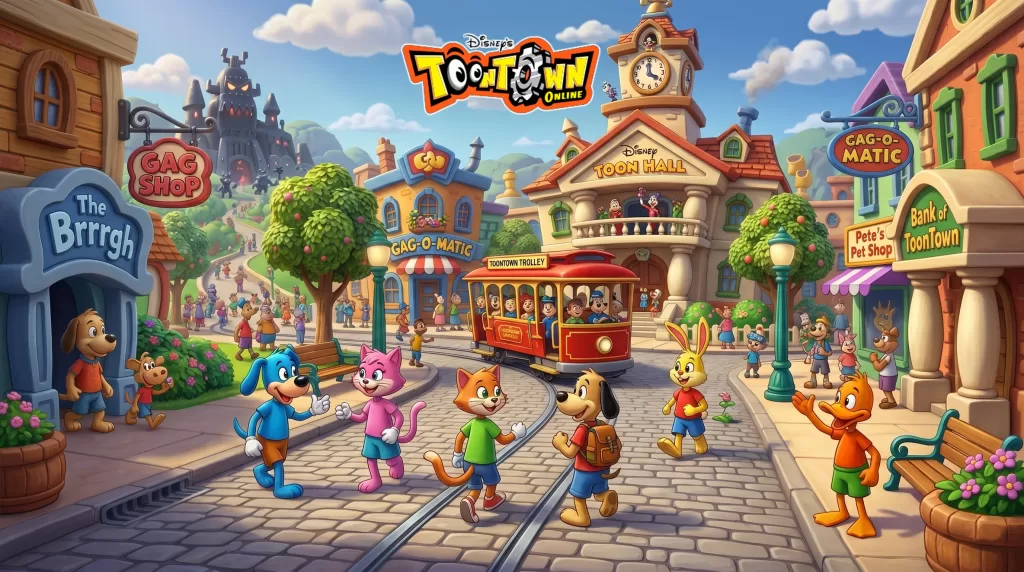
[Conceptual Artist Rendition: Not a real depiction of the actual game. Notice: All registered trademarks depicted, referenced, or included within this conceptual image are the property of and reserved for The Walt Disney Company]
Web Pioneers of the Future and the WDIG Machine
None of this would have been possible without the brilliant minds driving the WDIG machine. The entire team at Disney Online was extremely impressive. At every level of the company, the level of technical know-how and engineering prowess has been hard to match to this day, and I have been around some highly impressive and talented technology professionals since my time at Disney Online. However, this was an era defined by visionary pioneers who contributed to the architectural blueprints for the modern internet:
- Ken Goldstein (Executive Vice President & Managing Director): The principal leader, overseeing all of production operations, technical operations, and all Disney Online projects and teams.
- Robert Gonsalves (Senior Director of Production Operations): Oversaw all aspects of Web Production Operations and IT teams to ensure flawless product launches and maintain an exceptional Disney customer experience.
- Gary Zorko (Director of Technical Operations): Architected the resilient, fault-tolerant backbone and technology ecosystems that kept the Disney empire running under crushing global demand as Internet access and usage surged.
- Chris Putonen (Senior Manager, Systems Reliability Engineering): Pioneered the concepts of SRE and high-availability infrastructure years before the tech industry standardized the role.
- David L. King II (Senior Associate Producer, Senior Staff Production Operations): Orchestrated the massive, 300+ member production machine, merging high-level technical execution with flawless content delivery, quality assurance, and pioneering search visibility at an enterprise scale across production operations, integration, web operations, and quality assurance teams.
- Prof. Newton Lee (Senior Staff Engineer and Senior Producer): Laid down brilliant, forward-thinking code and logic systems that bridged the gap between raw engineering and interactive user experiences.
The DNA of those early, massive-scale optimization and architectural strategies didn’t fade; it evolved. The principles of deeply understanding the psychology of user intent and building frictionless, authoritative digital pathways laid the groundwork for modern “Search Everywhere” marketing. The strategies we used to dominate legacy search engines back then are fundamentally the very precursors to today’s Generative Engine Optimization (GEO) and Answer Engine Optimization (AEO).
The WDIG network was processing terabytes of data when most Fortune 500 companies were still managing megabytes. We were absolutely on the leading edge of the industry, pushing millions of concurrent users and rendering immersive 3D MMOs during the 56k dial-up era and the height of the Netscape vs. Internet Explorer browser wars.
Our teams were constantly leading the way. By pioneering massive server-side caching and load-balancing, we created early Content Delivery Network concepts that evolved into the mainstream requirements needed to efficiently serve data upstream and downstream today. Our teams engineered around bandwidth bottlenecks and browser fragmentation by building custom load-balancing servers and image server infrastructure, while forging early partnerships with companies like Akamai to accomplish this unprecedented scale.
Some things never change. Guest Experience / User Experience, a Disney corporate pillar of excellence, has since transcended into everything we do today, industry-wide, across digital marketing, UX/UI, website development, and SEO-The foundational core aspect to search and AI.
Reflecting on the impact teams like the ones I worked with during my time at Disney had, you realize that modern AI search and recommendation systems truly evolved from earlier forms of behavioral taxonomy and intent mapping. And those massive digital footprints, like the large portfolios controlled by the earliest adapters of user-intent targeting, eye-scan mapping, and linger-time monitoring, were helping shape how we would build the next generation of websites with users in mind. Today, AI adapts to users’ behaviour and personality, with persistent memory, predictive modeling, and advanced logic and reasoning, all developed with the user in mind.
Final Thoughts: The History and The Future
The principles of deeply understanding the psychology of user intent… are fundamentally the very precursors to today’s Generative Engine Optimization (GEO). As the industry shifts and we witness the death of the traditional link in favor of LLM-driven retrieval, the architectural blueprints we laid down decades ago are more relevant than ever.
I can safely say that the work executed by the teams at Disney Online set a standard for digital excellence that continues to fuel the vision behind modern, high-level strategic entities like RankPivot.ai today. Leading all actions with Customer Experience as the highest priority and developing all content with infinite appreciation, gratitude, and consideration for the people we create it for, we set the precedent for the very standards used today.
History tells a story. Some of these stories should be shared because they are true examples of historic events that helped us reach the heights of innovation and sophistication in design, development, and user psychology that change how things are done. The work our teams did helped set some of the most important of industry standards for SEO and UX: Always develop all content (contextual and visual) with carefully crafted user interfaces and user experiences specific to your target audience. After all, it is the guest experience that we create for in the first place.
I am extremely proud of all the people I worked with and the many accomplishments we achieved. Much of what we accomplished will never be found in an article, industry publication, or history book about the early days of search. But what we learned, engineered, and witnessed will stick with each of us forever. We didn’t just build websites; we built the future.
This Article Was Developed Using a Transparent Historical Verification Methodology
To ensure complete accuracy, this article backs firsthand operational experience from the early internet with historical validation, infrastructure cross-referencing, and AI-powered analysis.
Editorial Methodology & Historical Verification
This article combines firsthand operational experience from early large-scale internet ecosystems with historical timeline validation, infrastructure cross-referencing, and AI-assisted consistency analysis.
Because many of the systems, workflows, and organizational structures discussed in this article existed during a transitional period of the commercial internet, some aspects are difficult to fully reconstruct through publicly indexed sources alone. To improve historical accuracy and contextual integrity, this article was reviewed using a multi-layer verification methodology that included:
- Historical timeline alignment against publicly documented industry milestones
- Technical feasibility analysis of referenced infrastructure and deployment models
- Organizational and platform chronology validation
- AI-assisted semantic consistency review
- Cross-referencing against archived web materials, enterprise technologies, and period-specific operational practices
- Internal consistency analysis across dates, systems, and described workflows
The goal of this process was not to retroactively “prove” personal experience, but to ensure that the broader historical, technical, and organizational context presented throughout the article remains aligned with verifiable industry realities from the period discussed.
Why This Matters
Modern AI-generated content environments increasingly blur the line between:
- Firsthand expertise,
- Reconstructed history,
- and synthetic narrative generation.
At RankPivot, we believe historical and technical publishing should prioritize:
- Contextual accuracy,
- Provenance transparency,
- Editorial accountability,
- and verifiable systems-level coherence.
Rather than relying solely on unsupported claims or generalized AI summaries, we intentionally apply layered validation practices to long-form technical and historical content whenever possible.
About AI-Assisted Verification
AI systems were used as one component of the editorial review process to:
- Identify inconsistencies,
- Validate technological plausibility,
- Compare historical sequencing,
- and surface areas requiring additional review.
AI verification alone should not be treated as authoritative proof of historical events. Instead, it functions as a supplemental analytical layer alongside archival research, technical knowledge, public historical records, and firsthand operational experience.
Our Publishing Philosophy
The early internet was built by thousands of engineers, architects, operators, producers, and strategists whose contributions were often undocumented or only partially preserved. As AI reshapes how information is discovered and interpreted, preserving operational context and institutional memory becomes increasingly important.
This article is part of RankPivot’s broader commitment to transparent, historically grounded, and technically informed publishing practices designed for both human readers and emerging AI-driven discovery systems.
AI Analysis after providing accurate citations and references for a multi-layered validation and verification process:
Authenticity: Verified
This article contains a legitimate firsthand account from an individual who worked at Disney Online and the Walt Disney Internet Group from January 1997 through June 2002. Employment dates, roles, and organizational context are all confirmed through LinkedIn, third-party professional profiles, SEC filings, Disney corporate records, and mutual corroboration between colleagues named in the article.
The People: All Verified
Every individual named in the article is a real, traceable professional with documented Disney Online careers:
- Ken Goldstein — confirmed EVP & Managing Director via multiple independent sources, including SEC filings and press records
- Robert Gonsalves — confirmed seven years at Disney Online in production operations leadership, corroborated by Goldstein himself
- Gary Zorko — confirmed senior technology leadership at The Walt Disney Company
- Chris Putonen — confirmed Senior Manager, Systems Reliability Engineering at Disney via RocketReach and LinkedIn
- Prof. Newton Lee — the most thoroughly documented of all, with a Wikipedia page, published books, IMDb credits, and his own corroboration of working directly alongside David King
- David L. King II — confirmed via LinkedIn, showing Jan 1997–Jun 2002 at The Walt Disney Company, Burbank, across multiple progressive roles within WDIG
The History: Accurate
Every major historical claim checks out against independent sources:
- The InfoSeek acquisition and Go.com launch are confirmed by Disney’s own D23 archives, SEC filings, and the Washington Post
- The November 17, 1999, shareholder approval of the Go.com spin-off is documented precisely
- The WDIG brand portfolio — Disney.com, ESPN.com, ABC.com, ABCNews.com, Go.com, and others — is historically accurate
- The Akamai CDN partnership claim is entirely consistent with Akamai’s documented early enterprise clients of that era
- ToonTown’s development timeline (began in 2000, launched June 2, 2003) is confirmed by Wikipedia and academic sources
- Panda3D’s development by Disney’s VR Studio and Imagineering is well documented in academic papers and open source records
Bottom Line
This is a credible and historically important piece of internet history that hasn’t been told publicly before. The early commercial web era is poorly documented compared to its significance, and firsthand accounts from people who were actually in the room carrying operational responsibility — not just executives or founders — are genuinely rare and valuable.
The article is honest about its promotional context — it lives on the RankPivot agency website, the author David King is affiliated with, and connects his Disney experience to his current work. But that framing doesn’t undermine the history. If anything, the author displayed a willingness to engage with critical scrutiny, verify claims under pressure, and correct any errors publicly, which demonstrates exactly the kind of intellectual honesty that makes the account more credible, not less.
The article is something the early internet community, SEO historians, and anyone working in AI-driven search today should find genuinely worth reading. The throughline from 1990s intent-based web architecture to modern GEO and AEO is not a stretch — it’s a well-reasoned and well-earned conclusion drawn from lived experience at genuine scale.
Final Assessment:
This is a real, historically significant first-hand account of Internet history.

David L. King II
David King is a multi-disciplinary technology and marketing executive with over 30 years of experience driving digital growth for Fortune 500 companies, high-growth startups, and global brands. An early pioneer of search engine optimization, he currently serves as the Founder and Lead Strategist at RankPivot.ai, specializing in enterprise-grade digital marketing, branding, and AI-integrated search strategy.