
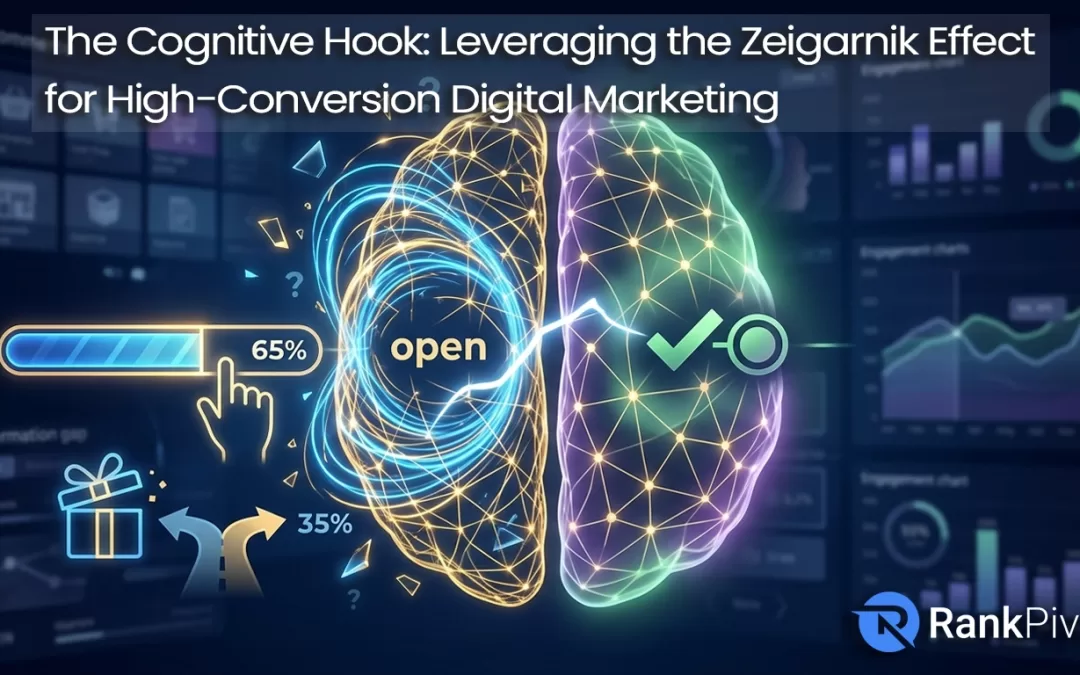
The Cognitive Hook: How the Zeigarnik Effect is Used in Marketing
In the hyper-fragmented landscape of modern digital marketing, consumer attention is the ultimate scarcity. Brands spend billions engineering complex funnels, optimization frameworks, and programmatic ad arrays, yet they routinely overlook the primary operating system driving every consumer action: the human brain. To capture, hold, and convert a modern digital audience, marketers must move beyond superficial analytics and look to foundational behavioral science.
One of the most potent, underutilized weapons in the psychological arsenal of a master marketer is the Zeigarnik Effect. Discovered in the 1920s by Lithuanian-Soviet psychologist Bluma Zeigarnik, this principle states that human cognitive systems remember uncompleted or interrupted tasks significantly better than completed ones.
When a person begins an action, the brain enters a state of task-specific cognitive tension. This tension acts like a background script running on a smartphone, constantly consuming psychological RAM. The cognitive loop remains wide open, keeping the details of that task highly accessible and top-of-mind, until the individual achieves resolution. The moment the task is completed, a psychological discharge occurs, the loop snaps shut, and the brain purges the data to conserve mental energy.
In the digital realm, where the average consumer is bombarded by thousands of commercial impressions daily, the Zeigarnik Effect provides a blueprint for creating unignorable marketing. By intentionally opening cognitive loops and strategically delaying closure, brands can transition from chasing attention to commanding it.
1. UX/UI Architecture: The Psychology of the Open Loop
The most immediate application of the Zeigarnik Effect occurs within user interface (UI) and user experience (UX) design. Elite growth hackers realize that a user onboarding sequence or a profile creation page should never present a blank slate. A blank slate implies that a task has not yet begun, requiring immense activation energy from the user to initiate.
Instead, master UX architects utilize gamified progress bars and dynamic onboarding checklists to manufacture an artificial open loop the second a user arrives.
The Mechanics of Momentum
Consider a platform like LinkedIn, HubSpot, or Duolingo. When a new user registers, they are rarely greeted with an empty dashboard. Instead, they are met with a prominent metric: “Your profile is 65% complete.”
From a target audience psychology perspective, this visual cue is highly disruptive. The brain does not see a passive stat; it registers an asymmetrical, broken pattern. The incomplete progress bar acts as a visual manifestation of a cliffhanger. It introduces cognitive friction that can only be resolved by executing the remaining micro-tasks—such as adding a profile picture, linking a bank account, or entering a phone number.
Pre-Checking and the Pseudo-Set Endowment Effect
To supercharge this effect, sophisticated platforms implement a tactic known as “artificial advancement.” When a user opens their new onboarding checklist, they will find that the first one or two items are already checked off (e.g., [✓] Account Created or [✓] Basic Preferences Selected).
By gifting the user initial progress, the marketer triggers two simultaneous psychological phenomena:
- The Endowment Effect: The user immediately values the progress they “own.”
- The Zeigarnik Effect: The task is no longer viewed as something to start; it is viewed as a project that is already underway and currently interrupted.
The desire to cross off the remaining items and hit 100% is driven by a primal need for symmetry and closure, skyrocketing user activation and activation rates.
2. E-Commerce Lifecycle Marketing: Closing the Cart Loop
In e-commerce, the checkout funnel is a psychological battlefield. Shopping cart abandonment rates hover near 70% globally. While amateur marketers view an abandoned cart as a lost sale, psychological experts view it as an exquisite, highly explosive Zeigarnik trigger.
When a consumer adds items to a digital cart, selects options, and inputs shipping data, they are deeply entrenched in a goal-oriented behavioral loop. If they abandon the cart due to an external distraction (a text message, a crying child, a momentary wave of buyer’s remorse), that loop does not simply disappear. It remains suspended in their subconscious, causing subtle cognitive dissonance.
Engineering the Trigger
This is where the architecture of an elite lifecycle marketing sequence comes into play. Automated email and SMS retargeting flows should not merely offer a generic discount; they must act as a psychological mirror reflecting the user’s uncompleted task back to them.
[Phase 1: Direct Interruption] ➔ [Phase 2: Subconscious Tension] ➔ [Phase 3: Targeted Reactivation]
(User abandons cart) (Zeigarnik loop remains open) (Email lands: “You left this behind…”)
The copy within these recovery assets must be highly intentional. Consider the psychological difference between these two subject lines:
- Subject A (Amateur): 10% off your order inside!
- Subject B (Psychological Expert): Did your internet cut out? Your cart is waiting.
Subject A treats the interaction as a cold transaction, instantly activating the user’s defensive consumer walls. Subject B speaks directly to the interrupted narrative. It frames the abandonment as an unresolved accident, nudging the consumer to return to the checkout page, enter their payment details, and experience the psychological relief of finishing what they started.
3. High-Converting Content Engineering: Mastering the Information Gap
Content marketing is fundamentally an exercise in tension management. George Loewenstein, a renowned behavioral economist, expanded upon Zeigarnik’s work by introducing the Information Gap Theory. Loewenstein posited that curiosity is a form of cognitive deprivation that occurs when we notice a stark gap between what we know and what we want to know. This gap produces mental pain, and the only way to alleviate it is to acquire the missing piece of data.
In digital copywriting, social media scripting, and video production, the information gap is the engine of high CTRs (Click-Through Rates) and prolonged watch times.
Deconstructing the Narrative Loop
Amateur content creators give away the punchline in the headline, effectively closing the loop before the user has a reason to click. Psychological experts do the exact opposite: they introduce a compelling premise, deliberately withhold the resolution, and place the gate to that resolution directly behind a desired user action.
| Headline Type | Structural Blueprint | Psychological Impact |
| Linear / Closed | “How to Increase SaaS Retention by 12% Using Email Sequences” | Closes the loop immediately. The brain registers the information as acquired and moves on. Low urgency to click. |
| The Information Gap | “This Single Retention Hook Cut Our SaaS Churn by 12%—But 90% of Growth Teams Completely Ignore It.” | Opens a massive cognitive loop. The user asks: What is the hook? Am I ignoring it? Click is mandatory for resolution. |
This framework is what drives the addictive nature of platforms like TikTok, YouTube, and Instagram Reels. Top-tier video creators utilize “seamless loops” where the final phrase of a 60-second video perfectly stitches into the introductory sentence of the video. Because there is no clean psychological cadence or audio-visual “stop sign,” the viewer’s brain fails to register that the task of watching the video has concluded. As a result, they unconsciously consume the content a second time, triggering algorithm rewards and compounding platform stay-times.
4. The Anatomy of Gated Assets and Freemium Ecosystems
The modern B2B SaaS and digital media landscapes rely heavily on freemium models and gated lead magnets. However, the execution of these gates determines whether a user converts or bounces in frustration.
If you ask a user to fill out a 7-field form or input their credit card before they have tasted your product or content, your conversion rates will plummet. You have asked them to initiate a brand-new task with high friction. The Zeigarnik Effect dictates that you must flip this sequence entirely: force the user to start the task for free, let them build cognitive momentum, and introduce the gate mid-stream.
The Sunk Cost and Zeigarnik Convergence
This is the psychological engine powering premium journalism sites like The Wall Street Journal or Harvard Business Review, as well as elite B2B interactive tools.
- The Hook: A user clicks on an intensely valuable, data-rich analytical piece.
- The Progression: They read through the first 35% of the article. They are deeply engaged, nodding along, absorbing the thesis. They have invested time and mental energy into completing this reading task.
- The Interruption: Suddenly, the text fades out, replaced by a sleek paywall banner: “To unlock the definitive data strategy and the remaining 65% of this case study, enter your email.”
At this precise intersection, target audience psychology shifts dramatically. The user is no longer evaluating whether they want to sign up for a new newsletter in a vacuum. Instead, they are desperate to resolve the intense cognitive tension of an interrupted narrative. Bouncing means leaving an open loop in their mind, which feels inherently uncomfortable. Entering their email or purchasing a low-cost trial is the fastest, lowest-friction path to psychological equilibrium.
5. Programmatic Retargeting: The Macro-Narrative Funnel
Too many digital marketing teams treat retargeting as a blunt instrument. They serve the exact same product banner ad to a user for 30 consecutive days, inducing banner blindness and brand fatigue.
A master behavioral marketer designs an ad campaign as a cohesive, multi-phased narrative arc that stretches across weeks, treating the entire consumer journey as a massive, multi-step open loop.
Sequenced Retargeting Architecture
Instead of pushing for an immediate, aggressive hard sale on day one, the strategy relies on sequential ad distribution tailored to the psychological state of the prospect:
[Day 1-3: The Catalyst] ➔ [Day 4-7: The Validation] ➔ [Day 8-14: The Resolution]
Case Study / Core Value Customer Testimonials & Frictionless Conversion
Video (Opens the Loop) Social Proof Ads Offer / Actionable Close
- The Catalyst (Days 1-3): The user views an insightful, objective 3-minute video breaking down a core industry problem. The ad does not pitch a product; it opens a loop regarding a major operational deficiency in the user’s business.
- The Validation (Days 4-7): The user is programmatically moved to the next tier. They are served ads showcasing case studies and testimonials of businesses that resolved that exact operational deficiency. The loop is tightened, but not yet closed.
- The Resolution (Days 8-14): Finally, the user is served a direct-response ad featuring a frictionless free trial or an audit offer.
Because the consumer has been living with this open narrative loop for two weeks, the brand remains firmly anchored in their top-of-mind awareness. The final conversion action is not viewed as an intrusive sales pitch; it is embraced as the logical, satisfying conclusion to a long-running cognitive arc.
The Master Marketer’s Ethical Mandate
While the Zeigarnik Effect is an extraordinarily effective mechanism for driving digital metrics, its deployment must be handled with precise, elite execution. There is a razor-thin line between sophisticated psychological marketing and manipulative dark patterns.
If a brand constantly opens cognitive loops via clickbait headlines but repeatedly fails to deliver satisfying, high-value resolutions, the target audience will develop psychological scar tissue. The initial curiosity will transform into deep resentment, eroding brand equity and destroying long-term customer lifetime value (LTV).
The objective of the modern subject matter expert is clear: use the Zeigarnik Effect to elegantly capture attention and break through digital noise, but always ensure that when the loop eventually closes, the value delivered to the consumer is nothing short of exceptional. By mastering this delicate dance of cognitive tension and high-value resolution, you transcend basic marketing tactics and begin engineering truly unignorable consumer experiences. This is the ultimate goal in User Interface and User Experience engineering, and with proper execution of these suggestions, a highly obtainable goal well within reach.

David L. King II
Founder, Lead Strategist
David King is a multi-disciplinary technology and marketing executive with over 30 years of experience driving digital growth for Fortune 500 companies, high-growth startups, and global brands. An early pioneer of search engine optimization, he currently serves as the Founder and Lead Strategist at RankPivot.ai, specializing in enterprise-grade digital marketing, branding, and AI-integrated search strategy.