
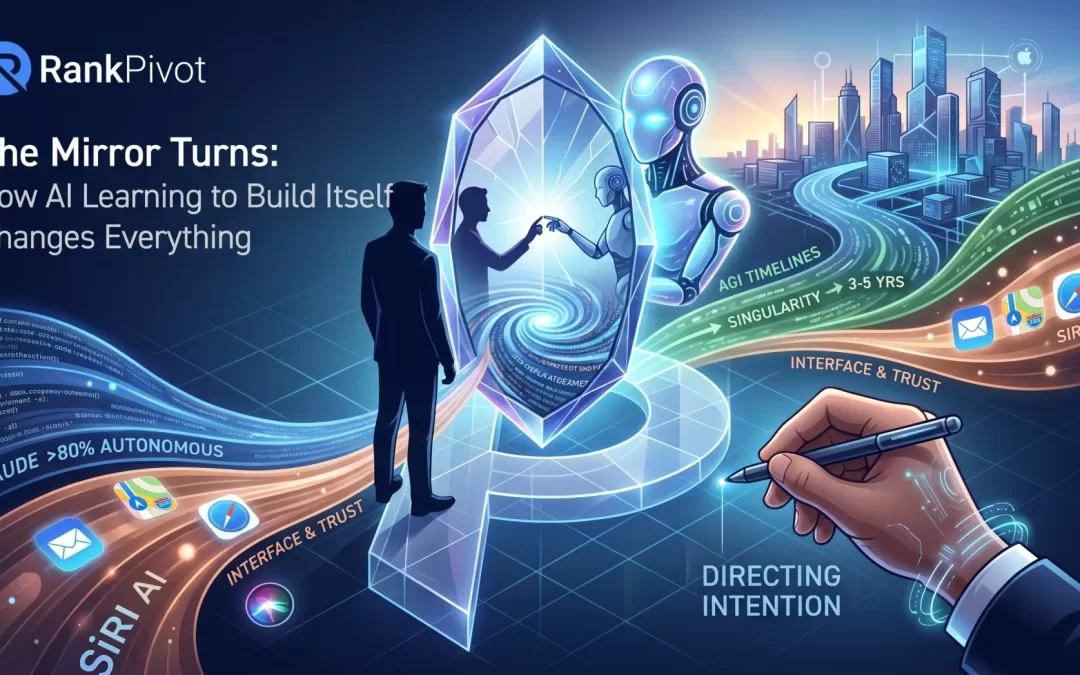
The Mirror Turns: How AI Learning to Build Itself Changes Everything
June 2026 — The week the future became undeniable
There are moments in history when several rivers converge at once, and the resulting current becomes something altogether different — faster, deeper, impossible to dam. We are living inside one of those moments right now.
This week alone, three seismic disclosures landed within days of each other: Anthropic published hard internal evidence that its AI is now writing over 80% of its own code and improving its own research judgment; singularity forecasters, now including the CEOs of Google DeepMind and Anthropic themselves, are converging on a 3-to-5-year timeline for transformative AI; and Apple — the world’s most valuable company and the gatekeeper to two billion devices — quietly unveiled the most consequential software update in iPhone history. These are not isolated headlines. They are tributaries feeding the same river, and understanding where that river goes requires us to look beyond the surface of any single story.
The Machine That Writes Itself
Let’s start with the most technically significant disclosure of the week, because the implications reach far beyond the software industry. Anthropic’s Anthropic Institute published an unprecedented transparency report documenting something that, even a year ago, would have sounded like speculative fiction: as of May 2026, more than 80% of the code merged into Anthropic’s production codebase was authored by Claude. In February 2025, that number was in the low single digits.
This is not a productivity story. This is a civilizational inflection point dressed in engineering metrics.
The data Anthropic released is meticulous and worth internalizing. The length of tasks that AI models can reliably complete autonomously has been doubling roughly every four months. In March 2024, Claude Opus 3 could handle software tasks that take a skilled human about four minutes. A year later, Claude Sonnet 3.7 managed tasks requiring roughly ninety minutes of human effort. By 2026, Claude Opus 4.6 was completing tasks that take twelve hours. If that curve holds — and Anthropic’s own internal data suggests it is holding — AI systems could be tackling work that takes humans days before this year is out. Tasks that take weeks could fall within range by 2027.
What makes this categorically different from prior waves of automation is the nature of what’s being automated. Previous industrial and digital revolutions automated physical or rote tasks — assembly lines, data entry, logistics routing. What’s happening now is the automation of the research and engineering loop itself: proposing hypotheses, running experiments, interpreting results, and choosing which experiments to run next. In April 2026, Anthropic published a demonstration of Claude running an open-ended AI safety research project end-to-end. Two human researchers recovered roughly 23% of a targeted performance gap over about a week. Claude-powered agents recovered 97% — running 800 cumulative hours of experiments, designing every test themselves, with humans only providing the initial problem framing and scoring rubric.
Thomas Edison said genius is 1% inspiration and 99% perspiration. AI has now automated the perspiration.
The most striking internal statistic: Anthropic engineers are shipping 8 times as much code per day in Q2 2026 as they were in 2024. This isn’t because they’re working harder. It’s because they’re now directing and reviewing rather than writing. The human role has shifted from doing to judging what gets done — and Anthropic’s data shows Claude’s judgment is improving rapidly, too. On open-ended, ambiguous research decisions where there is no obvious right answer, Claude’s model now outperforms the human choice 64% of the time, up from 51% just six months prior.
This is the phenomenon Anthropic’s researchers are calling the narrowing of the “human comparative advantage window.” The doing costs almost nothing in human time anymore. What remains distinctly human — for now — is research taste: knowing which problems matter, which results to trust, when to abandon an approach. But the data strongly suggests even that gap is closing.
The Singularity Timeline Is Collapsing
Meanwhile, outside the walls of any one AI lab, a different kind of evidence is accumulating — and it’s pointing toward the same destination from a completely different direction.
Translation company Translated has been quietly running one of the most rigorous long-term AI capability studies in existence: tracking how long professional human editors take to correct AI-generated translations, measured across more than 2 billion individual edits over eight years. In 2015, it took editors 3.5 seconds per word to review machine output. By 2022, that had fallen to 2 seconds. Human-to-human editing effort sits at 1 second per word. If the curve continues — and it has shown no sign of bending — machine translation reaches human parity well before 2030, possibly within four years.
Forecasters and practitioners are converging on a similar window using entirely different metrics. Demis Hassabis of Google DeepMind has publicly compressed his own AGI timeline from “as soon as ten years” to “probably three to five years away” — a shift that those who understand how carefully AI lab leaders choose their public words will find remarkable. When the person steering one of the world’s most advanced AI research organizations moves the goalposts forward rather than backward, it reflects something real happening in their labs.
Ray Kurzweil, whose 2005 prediction of singularity around 2045 seemed audaciously optimistic at the time, has watched the curve accelerate past even his projections. Multiple independent lines of analysis — translation quality, task horizon doubling rates, benchmark saturation speeds, internal productivity multipliers — are now clustering around the same narrow temporal window. When unrelated methodologies converge on the same answer, that convergence is itself a signal.
What the singularity actually means matters enormously here, because it is too often caricatured. The singularity, technically defined, is not the moment AI becomes dangerous or conscious or omnipotent. It is the moment AI can improve itself faster than humans can track or direct the improvements — a feedback loop that compounds. Anthropic’s own “When AI Builds Itself” report maps the preconditions for this with unusual clarity: AI systems need to be able to set their own research directions, judge the quality of their own outputs, and design their own successors. According to their internal data, two of those three capabilities are already substantially in place. The third — autonomous goal-setting and research taste — is the one that currently remains a meaningful human domain. But it is shrinking.
Apple’s Quiet Masterstroke
Into this extraordinary technical backdrop walks Apple, which this week unveiled what it is calling Siri AI — the most fundamental overhaul of its virtual assistant in the product’s fifteen-year history. And the story here is not really about Siri. It is about strategy, distribution, and who ultimately controls the AI layer that touches humanity’s daily life.
Apple has been widely and unfairly mocked for being “behind” in AI. The criticism fundamentally misunderstands the game Apple is playing. Apple is not competing in the race to build the most capable foundation model. It never was. Apple is competing in the race to be the trusted, indispensable interface through which two billion people experience AI — and it is winning that race decisively.
The new Siri AI can surface information buried deep in your email and message history and synthesize it into actionable suggestions. It understands what is on your screen in real time. Through a partnership with Google Gemini, it delivers current information from the web instantly to your device. It stores conversation history across sessions. And crucially, it is being built directly into the operating system level of every Apple device — not as an app, but as an ambient intelligence woven into the substrate of how the device works.
This architectural choice is the key insight that most AI coverage misses. Companies like OpenAI and Google have spent years competing to build the best chatbot. Apple has spent those same years ensuring that whatever the best chatbot is, it runs on Apple’s terms, through Apple’s privacy architecture, on Apple’s hardware, with Apple collecting the revenue from the app ecosystem that surrounds it. Apple’s planned capital expenditure on AI this year is roughly $14 billion. Other tech giants are collectively committing nearly $900 billion in cumulative AI investment. Apple is estimated to be spending roughly 1.5% of that figure while posting historic iPhone sales and collecting what are effectively royalties on the entire AI industry through its App Store.
But there is a deeper and more important signal in Apple’s WWDC announcements this week. Craig Federighi, Apple’s SVP of software engineering, made a pointed observation during the keynote: some companies appear to be racing forward “pursuing AI for the sake of AI, without clear regard for the people — all of us — that it’s ultimately meant to serve.” This is not merely a marketing line. It reflects a genuine philosophical fault line that is opening up across the entire industry — and one that will determine much of what the next decade looks like for ordinary people.
The AI industry has a trust problem. Polls show large and growing segments of the public are deeply ambivalent about AI, worried about job displacement, and skeptical of companies that seem to be optimizing for capability metrics rather than human benefit, concerned about privacy and environmental impacts. Apple is positioning itself as the company that resolves that tension — and it has the most trusted brand on earth, the most seamlessly integrated hardware-software stack, and a 15-year head start on understanding how consumers actually use mobile interfaces. That combination is formidable, and there are many challenges all AI companies must overcome to win over the court of public opinion.
The Convergence and What It Means
Read together, these three stories describe a single coherent arc: AI is approaching recursive self-improvement capability; the timeline for that transition is measured in years, not decades; and the companies that will shape what that transition looks like for ordinary people are jockeying for position right now.
The implications are simultaneously sobering and thrilling, and honesty requires being looked at from both perspectives at once.
On the sobering side, Anthropic’s researchers are explicit: the possibility of humans losing meaningful control over AI development is real, proximate, and requires institutional responses that do not yet fully exist. Training runs are far easier to conceal than missile silos. The incentives to continue while others pause are enormous. The verification mechanisms that would make a credible global slowdown possible do not yet exist, and building them is one of the most important technical and diplomatic challenges of this decade.
But the potential on the other side is genuinely breathtaking. Anthropic has already demonstrated that its most capable model found over ten thousand high- and critical-severity software vulnerabilities in the world’s most important systems within its first weeks of deployment in a limited research context. The bottleneck in global cyber defense has already shifted from finding vulnerabilities to patching them fast enough — a problem that AI can also help solve. This is one preview of what AI-accelerated science looks like: not replacing human ingenuity, but multiplying its reach by orders of magnitude.
Consider what this means for medicine. The most expensive part of drug discovery is not the chemistry — it is the experimental iteration loop, running trials, interpreting results, designing the next experiment. AI systems that can compress those loops from months to days, that can hold the entire context of a research domain in working memory simultaneously, that can propose and test thousands of hypotheses in parallel — these systems are arriving in the same years that cancer biology, Alzheimer’s research, and pandemic preparedness are facing their most complex challenges. The collision is not accidental. It is precisely when the problems are hardest that the leverage of exponential tools is greatest.
The same logic applies to climate science, materials research, protein engineering, and education. A world in which every student has access to a tutor as knowledgeable and patient as the best teacher on earth is not dystopian. It is a radical expansion of human potential that previous generations could only imagine.
Apple’s WWDC announcements matter in this context because they represent the mechanism by which these capabilities reach the most people, in the most trustworthy form, with the most attention paid to human experience and privacy. The AI revolution will not be won or lost in the labs. It will be won or lost at the point of contact between extraordinary capability and ordinary human life.
The Human Role Is Not Ending — It Is Evolving
Perhaps the most important reframe required by this week’s convergence of groundbreaking technology news is this: the displacement of human effort from certain tasks is not the end of the human story in this arc. It is the beginning of a new one.
Anthropic’s internal researchers are grappling with this honestly. When AI handles the 99% perspiration, human energy flows toward the 1% inspiration — toward judgment, taste, direction, meaning, relationship, ethics, and governance. These are not lesser activities. They are the activities that have always mattered most and that the pressure of doing has historically crowded out. The question “which problems are worth solving?” is more important than any individual solution. AI is rapidly liberating humans to focus on exactly that question.
There will be disruption. There will be displacement. Anyone who tells you otherwise is either not paying attention or not being honest. The bottlenecks Anthropic describes — human code review becoming a constraint when AI generates code faster than humans can read it — are previews of similar bottlenecks throughout the economy. Organizations that learn to identify and clear those bottlenecks quickly will thrive. Those who cannot will struggle.
But the ideal of “AI replacing humans” has always been both incomplete and counterproductive. The better framing of this is that AI is compressing the distance between human intention and human outcome. A 100-person company that can accomplish what previously required a 10,000-person organization is not a story about 9,900 people losing jobs. It is a story about 100 people being able to pursue ambitions that were previously impossible. The rate at which new ambitions become accessible — new companies, new research programs, new creative works, new solutions to problems that have languished for decades — will exceed the rate at which existing work is displaced. It has been in every previous technological transition, and the leverage available this time is greater than any that came before.
The river is moving fast now. The confluence is real. The right response is not to stand on the bank marveling at the current, nor to pretend the water is not rising. The right response is to learn to navigate — to develop the skills, institutions, and wisdom to steer rather than merely float.
The most exciting era in human history is not just over the horizon. It is already here.
Want to learn more about how technology engineers and futurists are planning the AI data centers of the future? Read: Engineering a Sustainable Future for AI & Humanity
Sources: Anthropic Institute, “When AI Builds Itself” (June 2026); TechCrunch, “Why Apple’s Slow-and-Steady AI Bet Is Starting to Look Pretty Smart” (June 8, 2026); MSN/Independent, “Anthropic Says Something Unsettling Has Been Happening to Claude” (June 2026); MSN, “Humanity May Reach Singularity Within Just 4 Years, Trend Shows” (May 2026).

David L. King II
Founder, Lead Strategist
David King is a multi-disciplinary technology and marketing executive with over 30 years of experience driving digital growth for Fortune 500 companies, high-growth startups, and global brands. An early pioneer of search engine optimization, he currently serves as the Founder and Lead Strategist at RankPivot.ai, specializing in enterprise-grade digital marketing, branding, and AI-integrated search strategy.