
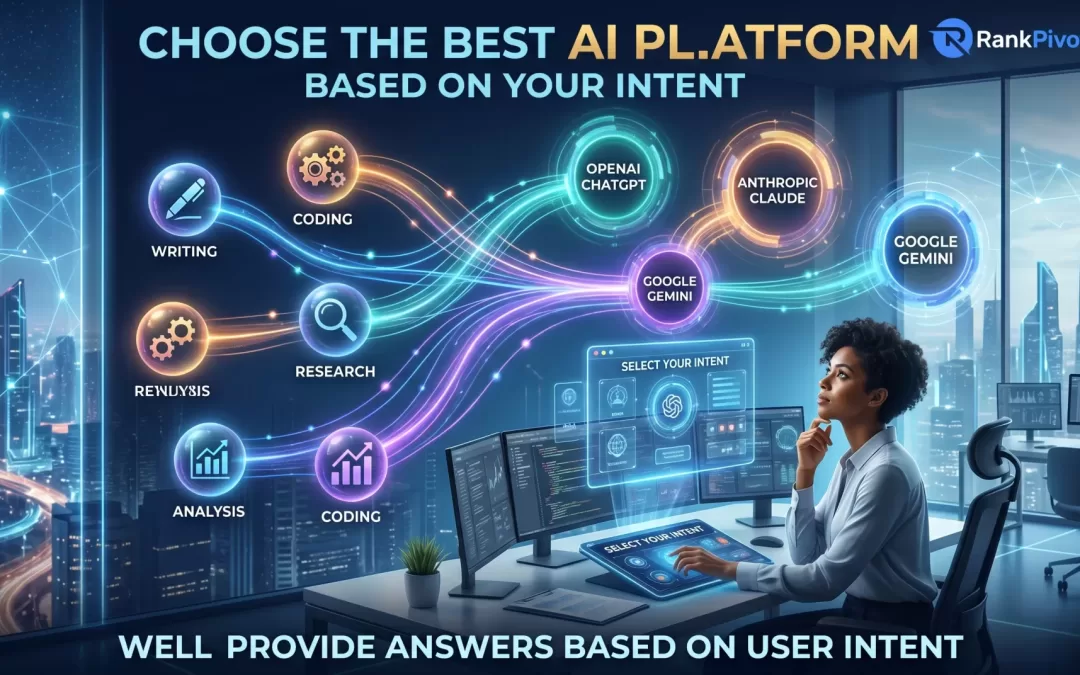
FACT: User Intent Dictates True Winner of the AI Platforms, Not Some So-Called “Experts”
We’re not sorry—we couldn’t resist the reminder. However, some things need to be said a little louder for the people way in the back too. This is one of those things, as I know some of you are well aware. For those who aren’t, move your way up to the front and let’s chat a bit.
Every piece of content ever created is forged from a singular, spark of an idea with a foundational truth: whatever “IT” is, “IT” is meant to be seen, to be shared with an audience. We create for others. Art is meant to be seen. Articles, stories, and insights are meant to be consumed.
This is why all content creation must begin and end with the user in mind. Consequently, no “best of” list for AI platforms would be truly honest without breaking down the distinct nuances, specialized features, and strategic use cases that allow you to maximize one over another.
If you want to discover the absolute best AI tools and platforms for your specific objectives, let’s dive into exactly why certain models outshine the rest. As a digital marketing agency that actively builds custom AI tools, deploys autonomous AI agents for daily operational workflows, and provides industry-leading SEO, AEO, GEO, and LLMO services, we want to share our frontline experience. We expect nothing in return—save for the hope that sharing our insights will help foster a richer, more intentional user experience across the modern web.
What is the purpose of creation, after all, if not to be useful, helpful, and generous with the knowledge others can benefit from?
To give you a complete playbook, we will start with a deep dive into the evolution of the Google Gemini ecosystem and its intersection with modern search optimization (AEO, GEO, and LLMO). From there, we will provide a comprehensive, industry-wide comparison of today’s AI market-share leaders—including ChatGPT, Claude, Perplexity, and Grok—highlighting the exact use cases and features you should master to stay ahead of the curve.
Navigating the Modern AI Ecosystem: From Gemini 3.5 to the Broader Frontier
The artificial intelligence landscape has fundamentally shifted from isolated chatbots to specialized, highly optimized operational engines. No longer are organizations choosing a generic AI; instead, they are deploying targeted models tailored for distinct tasks. This paradigm shift is perfectly exemplified by Google’s latest dual-flagship strategy: Gemini 3.5 Pro and Gemini 3.5 Omni.
While Gemini 3.5 Pro serves as the company’s pinnacle language and reasoning model—heavily optimized for complex agentic workloads, long-context data analysis, and multi-hop reasoning—Gemini 3.5 Omni operates on a fundamentally different native multimodal architecture designed to natively ingest, process, and generate 4K video, audio, and images seamlessly alongside text. Understanding the core differences between these iterations is no longer just a technical exercise; it is the cornerstone of modern digital visibility, content strategy, and business planning.
Google Gemini Evolution: Technical Breakthroughs & Strategic Implementation
Google’s Gemini project unified disparate machine learning tracks into a cohesive, native multimodal framework. Every subsequent iteration has unlocked deep architectural shifts that businesses must understand to maximize visibility across modern search frameworks.
[Gemini 1.0/1.5] ——–> [Gemini 2.0/2.5] ——–>
[Gemini 3.5 Pro & Omni / Flash]
- Native Multimode Basics • Agentic Foundations • Hyper-Specialized Split
- Million-Token Window • Advanced Coding Logic • Pro: Heavy Logic & Reasoning
- Speed vs. Cost Tiers • High-End Live Voice • Omni: Native 4K Media Engine
Gemini 1.0 & 1.5: The Long-Context & Native Multimodal Foundation
- How They Functioned: Built from the ground up to simultaneously process text, code, images, audio, and video rather than stitching separate models together.
- The Breakthroughs: Gemini 1.5 introduced a Mixture-of-Experts (MoE) neural architecture and expanded the context window to an unprecedented 1 million tokens (and later 2 million).
- Business & Optimization Value: This iteration made it possible to ingest massive corporate datasets, entire repositories of code, or hours of video instantly. For SEO and LLMO, it proved that Google could deep-index non-textual assets, marking the end of text-only search optimization.
Gemini 2.0 & 2.5: The Agentic Transition
- How They Functioned: Transitioned from passive information retrieval to agentic workflow execution, utilizing reasoning chains to accomplish multi-step goals autonomously.
- The Breakthroughs: Integration of low-latency live audio-visual streams and gold-medal-level performance in complex programming environments. It introduced hyper-efficient model tiers like Gemini 2.5 Flash to drastically lower API latency.
- Business & Optimization Value: Shifted user behavior from searching for links to executing tasks via voice and automation. To remain visible, websites had to ensure their APIs and structured data were structured cleanly so Gemini agents could scrape, book, or extract information on behalf of a user.
Gemini 3.5 Series: The Era of Hyper-Specialization
- How They Functioned: Google bifurcated its top-tier intelligence. Instead of demanding a single model handle both heavy structural logic and creative media generation, the 3.5 ecosystem split into distinct cognitive and sensory engines.
- The Breakthroughs:
- Gemini 3.5 Pro: Unmatched multihop reasoning, complex data synthesizing, and advanced software engineering pipelines.
- Gemini 3.5 Omni / Flash: A fully unified generative media engine capable of understanding physical properties, spatial layouts, and audio design natively within video creations.
- Business & Optimization Value: This split allows for highly optimized cost-to-performance planning. Organizations use Pro for deep analytical tasks, internal knowledge graphs, and back-end logic, while leveraging Omni for rapid, automated scale-up of rich media content.
The Modern Search & Visibility Framework: SEO, AEO, GEO, and LLMO
To ensure your brand or website is recommended by systems powered by Gemini (like Google’s AI Overviews, which serves billions of users monthly), you must align content with the distinct way these versions process information:
- SEO (Search Engine Optimization): Legacy SEO still matters for foundational site structure, crawlability, and indexing. However, traditional keyword stuffing fails entirely against Gemini 3.5’s semantic understanding. Focus on logical topical authority.
- AEO (Answer Engine Optimization): Tailoring content specifically to answer user queries concisely. Because Gemini extracts exact data points from a page to build its summaries, your site should offer clear, direct answers, definitions, and bulleted steps right at the top of informational pages.
- GEO (Generative Engine Optimization): Optimizing for how generative AI engines cite sources. Gemini synthesizes multiple pages simultaneously. To be selected as a citation link within an AI Overview, your content must offer unique, high-integrity data, original primary research, or authoritative case studies that stand out during the model’s MoE filtering phase.
- LLMO (Large Language Model Optimization): Structuring your digital footprint so that models include your brand in their offline training data and real-time token lookups. This requires robust use of Schema.org structured data, keeping public documentation cleanly formatted, and generating organic brand mentions across high-authority digital platforms.
Competitive Landscape: Overviews of Major AI Platforms
To properly plan your tech stack, it is vital to contrast Google’s trajectory against the rest of the industry’s frontrunners.
ChatGPT (OpenAI)
- First Version vs. Latest: Began as GPT-3.5—a text-only, next-token prediction chatbot prone to heavy hallucination. Today, the ecosystem includes GPT-4o (a fast, highly conversational multimodal model) and the o1/o3/o3-mini series (reasoning models that pause to “think” via internal chains of thought before responding).
- Core Mechanics: Non-reasoning versions predict text instantly. Reasoning versions (o-series) generate internal hidden tokens to break down math, logic, and code before outputting the final response.
Claude (Anthropic)
- First Version vs. Latest: Claude 1 focused primarily on basic safety and long-form text analysis. The current Claude 3.5 Sonnet and Claude 3.5 Opus models have set industry high-water marks for programming, nuance comprehension, and data visualization. Claude 4.8 Opus is absolutely next-level when it comes to human and AI interactions and the rapid learning of personality and adpatability with light speed like comprehension leading to less prompting and more next projecting.
- Core Mechanics: Utilizes “Constitutional AI” to train safety directly into the model’s principles. Features an integrated interface called “Artifacts” that allows users to run, view, and live-edit generated code, web apps, and documents side-by-side with the chat window.
Perplexity AI
- First Version vs. Latest: Started as a clean, multi-source search wrapper. It has evolved into an advanced answer engine capable of deep research threads, multi-step web execution, and customized user “Spaces” that act as localized knowledge bases.
- Core Mechanics: Acts as an orchestrator. When a query is made, Perplexity writes search strings, scrapes the live web simultaneously, passes the relevant chunks to a chosen underlying LLM (like Claude or GPT), and synthesizes an answer with inline programmatic citations.
Microsoft Copilot
- First Version vs. Latest: Launched as Bing Chat (using basic OpenAI integration). It is now deeply integrated into Windows, Microsoft 365, and Edge as an enterprise-grade agent.
- Core Mechanics: Merges OpenAI’s reasoning capabilities with the Microsoft Graph, pulling real-time context from a user’s internal corporate emails, calendar, chats, and documents while strictly adhering to enterprise data boundaries.
Grok (xAI)
- First Version vs. Latest: Grok 1 was a standard, witty text assistant. The latest iterations leverage massive compute clusters to parse real-time information with high multimodal understanding.
- Core Mechanics: Natively integrated into the X (formerly Twitter) real-time data stream. This design allows it to analyze breaking news, viral sentiments, and live discussions hours before other models capture them in search indexes.
Macro Head-to-Head Comparison
The following matrix showcases exactly where each platform shines and how their design methodologies stack up for business utility:
| Platform | Accuracy & Factuality | Speed & Latency | User Intent & Nuance | Developer & Coding Edge | Best Suited For |
| Google Gemini (3.5 Pro/Omni) | High (Backed by real-time Google search indexing & deep citations) | Very High (Flash tiers lead industry speed benchmarks) | Excellent (Differentiates between deep reasoning and creative intent) | Strong (Unrivaled 2M context window allows parsing massive codebases) | Large-scale content workflows, multi-hour video/audio analysis, and enterprise research. |
| OpenAI ChatGPT (GPT-4o / o3) | Very High (Reasoning models self-correct errors before answering) | Moderate to Low (Reasoning takes time to compute) | Very High (Flawless conversational pacing and memory) | Exceptional (o3 models lead math and logic benchmarks) | Complex math, debugging intricate logical software bugs, and highly interactive voice conversations. |
| Anthropic Claude (4.8) | High (Deeply objective, low hallucination rates) | High (Sonnet is optimized for immediate deployment) | Exceptional (Grasps humor, complex tonal shifts, and prompt intent) | Exceptional (Artifacts engine makes front-end web design effortless) | UI/UX prototyping, writing natural long-form marketing content, and legacy code migrations. |
| Perplexity AI | Very High (Strictly bound to immediate live web sources) | Moderate (Requires real-time multi-site scraping) | High (Tailored for academic or investigative intent) | Moderate (Excellent for finding code documentation, weaker at generation) | Market research, breaking news tracking, and replace traditional search engine queries. |
| Microsoft Copilot | High (Grounded in enterprise business data) | Moderate | High (Excellent at interpreting workplace workflows) | Strong (Deeply integrated via GitHub Copilot ecosystem) | Corporate productivity, internal document management, and seamless Office 365 automation. |
| xAI Grok | Moderate (Can pick up unverified rumor mill data from social media) | High | Moderate (Tuned for casual, witty, or opinionated interactions) | Strong (Highly competent foundational codebase) | Real-time social sentiment tracking, monitoring breaking news, and unfiltered brainstorming. |
Verdict: Who is Ahead of the Curve When it Comes to AI Platforms Right Now?
Determining which AI company leads the pack depends entirely on the needs of the user and the operational arena:
The Pure Reasoning & Logic Leader:
- OpenAI (with the o3/o1 series) holds the lead in raw, multi-step logical thinking, competitive mathematics, and self-correcting code generation. GPT-5.5 and GPT-5.5 Pro. Released in late April 2026, these versions represent OpenAI’s highest-tier reasoning and computer-operation systems to date.
The Context & Multimodal Scalability Leader:
- Google (Gemini 3.5 Flash) dominates when handling massive amounts of data. Its 2-million-token window and decoupled Pro/Omni infrastructure make it the undisputed choice for businesses looking to automate video editing, analyze full books, or scale localized GEO strategies. Gemini 3.5 Flash, announced at Google I/O 2026, is Google’s latest and fastest agentic model, designed specifically for heavy coding workflows and long-horizon tasks, although for heavier tasks, Gemini 3.5 Pro is the tool of choice.
The Creative Coding & Tonal Nuance Leader:
- Anthropic (Claude 4.8) remains ahead in terms of human-like writing, code execution within its Artifacts UI, and interpreting complex, multi-layered visual graphs. Claude Opus 4.8, released at the end of May 2026, introduces autonomous “dynamic workflows” to write code across repos, manage long-horizon tasks independently, and flag its own coding mistakes before they are visible.
In the end, it really all boils down to how you intend to use AI, which will determine which AI platform is better than the others. No matter what you plan on using AI for, we certainly hope we provided some valuable insight and honest opinions that may help you get the most out of each AI tool at your fingertips or within earshot to prompt via voice command.

David L. King II
Founder, Lead Strategist
David King is a multi-disciplinary technology and marketing executive with over 30 years of experience driving digital growth for Fortune 500 companies, high-growth startups, and global brands. An early pioneer of search engine optimization, he currently serves as the Founder and Lead Strategist at RankPivot.ai, specializing in enterprise-grade digital marketing, branding, and AI-integrated search strategy.